
1. Executive Background & Scope of Evidence
1.1 Botanical, Ethnopharmacological, and Therapeutic Profile
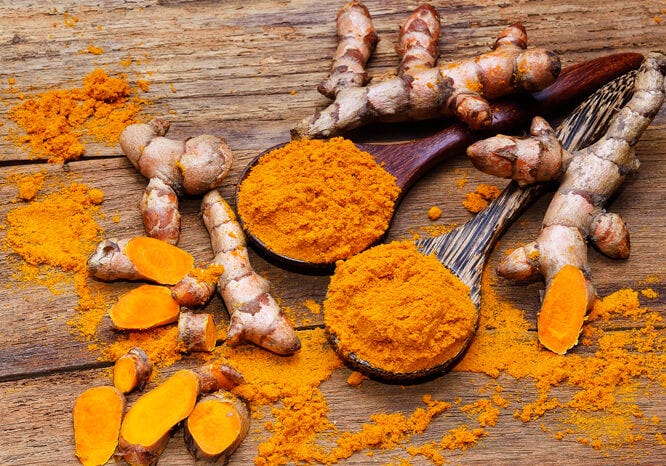
Curcuma longa L. (turmeric) is a perennial botanical species belonging to the Zingiberaceae (ginger) family. Asian ethnopharmacological traditions have long used its rhizomes, notably in Traditional Chinese Medicine (TCM) and Ayurveda. In TCM, turmeric is recognized for its capacity to invigorate blood circulation and resolve blood stasis. Modern cellular and clinical evaluations confirm that its primary bioactive polyphenol is curcumin, a natural compound exhibiting a broad multi-target therapeutic profile:
Anti-Inflammatory Properties: Suppresses key enzymatic signaling cascades and pro-inflammatory cytokine networks.
Antitumor and Chemopreventive Activity: Regulates signal transduction pathways involved in cell proliferation, apoptosis, angiogenesis, and malignant transformation.
Antioxidant Properties: Neutralizes reactive oxygen species (ROS) and mitigates tissue biomarkers of oxidative stress.
Lipid-Regulating Activity: Modulates systemic lipid profiles and metabolic parameters.
Anticoagulant Effects: Influences vascular stasis, platelet aggregation, and hematological dynamics.
In oral mucosal pathology, curcumin has attracted clinical interest for managing oral lichen planus (OLP). OLP is a chronic immunological disease of the oral mucosa classified as an oral potentially malignant disorder (OPMD), with a documented malignant transformation rate of 1.14% (95% CI: 0.84–1.49%).
1.2 Scope of Meta-Analytic Evidence Base
This synthesis report integrates meta-analytic evidence evaluating oral and topical curcumin formulations across two clinical domains: degenerative joint disease (Knee Osteoarthritis) and chronic mucosal inflammation (oral lichen planus).
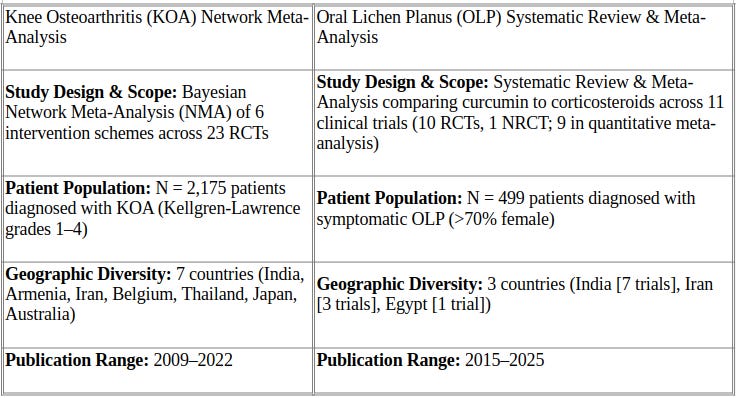
Note: Comparative mapping of foundational meta-analytic frameworks evaluating curcumin formulations in joint degradation and mucosal pathology.
2. Preclinical & Molecular Mechanisms of Action
2.1 Anti-Inflammatory, Enzymatic, and Neurotransmitter Regulation
Curcumin suppresses tissue-damaging inflammatory processes by modulating upstream transcriptional signaling pathways. Preclinical models show that curcumin blocks activation of Nuclear Factor-kappa B (NF-κB) and the Toll-like Receptor 4/MyD88 (TLR4/MyD88) cascade. Downstream of these transcriptional regulators, curcumin directly inhibits the expression and biological activity of primary inflammatory enzymes:
Cyclooxygenase-2 (COX-2)
Lipoxygenase
Inducible Nitric Oxide Synthase (iNOS)
Inhibition of these enzymatic drivers reduces the mRNA expression and cellular secretion of critical pro-inflammatory cytokines, chemokines, and inflammatory mediators:
Interleukin-1β (IL-1β)
Interleukin-6 (IL-6)
Interleukin-8 (IL-8)
Tumor Necrosis Factor-α (TNF-α)
Prostaglandin E2 (PGE2)
Nitric Oxide (NO)
2.2 Chondroprotective and Extracellular Matrix Degradation Mechanisms
In articular joint cartilage, pro-inflammatory cytokines such as IL-1β and TNF-α induce matrix degradation, leading to progressive cartilage loss. Curcumin preserves cartilage structural integrity by suppressing cytokine-induced inflammatory pathways in chondrocytes.
Key chondroprotective cellular mechanisms include:
Suppression of Matrix Metalloproteinases: Curcumin directly inhibits IL-1β- and TNF-α-stimulated expression of MMP-1, MMP-3, and MMP-9, halting the enzymatic cleavage of type II collagen and proteoglycan components within the extracellular matrix.
Chondrocyte Homeostasis: Curcumin promotes chondrocyte proliferation and suppresses chondrocyte apoptosis under catabolic conditions.
Up-regulation of Protective Regulators: Curcumin increases the expression of CITED2 (CBP/p300-interacting transactivator with ED-rich tail 2), a transcriptional regulator that counters matrix degradation and maintains cartilage homeostasis.
3. Clinical Efficacy in Oral Potentially Malignant & Inflammatory Mucosal Disorders (OLP Analysis)
3.1 Comparative Pain and Burning Sensation Reduction
Meta-analyses of clinical trials comparing curcumin with active corticosteroid controls (topical triamcinolone acetonide 0.1%, betamethasone, or systemic prednisone) show rapid analgesic onset and sustained symptom relief.
Time-course pooled standardized mean differences (SMD) for pain and burning severity (measured via Visual Analog Scale [VAS] or Numerical Rating Scale [NRS]) demonstrate:
1 Week Follow-Up: Curcumin achieved significantly superior pain reduction compared to corticosteroid controls (SMD = -0.70, 95% CI: -1.33 to -0.07, p = 0.03).
2 Weeks Follow-Up: Curcumin demonstrated equivalent analgesic efficacy to corticosteroids (SMD = -0.23, 95% CI: -0.75 to 0.29).
4-Week Follow-Up: Analgesic suppression remained comparable between groups (SMD = 0.21, 95% CI: -0.06 to 0.47).
12-Week Follow-Up: Long-term symptom control did not differ significantly between interventions (SMD = 0.33, 95% CI: -0.05 to 0.72).
Delivery vehicles and administration schedules influence early symptom response. Topical preparations (1% gel, 5% oral paste) applied more frequently (e.g., 6 times daily vs. 3 times daily) and systemic formulations (oral nanocurcumin 80 mg capsules) increase mucosal contact time or systemic absorption, contributing to rapid early symptom reduction.
3.2 Objective Clinical Improvement and Lesion Resolution
Objective clinical signs—evaluated using the Thongprasom Sign Score (TSS), Modified Oral Mucositis Index (MOMI), and direct planimetric measurements of erosion, ulceration, and erythema—show that curcumin achieves lesion resolution equivalent to corticosteroid therapy across evaluated time points (p > 0.05).
Individual trial analyses highlight specific advantages across mucosal parameters:
Erythema Reduction: Clinical trials by Keshari et al. (p = 0.002), Pai & Ganesan (p = 0.02), and Singh et al. showed that topical curcumin reduced mucosal erythema scores significantly more than topical triamcinolone acetonide 0.1%.
Burning Sensation Resolution: Pai & Ganesan noted significantly greater suppression of burning sensation in the curcumin group relative to corticosteroids (p = 0.001).
Higher application frequencies (e.g., 1% gel applied 6 times daily) and bio-enhanced delivery vehicles overcome rapid salivary clearance, maintaining effective local tissue concentrations required for lesion resolution.
4. Clinical Efficacy in Degenerative Joint Disorders (KOA Network Meta-Analysis)
4.1 Pain Relief Metrics (VAS Pain Score Analysis)
In the Bayesian network meta-analysis of 23 RCTs involving 2,175 knee osteoarthritis patients, 9 trials evaluated changes in Visual Analog Scale (VAS) pain scores across 6 intervention categories. Curcumin monotherapy demonstrated statistically significant pain reduction compared to placebo:
Curcumin vs. Placebo: Mean Difference (MD) = -1.63 (95% CI: -2.91 to -0.45).
4.2 Functional Restoration and WOMAC Subscale Analysis
Across Western Ontario and McMaster Universities Osteoarthritis Index (WOMAC) endpoints, curcumin yielded improvements in functional mobility and overall joint performance:
Total WOMAC Score (9 RCTs): Curcumin monotherapy was statistically superior to placebo (MD = -18.85, 95% CI: -29.53 to -8.76).
WOMAC Pain Subscale (8 RCTs): Curcumin monotherapy significantly reduced joint pain scores relative to placebo (MD = -2.24, 95% CI: -4.57 to -0.52).
WOMAC Physical Function (PF) Subscale (7 RCTs): Pairwise differences between active pharmacotherapies were not statistically significant; however, probability rankings identified curcumin as the top single intervention for physical function restoration.
WOMAC Joint Stiffness Subscale (7 RCTs): Pairwise comparisons showed no statistically significant differences between active agents, with curcumin and conventional NSAIDs showing efficacy comparable to placebo.
4.3 Rescue Medication (RM) Sparing Effect
Analysis of 11 RCTs reporting rescue medication (e.g., acetaminophen, ibuprofen) reliance demonstrated that curcumin-containing regimens significantly reduce the consumption of add-on analgesics relative to placebo:
Curcumin Monotherapy vs. Placebo: Odds Ratio (OR) = 0.17 (95% CI: 0.08 to 0.36)
NSAIDs Monotherapy vs. Placebo: OR = 0.11 (95% CI: 0.02 to 0.47)
Curcumin + NSAIDs Combination vs. Placebo: OR = 0.01 (95% CI: 0.00 to 0.13)
Curcumin + NSAIDs Combination vs. NSAIDs Alone: OR = 0.09 (95% CI: 0.01 to 0.76)
Combining curcumin with synthetic NSAIDs produces a synergistic sparing effect, significantly reducing total pharmaceutical analgesic consumption compared to NSAID monotherapy.
5. Comparative SUCRA Probability Rankings & Treatment Optimization
5.1 SUCRA Cumulative Ranking Metrics
The Surface Under the Cumulative Ranking Curve (SUCRA) quantifies the overall probability that each intervention ranks as the most effective or safest choice across the evaluated endpoints.
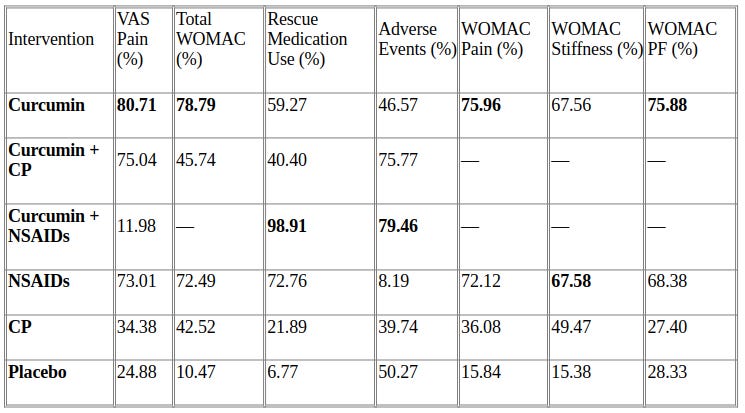
Note: SUCRA (Surface Under the Cumulative Ranking Curve) percentages represent cumulative ranking probabilities. Higher percentages indicate greater comparative efficacy for therapeutic outcomes and a lower incidence of adverse reactions for safety outcomes.
5.2 Clinical Prescription Insights
Primary Analgesia & Functional Recovery: Curcumin monotherapy ranks highest across SUCRA metrics for reducing VAS pain (80.71%), Total WOMAC scores (78.79%), WOMAC Pain (75.96%), and WOMAC Physical Function (75.88%), supporting its role as a standalone option for symptom management and functional recovery.
Optimized Sparing Regimens: The Curcumin + NSAIDs combination ranks highest for minimizing rescue medication use (98.91%) while showing a favorable safety rank for adverse drug events (79.46%). This dual profile allows lower synthetic NSAID dosages without compromising analgesic efficacy.
6. Safety, Bioavailability Formulations, and Risk of Bias Analysis
6.1 Safety Profile and Adverse Event (AE) Comparative Analysis
Knee Osteoarthritis Safety Profile: Network meta-analysis of 20 RCTs evaluating safety demonstrated that curcumin-containing regimens significantly reduce adverse drug reactions relative to conventional synthetic NSAIDs:
Curcumin Monotherapy vs. NSAIDs Alone: OR = 0.51 (95% CI: 0.25 to 0.94), showing a lower rate of adverse events.
Curcumin + NSAIDs Combination vs. NSAIDs Alone: OR = 0.23 (95% CI: 0.06 to 0.90), indicating a lower rate of adverse reactions.
NSAIDs Monotherapy Risk: Synthetic NSAID monotherapy exhibited the lowest safety probability among evaluated active treatments (SUCRA = 8.19%).
Oral Lichen Planus Safety Profile: Corticosteroid therapy was associated with localized adverse effects, including oral candidiasis, xerostomia, mucosal thinning, and burning sensations. Curcumin formulations were well tolerated across trials, with zero to minimal self-limiting side effects (e.g., mild transient burning or local irritation that resolved within the first week).
6.2 Bioavailability Formulations and Administration Regimens
To overcome the natural lipophilicity, rapid systemic elimination, and low intrinsic oral bioavailability of native curcuminoids, multiple bio-optimized commercial formulations were utilized across the clinical trial base:
Longvida®: Solid lipid curcumin particles (80 mg curcumin per capsule).
CuraMed®: Curcuminoid complex extract (333 mg curcuminoids per capsule).
SinaCurcumin™: Soft gelatin capsules containing nanomicelles (40 mg curcuminoids) to enhance systemic absorption.
FLEXOFYTOL®: Bio-optimized Curcuma longa extract (46.67 mg extract per capsule).
BCM-95® (Biocurcumax): Standardized extract combining curcuminoids with essential oils of turmeric (≥95% total complex, ≥88% curcuminoids, ≥68% curcumin).
Theracurmin®: Highly bioavailable submicronized curcumin dispersion (180 mg curcumin).
CurQfen®: Curcumagalactomannoside (CGM) complex combining curcuminoids with soluble fenugreek dietary fiber.
Curcugen®: Water-dispersible formulation containing 50% curcuminoids.
Turmacin™ (NR-INF-02): Water-soluble aqueous extract rich in turmerosaccharides.
Administration Frequency Impact: In topical OLP management, applying 1% curcumin gel 6 times daily reduced clinical sign scores and pain severity more than a 3-times-daily regimen (Thomas et al.), indicating that adequate mucosal application frequency is essential for optimal therapeutic response.
6.3 Methodological Quality, Risk of Bias, and Trial Limitations
Methodological Quality Summary
OLP Evidence Base: Quality evaluation via the Cochrane RoB 2 tool identified 1 trial at “Low Risk” of bias (Kia et al. 2020). The remaining 10 trials presented either “High Risk” (7 trials: Nosratzehi et al. 2018; Tantia & Gupta 2021; Thomas et al. 2017; Keshari et al. 2015; Patel et al. 2022; Singh et al. 2021; Kotb et al. 2025) or “Some Concerns” (3 trials: Kia et al. 2015; Biswas et al. 2018; Pai & Ganesan 2018), primarily due to incomplete descriptions of randomization sequences, inadequate blinding, and selective outcome reporting.
KOA Evidence Base: Assessment of 23 RCTs demonstrated overall acceptable methodology, with low risk in random allocation generation across 21 RCTs. However, 4 trials had high risk due to unblinded designs, and the funnel plot showed asymmetry for VAS pain and total WOMAC endpoints, suggesting small-sample effects or publication bias.
Clinical Trial Limitations
Patient Population Heterogeneity: KOA trials included patients across Kellgren-Lawrence grades 1-4 without subgroup stratification, obscuring stage-specific treatment responsiveness.
Product Standardization & Purity: Heterogeneous extraction protocols, excipient compositions, and active concentration variations across commercial preparations complicate direct cross-study comparisons.
Limited Direct Active-Comparator Arms: Few trials directly compared curcumin against chondroprotective agents (CP) or direct combination therapies (Curcumin + NSAIDs).
Inconsistent Diagnostic Verification: Several OLP clinical trials relied exclusively on clinical examination without mandatory histopathological confirmation.
Recommendations for Future Clinical Trial Designs
Mandatory Disease-Stage Subgroup Stratification: Design future KOA trials around explicit Kellgren-Lawrence structural severity grades (e.g., K-L Grade 2 vs. Grade 4) to define specific therapeutic windows.
Standardized Dosing & Bioavailability Protocols: Utilize bio-enhanced delivery systems with validated pharmacokinetic profiles and standardized dosage metrics.
Extended Diagnostic & Follow-Up Windows: Incorporate mandatory histopathological confirmation for mucosal lesion trials and establish long-term follow-up periods (>6–12 months) to assess recurrence rates and disease modification.
References
Al-Maweri, S. A., Al-Qadhi, G., Alqutaibi, A. Y., Sallam, N. M., Assad, M., Abdulghani, M. A., & Mohammed, M. M. A. (2025). Curcumin versus corticosteroids for symptomatic oral lichen planus: A systematic review and meta-analysis. Clinical and Experimental Dental Research, 11(5), Article e70227. (Source:
Clinical Exp Dental Res - 2025 - Al‐Maweri - Curcumin Versus Corticosteroids for Symptomatic Oral Lichen Planus A.pdf)Cleveland Clinic Health Essentials. (2022). 6 health benefits of turmeric. (Source:
Turmeric Health Benefits and Side Effects.pdf)Hewlings, S. J., & Kalman, D. S. (2017). Curcumin: A review of its effects on human health. Foods, 6(10), Article 92. (Sources:
foods-06-00092.pdf&foods-06-00092-v3.pdf)Johns Hopkins Medicine. (2026). Turmeric benefits. Johns Hopkins Health Library. (Source:
Turmeric Benefits _ Johns Hopkins Medicine.pdf)Kou, H., Huang, L., Jin, M., He, Q., Zhang, R., & Ma, J. (2023). Effect of curcumin on rheumatoid arthritis: A systematic review and meta-analysis. Frontiers in Immunology, 14, Article 1121655. (Source:
fimmu-14-1121655.pdf)Liu, X., Lin, L., & Hu, G. (2024). Meta-analysis of the effect of curcumin supplementation on skeletal muscle damage status. PLoS ONE, 19(7), Article e0299135. (Source:
journal.pone.0299135.pdf)Memorial Sloan Kettering Cancer Center. (2026). The truth about turmeric and cancer. (Source:
The Truth About Turmeric and Cancer _ Memorial Sloan Kettering Cancer Center.pdf)Mokgalaboni, K., Mashaba, R. G., Phoswa, W. N., & Lebelo, S. L. (2024). Curcumin attenuates hyperglycemia and inflammation in type 2 diabetes mellitus: Quantitative analysis of randomized controlled trial. Nutrients, 16(23), Article 4177. (Source:
nutrients-16-04177-v4.pdf)National Cancer Institute. (2023). PDQ® curcumin (Curcuma, turmeric) and cancer. National Institutes of Health, U.S. Department of Health and Human Services. (Source:
Curcumin (Curcuma, Turmeric) and Cancer.pdf)Restivo, J. (2024). Turmeric benefits: A look at the evidence (T. Fung, Ed.). Harvard Health Publishing, Harvard Medical School. (Source:
Turmeric benefits_ A look at the evidence - Harvard Health.pdf)Różański, G., Tabisz, H., Zalewska, M., Niemiro, W., Kujawski, S., Newton, J., Zalewski, P., & Słomko, J. (2023). Meta-analysis exploring the effect of curcumin supplementation, with or without other advice, on biochemical and anthropometric parameters in patients with metabolic-associated fatty liver disease (MAFLD). International Journal of Environmental Research and Public Health, 20(5), Article 4266. (Source:
ijerph-20-04266-v3.pdf)Shen, W., Qu, Y., Jiang, H., Wang, H., Pan, Y., Zhang, Y., Wu, X., Han, Y., & Zhang, Y. (2022). Therapeutic effect and safety of curcumin in women with PCOS: A systematic review and meta-analysis. Frontiers in Endocrinology, 13, Article 1051111. (Source:
fendo-13-1051111.pdf)Zeng, L., Yang, T., Yang, K., Yu, G., Li, J., Xiang, W., & Chen, H. (2022). Curcumin and Curcuma longa extract in the treatment of 10 types of autoimmune diseases: A systematic review and meta-analysis of 31 randomized controlled trials. Frontiers in Immunology, 13, Article 896476. (Source:
fimmu-13-896476.pdf)Zeng, L., Yu, G., Hao, W., Yang, K., & Chen, H. (2021). The efficacy and safety of Curcuma longa extract and curcumin supplements on osteoarthritis: A systematic review and meta-analysis. Bioscience Reports, 41(6), Article BSR20210817. https://doi.org/10.1042/BSR20210817 (Source:
bsr-2021-0817.pdf)Zhao, J., Liang, G., Zhou, G., Hong, K., Yang, W., Liu, J., & Zeng, L. (2024). Efficacy and safety of curcumin therapy for knee osteoarthritis: A Bayesian network meta-analysis. Journal of Ethnopharmacology, 321, Article 117493. (Source:
1-s2.0-S0378874123013636-main.pdf)