

Module 1: Mebendazole in Pediatric Brain Tumors & Clinical Trial NCT02644291
1.1 Disease Burden and Pediatric High-Grade Glioma (HGG) Dynamics
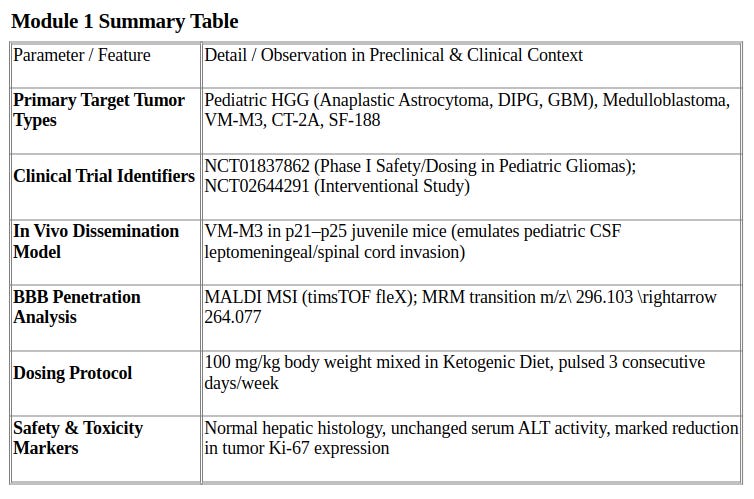
Pediatric high-grade gliomas (HGGs) represent the primary cause of cancer-related mortality in children within the United States. Classified under WHO diagnostic criteria into anaplastic astrocytoma, diffuse intrinsic pontine glioma (DIPG), and pediatric glioblastoma (GBM), these tumors have seen virtually no improvement in management or overall survival outcomes in over a decade. Standard clinical management—surgical resection, radiotherapy, corticosteroids, and alkylating agents like temozolomide—offers modest therapeutic benefit but imposes severe, lifelong adverse effects and treatment burdens on long-term survivors.
A defining pathophysiological characteristic of pediatric HGGs is their higher rate of distant dissemination through cerebrospinal fluid (CSF) than adult malignant gliomas. While spinal cord dissemination occurs in 2% to 14% of adult glioma cases at recurrence, pediatric malignant gliomas exhibit a marked risk of distant relapse and leptomeningeal spread. Tumor tissue in DIPG and GBM is heavily infiltrated by cells expressing microglial/macrophage markers, constituting 30% to 50% of the total tumor cell population. These mesenchymal-origin neoplastic cells exhibit amoeboid motility, facilitating deep parenchymal infiltration and dissemination throughout the central nervous system (CNS) via Scherer’s structures and CSF pathways.
1.2 Preclinical Model Systems
To replicate the invasive and metabolic phenotypes of pediatric CNS tumors, specific syngeneic mouse models and human cell lines are utilized:
VM-M3 Glioblastoma: A highly aggressive, invasive mesenchymal tumor that arose spontaneously in the cerebral cortex of an adult VM/Dk mouse. When orthotopically implanted into juvenile mice (postnatal days p21–p25, corresponding developmentally to human children aged 3–7 years), VM-M3 cells invade extensively from the cerebral cortex into the spinal column and meninges via the CSF. This model reproduces the distal leptomeningeal dissemination characteristic of pediatric HGG.
CT-2A Glioblastoma: An anaplastic astrocytoma/neural stem cell tumor induced by 20-methylcholanthrene implantation in C57BL/6J mice. CT-2A tumors are highly angiogenic but strictly non-invasive.
VM-NM1 Glioblastoma: A non-invasive glioblastoma stem cell tumor line derived from VM/Dk mice, expressing neural stem cell markers without distal spinal cord invasion.
SF-188: An established human pediatric glioblastoma cell line utilized for in vitro metabolic and apoptotic evaluations.
[ Tumor Models & Invasive Patterns ]
├── VM-M3 (Mesenchymal, VM/Dk host) ──> Distal CSF invasion, Spinal cord/Meningeal spread
├── CT-2A (Neural Stem Cell, C57BL/6J) ──> Highly angiogenic, Strictly Non-Invasive
├── VM-NM1 (Stem Cell, VM/Dk host) ──> Non-Invasive intracranial growth
└── SF-188 (Human Pediatric GBM) ──> In vitro human pediatric translation model
1.3 Clinical Trial Parameters and Repurposing Context
Mebendazole (MBZ; methyl 5-benzoyl-1H-benzimidazol-2-ylcarbamate) is a repurposed synthetic benzimidazole anthelmintic with established preclinical efficacy against glioblastoma and medulloblastoma.
Clinical Trial NCT01837862: A Phase I open-label clinical trial initiated to evaluate the safety, tolerability, and maximum tolerated dose (MTD) of mebendazole in pediatric patients with newly diagnosed, recurrent, or refractory high-grade gliomas.
Clinical Trial NCT02644291: An interventional clinical trial designed to assess parameters surrounding therapeutic interventions and drug regimens in oncology.
1.4 Blood-Brain Barrier (BBB) Penetration and MALDI Mass Spectrometry Imaging
A critical hurdle in neuro-oncology is delivering drugs effectively across the blood-brain barrier. We definitively demonstrated mebendazole’s CNS penetration and tissue accumulation using Matrix-Assisted Laser Desorption/Ionization (MALDI) Mass Spectrometry Imaging (MSI).
Instrumentation & Method: We analyzed brain tissue cryosections (10 \mum thickness) on a timsTOF fleX mass spectrometer in positive-ion Multiple Reaction Monitoring (MRM) mode.
MRM Transition: The specific fragment transition monitored was m/z\ 296.103 \rightarrow 264.077 (isolation width 3 m/z, collision energy 15 eV), corresponding to the precursor ion [C_{16}H_{13}N_3O_3 + H]^+ yielding the product ion [C_{15}H_{10}N_3O_2 + H]^+ (exact mass 264.08).
Matrix Application: 2,5-dihydroxybenzoic acid (80 mg/mL in 70:30 methanol: water with 0.1% TFA and 1% DMSO) applied via a TM Sprayer.
Detection Results: High-intensity signals (yellow pixel distributions) confirmed robust MBZ accumulation throughout the tumor-bearing brain parenchyma of mice receiving MBZ with a ketogenic diet, whereas untreated control brains showed no background signal.
[ Precursor Ion: m/z 296.103 ] ──(CID / 15 eV)──> [ Product Ion: m/z 264.077 ]
                      (Exact Mass: 264.08)
1.5 Dosing Schedule, Proliferative Arrest, and Toxicity Profile
Dosing Schedule: In preclinical juvenile mouse models (p21–p25), MBZ was administered orally, thoroughly mixed into a Ketogenic Diet (KD), at a dosage of 100 mg/kg body weight for 3 consecutive days per week (pulsed schedule).
Proliferative Suppression: Immunostaining for Ki-67, a marker of cellular proliferation, showed a marked reduction in positive cells in treated brain tumors at both the primary tumor mass and the brain-tumor interface compared with standard-diet controls.
Histopathology: Hematoxylin and Eosin (H&E) staining revealed widespread tumor cell death and destruction of the primary tumor mass without parenchymal invasion in KD + MBZ-treated mice.
Systemic Safety Profile: Unlike conventional cytotoxic chemotherapy (e.g., temozolomide), MBZ demonstrated high systemic tolerability:
Liver Architecture: Histological examination of liver tissues from KD + MBZ groups showed normal hepatic lobular structure without enlarged hepatocytes, focal necrosis, or immune cell/inflammatory infiltration.
Enzymatic Safety: Serum Alanine Transaminase (ALT) activity levels remained completely normal and comparable between control and treated groups.
Module 1 Review Questions
Analytical Evaluation: Why is orthotopic brain implantation of VM-M3 cells in juvenile mice (p21–p25) superior to adult mouse models for studying pediatric high-grade glioma (HGG)?
Mass Spectrometry Protocol: Describe the specific MALDI MRM mass spectrometry parameters (precursor ion, product ion, collision energy, and matrix) used to confirm mebendazole penetration across the blood-brain barrier.
Pathophysiologic Mechanism: Contrast the invasive and structural growth patterns of the VM-M3 glioma model with the CT-2A and VM-NM1 models.
Toxicity Profile: What specific histological and biochemical markers demonstrated that pulsed mebendazole combined with a ketogenic diet avoids systemic hepatic toxicity?
Module 2: Ketogenic Metabolic Therapy & Press-Pulse Strategy
2.1 The Press-Pulse Therapeutic Framework
Cancer management using ketogenic metabolic therapy (KMT) operates on the Press-Pulse strategy framework:
Metabolic Press: High-carbohydrate standard diets elevate blood glucose, driving tumor fermentation, inflammation, and edema (often exacerbated by standard radiotherapy and dexamethasone/steroid therapy). KMT acts as a continuous metabolic “press.” By restricting dietary carbohydrates and elevating fat intake, KMT reduces blood glucose, suppresses insulin/IGF-1 signaling, elevates non-fermentable neuroprotective ketone bodies (\beta-hydroxybutyrate), lowers systemic inflammation, suppresses tumor angiogenesis, and creates persistent bioenergetic stress in tumor cells.
Pharmacological Pulse: Compromised cancer cells under metabolic stress become hypersensitive to targeted bioenergetic inhibitors. Short-term, periodic administration (”pulsing”) of small-molecule metabolic inhibitors—such as Mebendazole (MBZ), Devimistat (CPI-613), or 6-Diazo-5-oxo-L-norleucine (DON)—delivers lethal cytotoxic “pulses” to tumor cells while sparing normal, ketone-adapted neural tissues.
                  [ PRESS-PULSE THERAPEUTIC STRATEGY ]
                                   │
      ┌────────────────────────────┴────────────────────────────┐
      ▼                                                         ▼
[ METABOLIC PRESS: KMT ]                                [ PHARMACOLOGICAL PULSE ]
- Lowers Blood Glucose                                  - Mebendazole (MBZ): 100 mg/kg (3x/wk)
- Elevates Ketone Bodies (β-OHB)                        - Devimistat (CPI-613): 0.5–1.0 mg/kg (1x/wk)
- Reduces GKI to ≤ 2.0                                  - DON: 1.0 mg/kg (1–2x/wk)
- Inhibits Angiogenesis & Inflammation                  - Targeted Cytotoxic Destruction
2.2 Nutritional Ketosis as a Drug Delivery Vehicle
A crucial discovery in pediatric neuro-oncology is that nutritional ketosis acts as a delivery vehicle that enhances the brain delivery and therapeutic index of co-administered small molecules:
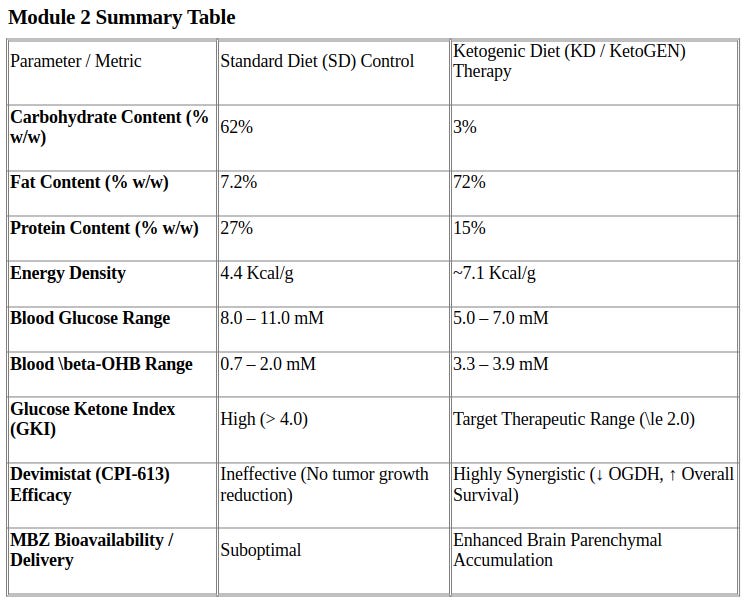
Bioavailability Enhancement: Highly lipophilic or low-solubility drugs like mebendazole show poor oral absorption on standard high-carbohydrate diets. Co-administration within a high-fat ketogenic matrix enhances systemic absorption and bioavailability.
Blood-Brain Barrier Facilitation: Nutritional ketosis alters blood-brain barrier permeability dynamics, increasing parenchymal concentrations of small molecules like DON, MBZ, and CPI-613.
Dose Reduction & Toxicity Mitigation: Enhanced CNS delivery allows lower pharmacological doses to achieve optimal tumor kill, preventing host toxicity.
2.3 Targeting Dual Fermentation Pathways: Glycolysis and Glutaminolysis
Malignant gliomas possess damaged mitochondrial oxidative phosphorylation (OxPhos). To meet energy demands and synthesize biomass, tumor cells depend simultaneously on two fermentation pathways:
Cytoplasmic Glucose Fermentation (Warburg Effect): Converts glucose to lactate despite the presence of oxygen.
Mitochondrial Glutamine Fermentation: Driven by glutaminolysis, in which glutaminase C (GAC) converts glutamine to glutamate—an enzyme gatekeeper that is highly overexpressed in aggressive brain tumors compared with normal tissue. Glutamate enters the TCA cycle to drive mitochondrial substrate-level phosphorylation (mSLP) at the succinyl-CoA ligase step, yielding ATP and succinate.
[ Cytoplasm ]    Glucose ──(Glycolysis)──> Pyruvate ──> Lactate + ATP (Warburg Effect)
                                                               │
[ Mitochondria ] Glutamine ──(Glutaminase C)──> Glutamate ──> α-KG ──(α-KGDH/OGDH)──> Succinyl-CoA ──(mSLP)──> Succinate + ATP
2.4 Pharmacological Mechanisms of Bioenergetic Inhibition
Mebendazole (MBZ):
Glycolytic Suppression: Inhibits glucose uptake and glycolytic enzymes. LC-MS metabolomics reveals reduced intracellular levels of lactate, glycolytic intermediates, and precursors for nucleotide and fatty acid biosynthesis (malonyl-CoA).
Glutaminolysis Suppression: In vitro assays in VM-M3 cells demonstrate that MBZ selectively abolishes proliferation and viability when glutamine is the sole available nutrient substrate. LC-MS metabolite profiling shows marked reductions in glutamate, \alpha-ketoglutarate (\alpha-KG), and succinate, along with elevations in 2-aminobutyrate and aspartate.
Enzymatic Down-regulation: Western blot analysis demonstrates that MBZ significantly down-regulates Glutaminase C (GAC) protein expression in treated brain tumors in vivo.
Oxygen Consumption Rate (OCR): Real-time bioenergetic monitoring (Resipher system) demonstrates that MBZ (1 \muM) significantly suppresses OCR over 6 hours.
Devimistat (CPI-613):
Mitochondrial Dehydrogenase Inhibition: A lipoate derivative that selectively targets lipoate-requiring mitochondrial enzyme complexes: Pyruvate Dehydrogenase (PDH) and 2-Oxoglutarate Dehydrogenase (OGDH / \alpha-ketoglutarate dehydrogenase).
Synergistic Dependency: CPI-613 alone on a Standard Diet (SD) fails to inhibit VM-M3 tumor growth in vivo. However, when paired with KMT, CPI-613 significantly decreases ex vivo brain bioluminescence, lowers OGDH protein levels (116 kDa band) in brain tumor tissue, and significantly prolongs overall mouse survival in both VM-M3 and CT-2A glioma models.
6-Diazo-5-oxo-L-norleucine (DON):
Unselective, robust glutamine antagonist used as a positive control. When pulsed (1.0 mg/kg i.p.) alongside KMT + MBZ, the tri-combination achieves over a 3-fold extension in overall survival in juvenile HGG mouse models.
2.5 Dietary Formulations and Systemic Physiological Parameters
The dietary compositions and blood physiological responses established in preclinical juvenile mouse studies (p21–p25) include:
[ Dietary Macronutrient Profiles ]
Standard Diet (SD):  [ Carbohydrates 62% ] [ Protein 27% ] [ Fat 7.2% ] (4.4 Kcal/g)
Ketogenic Diet (KD): [ Fat 72% ] [ Protein 15% ] [ Carbs 3% ] (7.1 Kcal/g)
Blood Glucose: Significantly reduced from 8.0–11.0 mM in SD-fed mice down to 5.0–7.0 mM in KD-fed mice.
Blood \ beta-hydroxybutyrate (\beta-OHB): Elevated from 0.7–2.0 mM in SD-fed controls to 3.3–3.9 mM in KD-fed mice.
Glucose Ketone Index (GKI): Calculated as [\text{Glucose (mM)}] / [\text{Ketones (mM)}]. KMT consistently drives GKI values down to \le 2.0.
Weight Maintenance: Ad libitum KetoGEN feeding maintained steady body weight in juvenile mice during critical development without causing growth retardation or lethargy.
Module 2 Review Questions
Conceptual Integration: Differentiate between the “press” and “pulse” components of Ketogenic Metabolic Therapy when treating pediatric high-grade gliomas.
Biochemical Calculations: Given a patient with a blood glucose reading of 5.4 mM and a blood \beta-hydroxybutyrate reading of 2.7 mM, calculate the Glucose Ketone Index (GKI). State whether this falls within the target therapeutic range for metabolic oncology.
Metabolic Pathway Analysis: How do mebendazole and devimistat (CPI-613) complement nutritional ketosis in targeting the dual fermentation pathways of glioblastoma cells?
Enzymatic Target Mechanisms: Detail the specific enzymatic targets inhibited by devimistat (CPI-613) and mebendazole within mitochondrial pathways.
Module 3: Fenbendazole Anticancer Mechanisms
3.1 Chemical Profile and Veterinary Repurposing Strategy
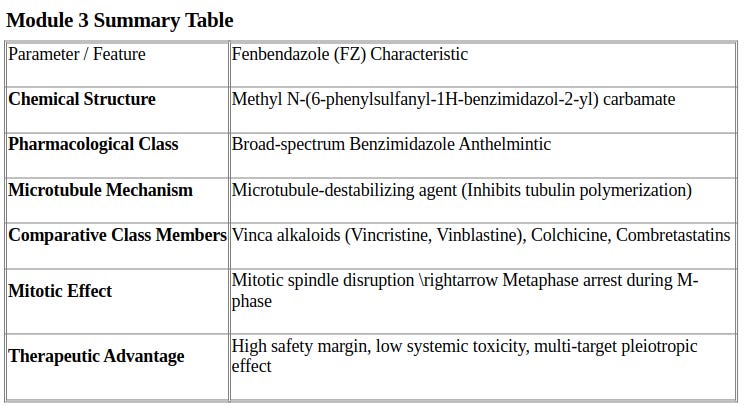
Fenbendazole (FZ; methyl N-(6-phenylsulfanyl-1H-benzimidazol-2-yl) carbamate) is a broad-spectrum benzimidazole anthelmintic widely approved for veterinary applications across multiple animal species. Repurposing veterinary anthelmintics for human oncology offers a cost-effective, high-efficiency pathway because of their established safety margins, low host toxicity, and high tolerability in animal toxicology studies.
            O
            ║
     S ─── [ Benzimidazole Core ] ─── NH ─── C ─── O ─── CH₃
3.2 Microtubule Dynamics and Structural Classification
Microtubules are dynamic polymers made of \alpha- and \beta-tubulin heterodimers that support cell division, mitotic spindle formation, intracellular trafficking, motility, and maintenance of cell morphology. Microtubule-targeting agents (MTAs) used in oncology fall into two functional classes:
Microtubule-Stabilizing Agents: Promote tubulin assembly and prevent depolymerization (e.g., paclitaxel, docetaxel, epothilones, discodermolide).
Microtubule-Destabilizing Agents: Inhibit tubulin polymerization and disrupt microtubule network assembly.
Fenbendazole is categorized as a microtubule-destabilizing agent. Like vinca alkaloids (vinblastine, vincristine, vinorelbine, vindesine, vinflunine), estramustine, colchicine, and combretastatins, fenbendazole binds tubulin to arrest microtubule polymerization dynamics.
[ Microtubule Targeting Agents ]
├── Stabilizing Agents (Prevent Depolymerization) ──> Paclitaxel, Docetaxel, Epothilones
└── Destabilizing Agents (Inhibit Polymerization) ──> Fenbendazole, Vinca Alkaloids, Colchicine
3.3 Mitotic Arrest and Pleiotropic Mechanisms
Metaphase Arrest: By interfering with mitotic spindle assembly during M-phase, fenbendazole disrupts mechanical chromosome segregation, capturing dividing tumor cells in metaphase arrest.
Apoptotic Induction: Prolonged M-phase arrest triggers intracellular apoptotic cascades, leading to programmed cell death in proliferating cancer cells.
Pleiotropic Action vs. Single-Target Resistance: Tumorigenesis involves alterations across interconnected cell signaling networks. Single-target antineoplastic drugs frequently induce treatment resistance through bypass mutations. Fenbendazole exerts pleiotropic, multi-target activity by simultaneously perturbing structural, mitotic, and metabolic networks, reducing the likelihood of acquired drug resistance.
Module 3 Review Questions
Structural Classification: Compare the mechanisms of microtubule-stabilizing agents versus microtubule-destabilizing agents. Into which category does fenbendazole fall?
Cell Cycle Effects: What specific cell cycle stage is disrupted by fenbendazole, and what structural events precipitate this arrest?
Resistance Circumvention: Explain why the pleiotropic mechanism of benzimidazole anthelmintics provides an advantage over highly selective single-target chemotherapies.
Module 4: Mebendazole Potency, Bioenergetic Monitoring, and Apoptotic Signatures
4.1 Comparative In Vitro Potency and Proliferative Inhibition
Mebendazole (MBZ) displays potent cytotoxic and antiproliferative action across multiple preclinical glioblastoma models:
VM-M3 (Mesenchymal Glioblastoma): MBZ suppresses cellular ATP content and bioluminescence in a strict dose-dependent manner. Brightfield microscopy demonstrates extensive cell death at 10 \muM MBZ. In vitro substrate-substitution experiments confirm that MBZ-induced viability reduction is significantly greater when cells depend on glutamine than on glucose.
SF-188 (Human Pediatric Glioblastoma): In SF-188/luc cells, MBZ (1 \muM) and CPI-613 (100 \muM) significantly suppress bioluminescence and cell viability at both 24 and 48 hours post-treatment.
[ Bioluminescence / ATP Reduction in SF-188 ]
Untreated Control ──(24h / 48h)──> High Viability Signal
MBZ (1 µM)         ──(24h / 48h)──> Significant Reduction (p < 0.05)
CPI-613 (100 µM)   ──(24h / 48h)──> Significant Reduction (p < 0.05)
4.2 Apoptotic Pathways and Caspase Activation
In both murine VM-M3 glioblastoma cells and human pediatric SF-188 glioblastoma cells, mebendazole (1 \muM) and devimistat (100 \muM) induce programmed cell death via apoptotic signaling pathways:
Caspase-3 Activation: Western blot analysis shows progressive, time-dependent cleavage and activation of caspase-3 after exposure to MBZ or CPI-613 at 24 and 48 hours.
Metabolic Apoptosis Link: Apoptosis induction directly follows the depletion of cellular ATP reserves caused by simultaneous inhibition of glycolytic and glutaminolytic substrate-level phosphorylation.
[ Bioenergetic Stress ] ──> [ ATP Depletion ] ──> [ Caspase-3 Cleavage ] ──> [ Apoptotic Cell Death ]4.3 Real-Time Resipher Oxygen Consumption Rate (OCR) Bioenergetics
To directly measure the bioenergetic impact of MBZ and devimistat (CPI-613) on live tumor cell respiration, real-time micro-coaxial oxygen sensing was performed using the Resipher optical sensing system:
Experimental Protocol: VM-M3 cells seeded at 2.0 \times 10^5 cells/well in 96-well plates were incubated in serum-free DMEM containing 12 mM glucose and 2 mM glutamine.
OCR Suppression: Continuous real-time monitoring over 6 hours showed that MBZ (1 \muM) or CPI-613 (100 \muM) treatment statistically significantly reduced real-time Oxygen Consumption Rate (OCR) compared with untreated vehicle controls.
Bioenergetic Significance: This rapid OCR reduction confirms that MBZ and CPI-613 directly and acutely inhibit mitochondrial bioenergetics and respiratory chain function in glioblastoma cells.
                      [ REAL-TIME OCR MONITORING (Resipher System) ]
                                            │
           ┌────────────────────────────────┴────────────────────────────────┐
           ▼                                                                 ▼
[ MBZ Treatment (1 µM) ]                                        [ CPI-613 Treatment (100 µM) ]
- Significant OCR suppression at 6 hours                        - Significant OCR suppression at 6 hours
- Depletes mitochondrial respiration                            - Inhibits PDH/OGDH dehydrogenase complexes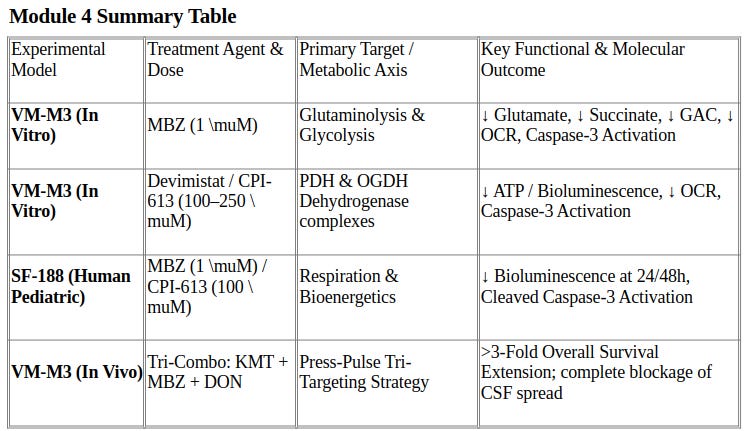
Module 4 Review Questions
Bioenergetic Assays: What specific real-time changes in oxygen consumption rate (OCR) did the Resipher sensing system record after exposure to mebendazole and devimistat?
Molecular Apoptosis: Describe the Western blot evidence confirming that mebendazole triggers programmed cell death in human SF-188 glioblastoma cells.
Metabolic Metabolomics: Summarize the changes in metabolite concentrations (glutamate, succinate, lactate, malonyl-CoA, 2-aminobutyrate) observed via LC-MS in mebendazole-treated tumor cells.
In vivo survival outcomes: Compare survival outcomes in juvenile mice bearing VM-M3 tumors treated with a Ketogenic Diet alone versus a Ketogenic Diet combined with pulsed Mebendazole and DON.
Peer-Reviewed Journal Articles
Dogra, N., Kumar, A., & Mukhopadhyay, T. (2018). Fenbendazole acts as a moderate microtubule destabilizing agent and causes cancer cell death by modulating multiple cellular pathways. Scientific Reports, 8(1), Article 11926. https://doi.org/10.1038/s41598-018-30158-6
(Source:41598_2018_Article_30158.pdf)Gupta, R., Roy, D., Ghosh, A., Begum, Y., Ghosh, D., & Swarnakar, S. (2025). Mebendazole exerts anticancer activity in ovarian cancer cell lines via novel Girdin-mediated AKT/IKKα/β/NF-κB signaling axis. Cells, 14(2), Article 113. (Source:
cells-14-00113.pdf)
Preprint Publication
Mukherjee, P., Maurer, J., Stopka, S. A., Greenwood, B., Aristizabal-Henao, J. J., Karmacharya, S., Chimento, A., Ta, N., Lee, D. C., Duraj, T., Bronson, R. T., Kiebish, M. A., & Seyfried, T. N. (2023). Ketogenic diet as a metabolic vehicle for enhancing the therapeutic efficacy of mebendazole and devimistat in preclinical high-grade gliomas grown in juvenile mice. BioRxiv. (Source:
2023.06.09.544252v2.full.pdf)
Clinical Trial Registry Records
Sidney Kimmel Comprehensive Cancer Center at Johns Hopkins. (2015–2022). Phase I study of mebendazole therapy for recurrent/progressive pediatric brain tumors (Identifier: NCT02644291). National Library of Medicine (US). https://clinicaltrials.gov/study/NCT02644291
(Source:NCT02644291.pdf)Sidney Kimmel Comprehensive Cancer Center at Johns Hopkins. (2022). Phase I study of mebendazole therapy for recurrent/progressive pediatric brain tumors: Researcher view ([suspicious link removed] Identifier: NCT02644291). National Library of Medicine (US). https://clinicaltrials.gov/study/NCT02644291
(Source:Researcher View _ NCT02644291 _ Phase I Study of Mebendazole Therapy for Recurrent_Progressive Pediatric Brain Tumors