

A comprehensive study guide comparing the preclinical evidence, cellular targets, and mechanisms of action for fenbendazole against other repurposed oncology candidates (including benzimidazole carbamates like mebendazole, albendazole, and flubendazole, as well as non-steroidal anti-inflammatory agents like diclofenac, and metabolic agents like dichloroacetate). The study guide should highlight comparative IC50 cytotoxicity, tubulin disruption, p53-dependent vs. p53-independent pathways, ferroptosis induction in chemoresistant tumors, selective toxicity over normal immune cells, and the clinical challenges surrounding drug repositioning and patient self-administration.
Section 1: Introduction and Conceptual Framework of Drug Repositioning in Oncology
The traditional pipeline for discovering and developing novel oncological therapeutics is constrained by severe economic and temporal bottlenecks. Developing a single new cancer drug candidate requires an estimated 11.4 to 13.5 years and financial investments ranging from USD $1.0 to $2.5 billion to clear obligatory trials mandated by regulatory bodies like the U.S. Food and Drug Administration (FDA). Despite this arduous process, only 5% of oncology drugs that enter Phase I clinical trials ultimately achieve clinical approval. Furthermore, traditional chemotherapeutic regimens are frequently compromised by the emergence of multidrug resistance (MDR), which accounts for approximately 90% of deaths in patients receiving conventional therapy.

To address these barriers, the strategy of drug repurposing (or reprofiling)—formalized by initiatives such as the Repurposing Drugs in Oncology (ReDO) project—has emerged as a vital alternative. Repositioning re-evaluates approved, non-oncology pharmaceutical agents with established pharmacokinetics, pharmacodynamics, and human/animal safety profiles. This framework dramatically accelerates integration into clinical practice and reduces development overhead.
Among repurposed candidates, anthelmintics—specifically the benzimidazole carbamate (BZ) class—have demonstrated significant antineoplastic potential. This group includes:
Mebendazole (MBZ)
Albendazole (ABZ)
Flubendazole (FLU)
Fenbendazole (FZ) (methyl N-(6-phenylsulfanyl-1H-benzimidazol-2-yl)carbamate)
Additionally, non-anthelminthic agents such as diclofenac (a non-steroidal anti-inflammatory agent), dichloroacetate (DCA) (a metabolic modulator), clarithromycin, cimetidine, and nitroglycerine are prominent candidates within the repositioning landscape.
Section 2: Broad Comparative Matrix of Repurposed Oncology Candidates
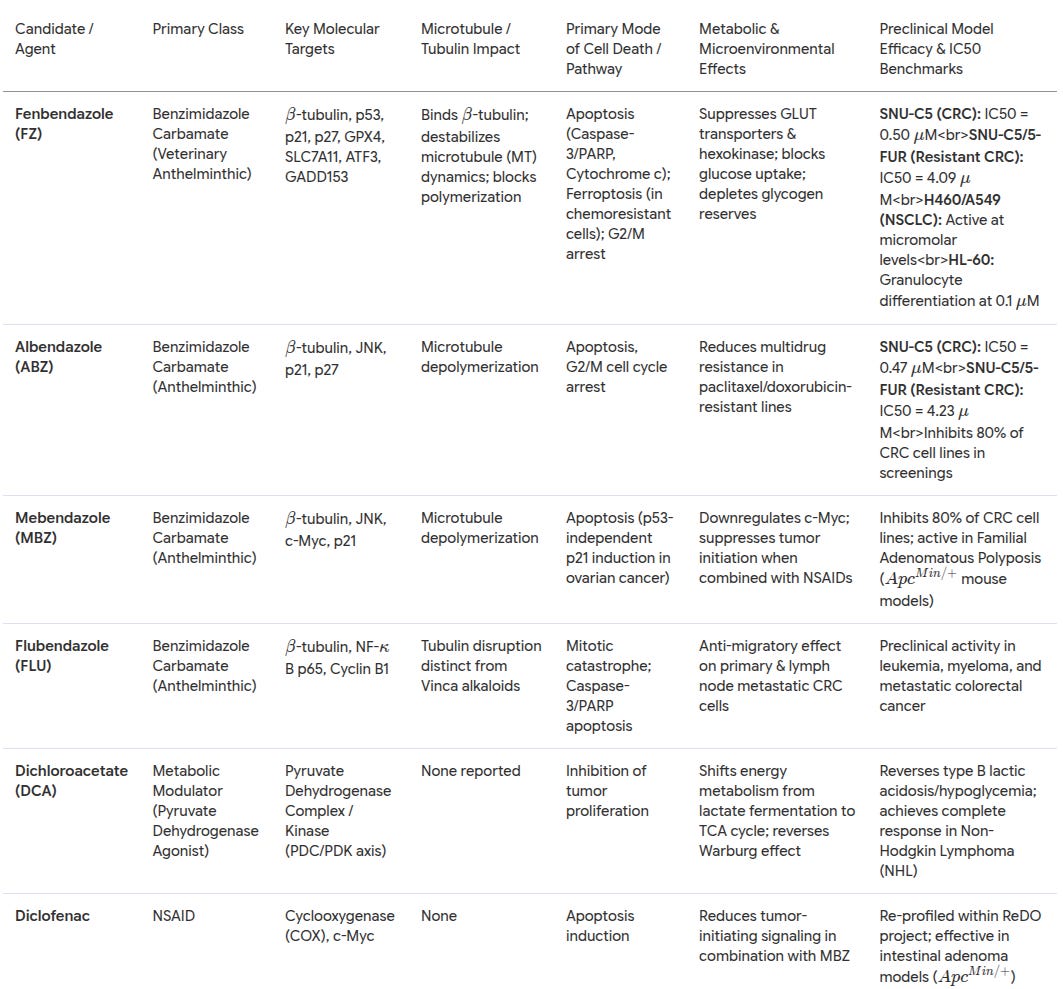
The following matrix synthesizes the molecular targets, mechanisms of action, cytotoxicity profile, metabolic impacts, and preclinical model data for key repurposed agents highlighted across the source literature.
Section 3: Cellular Targets and Molecular Mechanisms of Action of Fenbendazole
3.1 Microtubule Dynamics and Structural Disruption
Microtubules (MTs), composed of heterodimers of \alpha- and \beta-tubulin, are vital structural cytoskeletal components required for mitotic spindle formation, cell division, cellular motility, organelle transport, and cell shape maintenance.
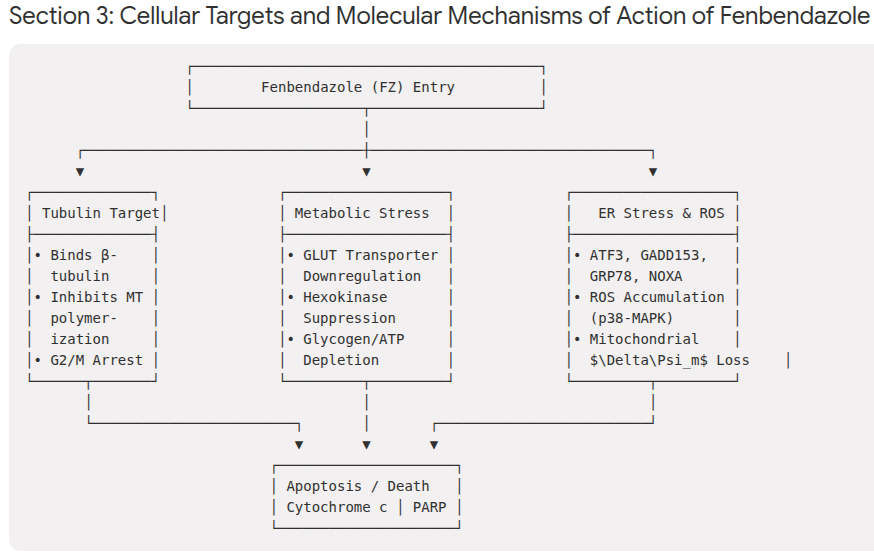
Primary Binding Target: FZ selectively binds to mammalian and parasite \beta-tubulin.
Mechanism: FZ acts as a moderate microtubule-destabilizing agent. It inhibits MT polymerization and destabilizes dynamic MT structures.
Comparison with Taxanes/Vinca Alkaloids: While taxanes (e.g., paclitaxel, docetaxel) stabilize microtubules against depolymerization and Vinca alkaloids (e.g., vincristine, vinblastine) cause aggressive depolymerization, FZ disrupts MT dynamics in a manner similar to Vinca alkaloids but exhibits a distinct binding profile that results in metaphase arrest and apoptosis in dividing cancer cells.
3.2 Endoplasmic Reticulum (ER) Stress, Mitochondrial Dysfunction, and ROS
Treatment of human cancer cells with FZ induces extensive cellular stress pathways:
ER Stress Marker Induction: FZ upregulates specific endoplasmic reticulum stress-associated transcription factors and proteins, including ATF3, GADD153, GRP78, IRE1\alpha, and NOXA.
Proteasomal Accumulation: FZ impairs the ubiquitin-proteasome pathway, causing an accumulation of apoptosis-regulatory proteins (e.g., cyclins, p53, I\kappaB\alpha).
Mitochondrial Pathway: FZ causes loss of mitochondrial membrane potential (\Delta\Psi_m), facilitating the mitochondrial translocation of p53 and triggering the release of Cytochrome c into the cytosol, which activates the intrinsic apoptotic cascade.
Reactive Oxygen Species (ROS): FZ induces ROS accumulation. In human leukemia (HL-60) and cervical cancer (HeLa) cells, ROS generation is a primary driver of cytotoxicity. This ROS surge activates the MEK3/6–p38-MAPK signaling pathway, inhibiting cell proliferation and promoting apoptosis. The scavenger N-acetyl cysteine (NAC) successfully rescues FZ-induced loss of metabolic viability in HL-60 cells, confirming ROS dependence in specific tumor types.
3.3 Glucose Transport and Metabolic Suppression
In parasites and mammalian tumor cells, FZ severely impairs energy metabolism:
Glycolytic Pathway Blockade: FZ downregulates key glycolytic enzymes, specifically hexokinase, and suppresses the expression of GLUT transporters.
Energy Starvation: By blocking glucose uptake and disrupting intracellular transport via microtubule depolymerization, FZ depletes cellular glycogen reserves and inhibits ATP formation.
Contextual Metamodulation: The Warburg Effect
Rapidly proliferating tumors undergo aerobic glycolysis (the Warburg Effect), converting glucose into lactate despite the presence of adequate oxygen. This metabolic shift confers a growth advantage but can trigger severe hematologic emergencies characterized by Type B lactic acidosis (pyruvate converted to lactate exceeding hepatic clearance capacity) and refractory hypoglycemia.
In high tumor burden states (e.g., advanced T-cell/lymphoma transformations):
Conventional interventions (e.g., high-rate dextrose infusions such as D10W or D20W, repeat pushes of D50W, sodium bicarbonate, or hemodialysis) often fail to correct systemic hypoglycemia and hyperlactatemia.
Metabolic repurposed agents directly target this phenomenon:
Dichloroacetate (DCA): Acts as a pyruvate dehydrogenase (PDH) agonist (via PDK inhibition), shifting energy metabolism away from lactate fermentation back into the mitochondrial tricarboxylic acid (TCA) cycle. DCA has demonstrated success in reversing Warburg-driven metabolic crises in Non-Hodgkin Lymphoma (NHL).
Monocarboxylate Transport (MCT) Inhibitors: Block transcellular lactate shuttling, preventing lactate-driven tumor angiogenesis, migration, and immune evasion.
Thiamine Supplemental Therapy: Re-establishes an essential enzymatic cofactor for pyruvate dehydrogenase in aerobic oxidative phosphorylation, countering thiamine depletion by rapidly proliferating blast cells.
Section 4: Cytotoxic Dynamics, IC50 Benchmarks, and Selective Toxicity
4.1 In Vitro vs. In Vivo Efficacy and IC50 Benchmarks
The antiproliferative activity of FZ varies significantly across cell lines, tissue types, and chemoresistance states:

Colorectal Cancer (CRC) Benchmark Studies:
In wild-type SNU-C5 cells, FZ exhibits a 3-day IC50 of 0.50 \muM (comparable to Albendazole at 0.47 \muM).
In 5-fluorouracil-resistant CRC cells (SNU-C5/5-FUR), FZ demonstrates an IC50 of 4.09 \muM (compared to Albendazole at 4.23 \muM).
Across large compound screenings (461 cancer cell lines), benzimidazoles maintain a general IC50 benchmark threshold of \le 5.0 \muM for sensitive lines.
Leukemic Differentiation: In HL-60 leukemia cells, ultra-low concentrations (0.1 \muM) of FZ induce granulocytic differentiation within 3 days via modulation of the PI3K/AKT, JAK/STAT, and MAPK pathways.
Hepatocellular Carcinoma (H4IIE): FZ selectively inhibits actively proliferating H4IIE cells while sparing confluent, quiescent cells.
4.2 Selective Toxicity and Immunological Considerations
A major limitation of traditional tubulin-binding chemotherapeutics (e.g., vincristine, paclitaxel) is their non-selective cytotoxicity toward non-malignant, rapidly dividing host cells. Repeated cycles of traditional chemotherapy cause severe immunosuppression by impairing lymphocyte function and depressing T-cell-mediated immune responses.
Conversely, preclinical studies indicate that FZ displays a high margin of safety:
Normal vs. Transformed Cells: FZ exhibits significantly higher IC50 values (lower toxicity) in normal non-malignant human cells—such as bone marrow-derived mesenchymal stem cells (BMSCs) and human foreskin fibroblasts (HFFs)—than in transformed cancer cell lines.
Selective Proliferative Targeting: FZ selectively targets actively cycling cells over quiescent populations, minimizing off-target cytotoxicity to non-cycling healthy tissues.
Section 5: Cell Cycle Regulation, Apoptosis, and Chemoresistance Pathways
5.1 G2/M Cell Cycle Arrest
Across multiple tumor models, FZ arrests cells at the G2/M phase:
Cyclin-Dependent Kinase Inhibitors: FZ causes marked upregulation of p21 and p27Kip1.
Oncogene Suppression: FZ significantly downregulates c-Myc expression.
Cyclin Dynamics: While FZ suppresses Cyclins B and D in rat hepatocellular carcinoma (H4IIE) at G1/S and G2/M checkpoints, studies in SNU-C5 and SNU-C5/5-FUR CRC models demonstrate robust G2/M accumulation with elevated p21/p27 without significant shifts in total Cyclin B1 levels.
5.2 p53-Dependent vs. p53-Independent Death Pathways
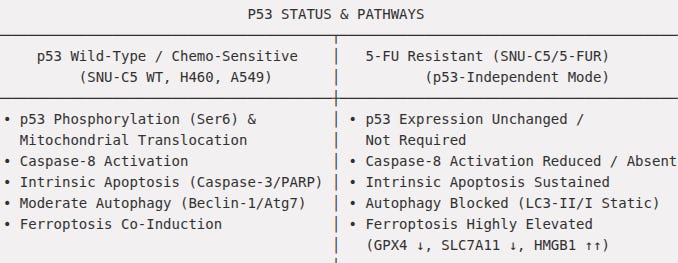
The mechanism of FZ-induced apoptosis depends heavily on the p53 status and chemoresistance profile of the tumor cell:
1. Wild-Type, Chemo-Sensitive Cells (e.g., SNU-C5 WT, H460, A549)
p53 Activation: FZ increases total p53 expression, induces p53 phosphorylation (Ser6), and drives p53 mitochondrial translocation.
Caspase Cascade: Activates Caspase-8, which cleaves and activates downstream Caspase-3 and PARP, leading to classic, p53-dependent intrinsic apoptosis accompanied by Cytochrome c release.
2. 5-FU Chemoresistant Cells (e.g., SNU-C5/5-FUR)
p53-Independence: Chemoresistant cells execute FZ-induced apoptosis without upregulation or activation of p53.
Altered Execution: Caspase-8 activation is substantially reduced. However, downstream Caspase-3 cleavage, PARP activation, and Cytochrome c release remain robust, proving that FZ bypasses 5-FU resistance mechanisms caused by p53 mutations or p38\alpha-MAPK dysregulation.
5.3 Ferroptosis Induction in Chemoresistant Tumors
When p53-dependent apoptotic pathways are compromised in chemoresistant tumors, FZ shifts its primary cytotoxic mechanism toward ferroptosis—an iron-dependent form of regulated cell death caused by lipid peroxidation:

Glutathione Peroxidase 4 (GPX4) Suppression: FZ significantly reduces expression of GPX4 (the key lipid-repair enzyme) in both WT and 5-FU resistant cells.
System x_c^- Component Downregulation: FZ suppresses SLC7A11 (cysteine/glutamate antiporter subunit) specifically in 5-FU resistant cells (SNU-C5/5-FUR), depriving the cell of cysteine required for glutathione synthesis.
Iron Flux Alterations: FZ upregulates Ferritin Heavy Chain (FTH1) and Ferroportin (FPN) while Transferrin Receptor (TfRC) expression remains unchanged.
DAMP Marker Surge: FZ induces a massive upregulation of HMGB1 (a damage-associated molecular pattern marker) in chemoresistant cells (2.36-fold vs. 1.30-fold in WT), signaling extensive cell destruction.
Paradoxical Effect of Anti-Ferroptotic Agents: Co-treatment of FZ with standard anti-ferroptotic inhibitors (Ferrostatin-1 or the iron chelator Deferoxamine [DFOM]) fails to rescue FZ-induced cell death. In fact, higher concentrations of Ferrostatin-1 (> 1\ \mu\text{M}) or DFOM (10\ \mu\text{M}) paradoxically enhance cytotoxicity, decreasing cell viability further.
5.4 Secondary Cell Death Pathways
Autophagy: FZ upregulates Beclin-1 in both wild-type and chemoresistant cells. However, in 5-FU-resistant cells, the conversion ratio of LC3-I to LC3-II remains static and Atg12-5 conjugate conversion is diminished, indicating an incomplete or impaired autophagic flux that fails to protect resistant cells.
Necroptosis: FZ increases receptor-interacting protein kinase (RIP) phosphorylation. However, it simultaneously downregulates RIP3 expression while MLKL activation remains unchanged. This disrupts the canonical RIP1-RIP3-MLKL necroptotic complex, ruling out full necroptosis execution.
Section 6: Clinical, Pharmacokinetic, and Social Challenges
6.1 Pharmacokinetics and Bioavailability Limits
Despite its compelling preclinical efficacy, FZ faces significant pharmacokinetic challenges that impede its straightforward translation into a systemic human oncological therapy:
Poor Systemic Absorption: Orally administered FZ is poorly absorbed across the mammalian gastrointestinal tract into the bloodstream.
Ruminant vs. Monogastric Dynamics: Maximum antiparasitic efficacy in animals relies on prolonged drug retention in the rumen or gut. Consequently, systemic tissue levels are low compared to intestinal luminal concentrations.
Metabolism & Excretion: FZ undergoes hepatic biotransformation into its primary active sulfoxide metabolite (oxfendazole). Excretion occurs predominantly via feces, with a minor fraction eliminated through urine.
Formulation Barrier: FZ’s low aqueous solubility hampers its ability to consistently achieve systemic micromolar therapeutic concentrations (1.0 - 5.0\ \mu\text{M}) in human solid tumors without dose-limiting toxicity.
6.2 Patient Self-Administration and The “Tippens Protocol”
In August 2016, an Oklahoma patient (Joe Tippens) diagnosed with terminal small-cell lung cancer self-administered an unapproved combination regimen following an informal veterinary recommendation. The regimen, widely known as the “Tippens Protocol”, consists of:
Fenbendazole: 222 mg daily (equivalent to 1 gram of commercial veterinary formulations such as Panacur™ or Safeguard™).
Vitamin E Supplements
Cannabidiol (CBD) Oil
Bioavailable Curcumin
Following subsequent resolution of his disease (which occurred while he was concurrently enrolled in an early-phase human clinical trial), the case spread rapidly across social networking services (SNS). This generated online patient communities (e.g., Facebook’s “My Cancer Story Rocks”, blogs, YouTube channels) and sparked self-administration trends globally, most notably in South Korea.

6.3 Clinical Risks, Toxicity, and Impact on Trial Integrity
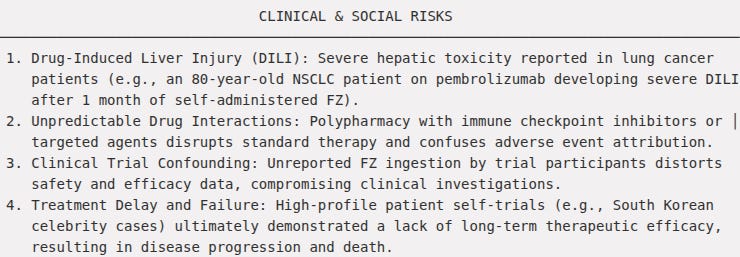
Self-administration of veterinary anthelmintics poses severe clinical risks and complicates formal oncological care:
Medical societies and regulatory agencies (including the Korean Medical Association and the Ministry of Food and Drug Safety) strongly advise against taking veterinary formulations. However, patient demand highlights the need for rigorous, formal human clinical trials to evaluate safety, human pharmacokinetics, and controlled dosing.
Section 7: Study Guide Summary & Key Review Questions
Key Takeaway Points
Mechanism: Fenbendazole (FZ) is a benzimidazole carbamate that destabilizes microtubules, halts cells at the G2/M phase, upregulates p21 and p27Kip1, induces ER stress, and suppresses GLUT/hexokinase-mediated glucose uptake.
Chemoresistance: In 5-FU resistant colorectal cancer cells (SNU-C5/5-FUR), FZ bypasses chemoresistance mechanisms by executing apoptosis in a p53-independent manner, backed by significant ferroptosis induction (downregulating GPX4 and SLC7A11).
Metabolic Crosstalk: FZ’s inhibition of glycolysis mirrors strategies used to reverse the Warburg Effect (e.g., DCA activation of PDH, MCT inhibitors).
Selectivity: FZ demonstrates selective toxicity toward actively proliferating cancer cells over normal BMSCs and fibroblasts, avoiding the widespread immune cell/T-cell depletion typical of traditional tubulin agents like vincristine.
Clinical Challenge: Systemic application is limited by poor aqueous solubility and low oral bioavailability. Uncontrolled self-administration carries significant risks, including Drug-Induced Liver Injury (DILI) and trial data confounding.
Jung, H., Lee, Y.-J., & Joo, H.-G. (2023). Differential cytotoxic effects of fenbendazole on mouse lymphoma EL-4 cells and spleen cells. Korean Journal of Veterinary Research, 63(1), Article e2. https://doi.org/10.14405/kjvr.20220040
Li, W., Jaga, S., Shah, S., & Cearras, M. (2025). Cancer’s metabolic hijack: The under-recognized hematologic emergency related to the Warburg effect. Cureus, 17(1), Article e77869. https://doi.org/10.7759/cureus.77869
Park, D., Lee, J.-H., & Yoon, S.-P. (2022). Anti-cancer effects of fenbendazole on 5-fluorouracil-resistant colorectal cancer cells. Korean Journal of Physiology & Pharmacology, 26(5), 377–387. https://doi.org/10.4196/kjpp.2022.26.5.377
Sultana, T., Jan, U., Lee, H., Lee, H., & Lee, J. I. (2022). Exceptional repositioning of dog dewormer: Fenbendazole fever. Current Issues in Molecular Biology, 44(10), 4977–4986. https://doi.org/10.3390/cimb44100338