

1. Fundamental Bio-Metabolic Mechanisms of Fenbendazole Disruption
Context & Strategic Importance
Repurposing non-oncology pharmaceuticals is a pivotal strategy in contemporary drug discovery, offering a faster path to clinical translation while reducing the exorbitant development costs and safety uncertainties of novel chemical entities. Fenbendazole [methyl N-(6-phenylsulfanyl-1H-benzimidazol-2-yl) carbamate; FBZ], an inexpensive, broad-spectrum benzimidazole anthelmintic routinely employed in veterinary medicine, has attracted rigorous scientific interest for its multifaceted antineoplastic properties. Malignant transformation involves structural plasticity and metabolic rewiring, features that often make mono-targeted therapeutics vulnerable to rapidly acquired resistance. By simultaneously destabilizing the tubulin cytoskeleton, activating p53-dependent stress cascades, inhibiting 26S proteasomal degradation, and enforcing upper glycolytic blockade, FBZ establishes a comprehensive multi-target therapeutic strategy capable of circumventing single-pathway resistance mechanisms.
Tubulin Dynamics and Cytoskeletal Perturbation
Microtubules are dynamic polymers of \alpha- and \beta-tubulin heterodimers essential for mitotic spindle assembly, intracellular vesicular transport, structural integrity, and cell motility. FBZ acts as a moderate microtubule-destabilizing agent, binding directly to mammalian tubulin at the colchicine-binding domain, as confirmed by competitive fluorescence binding assays. However, its biophysical impact on tubulin polymer kinetics differs markedly from classic, high-toxicity antimitotic agents like colchicine and nocodazole.
Polymerization Kinetics: In cell-free assays using purified bovine tubulin, FBZ gently and concentration-dependently suppresses tubulin polymerization, contrasting sharply with the immediate, complete shutdown of assembly induced by colchicine.
Soluble-to-Polymerized Tubulin Ratios: Quantitative subcellular fractionation and immunoblot analyses in A549 non-small cell lung carcinoma (NSCLC) models demonstrate that treatment with 1.0\,\mu\text{M} FBZ yields a modest increase in the soluble-to-polymerized tubulin ratio (\sim 1.5-fold elevation over baseline control). In comparison, nocodazole exposure yields a \sim 2.0-fold increase, while colchicine treatment produces a dramatic \sim 3.7-fold increase, rendering polymerized tubulin virtually unquantifiable.
Tubulin Acetylation Status: Post-translational modifications, particularly \alpha-tubulin acetylation at Lysine-40 (\text{Ac-}\alpha\text{-tubulin}), serve as crucial determinants of microtubule structural stability and intracellular stress signal transduction. Aggressive destabilizers such as colchicine, nocodazole, and vincristine rapidly and robustly deacylate and deplete \text{Ac-}\alpha\text{-tubulin}. Conversely, FBZ treatment preserves stable baseline levels of acetylated \alpha-tubulin. Maintaining the acetylated tubulin pool preserves the structural conduits required for stress-mediated signal transduction, thereby facilitating intracellular transport and subsequent nuclear translocation of transcriptionally active tumor suppressors.
p53 Pathway Activation and Subcellular Translocation
A key mechanism driving FBZ-induced cytotoxicity is its ability to disrupt cellular protein degradation by inhibiting proteasomal activity. Under basal conditions, the tumor suppressor p53 is maintained at low physiological levels through continuous polyubiquitination by the E3 ubiquitin ligase MDM2, which targets it for rapid degradation by the 26S proteasome. FBZ-mediated proteasomal impairment disrupts this degradative pathway. Instead of full polyubiquitination and proteolysis, p53 accumulates primarily as a monoubiquitinated protein in the cytosol.
Monoubiquitination serves as a post-translational sorting signal that diverts p53 away from immediate degradation and directs it toward distinct subcellular compartments:
Nuclear Translocation and Transcriptional Activation: A portion of the accumulated p53 translocates to the nucleus in a dose-dependent manner. There, it acts as a transcriptionally active factor, binding specific response elements to upregulate pro-apoptotic genes and metabolic regulators.
Mitochondrial Translocation and MOMP Induction: Concurrently, monoubiquitinated p53 translocates to the outer mitochondrial membrane (OMM). At the OMM, p53 directly interacts with anti-apoptotic Bcl-2 family proteins (such as Bcl-2 and Bcl-xL), neutralizing their inhibitory effect on Bax/Bak oligomerization. This interaction triggers mitochondrial outer membrane permeabilization (MOMP), rapidly collapsing the mitochondrial electrochemical gradient (\Delta\Psi_m), as measured by JC-1 dye conversion. MOMP causes the rapid extravasation of cytochrome c into the cytosol, initiating assembly of the apoptosome, cleavage of poly(ADP-ribose) polymerase (PARP), and activation of downstream executioner caspases.
Direct Glycolytic Suppression and Enzyme Modulation
Cancer cells preferentially utilize high-rate glycolysis for ATP generation and metabolic intermediates even under normoxic conditions—the classic Warburg effect. FBZ directly disrupts this bioenergetic adaptation through a combination of catalytic enzyme inhibition and transcriptional reprogramming:
Downregulation of GLUT-4 Transporters and Hexokinase II: FBZ treatment leads to marked transcriptional repression of glucose transporter 4 (GLUT-4) and hexokinase II (HKII). Functional tracking with the fluorescent, non-metabolizable analog 2-NBDG reveals a profound reduction in cellular glucose uptake, accompanied by decreased glucose oxidation and reduced extracellular lactate secretion.
HKII Active-Site Mimicry: Beyond lowering transcript abundance, FBZ directly inhibits HKII enzymatic activity. Molecular modeling and in-silico docking studies demonstrate that FBZ structurally mimics both glucose and its phosphorylated product, glucose-6-phosphate (G6P). By binding tightly to HKII's active catalytic pocket, FBZ prevents substrate phosphorylation, causing a substrate-level phosphorylation arrest that halts upper glycolysis.
Induction of Mitochondrial Succinate Dehydrogenase (SDH): While shutting down upper glycolytic flux, FBZ paradoxically enhances mitochondrial succinate dehydrogenase (Complex II of the electron transport chain) activity. SDH catalyzes the oxidation of succinate to fumarate within the tricarboxylic acid (TCA) cycle. Because intracellular succinate accumulation functions as an “oncometabolite” that stabilizes hypoxia-inducible factor 1-alpha (HIF-1\alpha), FBZ-mediated SDH activation reduces oncogenic succinate pools, exerting a tumor-suppressive metabolic effect.
p53-Directed Metabolic Reprogramming: The nuclear pool of p53 activated by FBZ drives the expression of metabolic target genes that actively suppress Warburg-type glycolysis and re-establish oxidative flux. Key induced targets include GLS2 (Glutaminase 2) and PRODH/POX (Proline Oxidase), which shift amino acid metabolism toward mitochondrial entry, alongside TIGAR (TP53-Induced Glycolysis and Apoptosis Regulator) and SCO2 (Synthesis of Cytochrome c Oxidase 2). TIGAR reduces intracellular fructose-2,6-bisphosphate levels to slow glycolytic flux, while SCO2 optimizes assembly of the cytochrome c oxidase complex, redirecting bioenergetic dependencies toward mitochondrial oxidative phosphorylation.
Section Transition
By combining mild tubulin depolymerization, proteasomal blockade, monoubiquitinated p53 mitochondrial targeting, and direct catalytic HKII inhibition, FBZ functions as a pleiotropic, multi-target metabolic disruptor. However, the phenotypic expression and ultimate cytotoxic potency of these multi-target disruptions depend heavily on the baseline bioenergetic wiring and genomic background of individual tumor models.
2. Cross-Cell Line Comparative Sensitivity and Metabolic Profiling
Context & Strategic Importance
Malignant tissues exhibit significant metabolic and genomic heterogeneity. Determining whether a given tumor relies primarily on Warburg-type aerobic glycolysis or Pasteur-type oxidative phosphorylation, combined with its baseline p53 status, is critical for predicting therapeutic vulnerability to FBZ. Comparative profiling across defined cell lines establishes the biochemical determinants governing FBZ responsiveness and helps identify selective therapeutic windows.
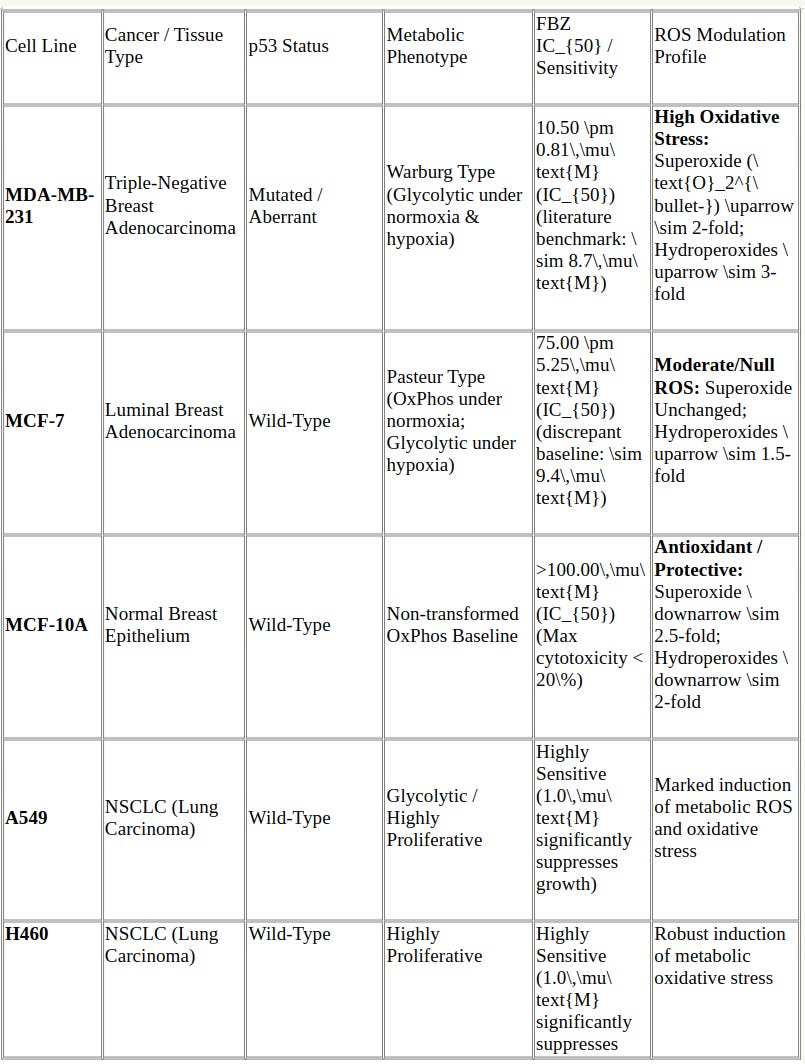
Comprehensive Cell Line Response Matrix
The table below synthesizes empirical parameters, sensitivity profiles, genomic status, and redox modulation characteristics across tested cell line models evaluated under
Warburg vs. Pasteur Phenotypes and Selective Redox Modulation
Differential sensitivity to FBZ among breast model systems demonstrates a clear relationship between baseline bioenergetic wiring and intracellular redox fate:
Warburg-Type Vulnerability (MDA-MB-231): Aggressive, triple-negative MDA-MB-231 cells rely predominantly on glycolytic flux regardless of oxygen tension. Treatment with 10\,\mu\text{M} FBZ for 48 hours induces strong intracellular oxidative stress. Dihydroethidium (DHE) assays demonstrate a \sim 2-fold increase in cytosolic superoxide (\text{O}_2^{\bullet-}), while DCFH-DA assays show a \sim 3-fold elevation in hydroperoxides. This sudden surge in reactive oxygen species (ROS) overwhelms the cell’s antioxidant capacity, exceeding the redox homeostatic threshold required to trigger apoptosis (IC_{50} = 10.50 \pm 0.81\,\mu\text{M}).
Pasteur-Type Resilience (MCF-7): Luminal MCF-7 cells exhibit bioenergetic flexibility, maintaining mitochondrial oxidative phosphorylation under normoxia and shifting to glycolysis only under hypoxic challenge. Exposure to 10\,\mu\text{M} FBZ produces no detectable change in superoxide levels and yields only a mild \sim 1.5-fold increase in hydroperoxides. Consequently, these cells tolerate higher concentrations of the drug, displaying an IC_{50} of 75.00 \pm 5.25\,\mu\text{M}.
Normal Cell Protective Mechanism (MCF-10A): In non-transformed MCF-10A epithelial cells, FBZ displays a paradoxical antioxidant and protective profile. Because these non-malignant cells maintain balanced mitochondrial respiration without hyper-activated upper glycolysis, FBZ treatment does not induce mitochondrial stress or outer membrane permeabilization. Instead, 10\,\mu\text{M} FBZ exposure decreases superoxide levels by \sim 2.5-fold and reduces hydroperoxides by \sim 2-fold relative to untreated controls by fine-tuning cellular reductive equivalents. While FBZ mildly suppresses MCF-10A proliferation, it does not induce direct cytotoxicity, producing an IC_{50} > 100.00\,\mu\text{M} (with maximum recorded cell death remaining below 20\%).
Role of p53 Status and Mitotic Arrest Dynamics
The apoptotic efficacy of FBZ is heavily governed by the functional status of the p53 gene product:
p53 Genomic Dependency: Non-small cell lung carcinoma cells expressing functional wild-type p53 (A549, H460) experience rapid growth inhibition and apoptotic entry when exposed to 1.0\,\mu\text{M} FBZ. In contrast, p53-null (H1299) and p53-mutant (H522) lines show minimal growth suppression at the same concentration. Transfection and transient expression of wild-type p53 into p53-null H1299 cells fully restores sensitivity to FBZ-induced apoptosis, establishing wild-type p53 as an important mediator of FBZ toxicity.
Mitotic Arrest Kinetics: Synchronized A549 cells exposed to FBZ display early elevation of Cyclin B1 and CDK1 protein complexes—detectable as early as 8 hours post-treatment, compared to 16 hours in untreated controls. This is accompanied by elevated levels of phosphorylated Histone H3 at Serine-10 [p-Histone H3 (Ser10)], a marker of active mitotic entry, at 12 and 24 hours.
Caspase-Independent Mitotic Death: Prolonged arrest at the G_2/M transition forces cells into mitotic exit without completing cytokinesis. Unlike colchicine, which causes mitotic slip into an 8N polyploidy state, FBZ triggers direct mitotic cell death without polyploid intermediate formation. Furthermore, this apoptotic cascade is not blocked by the broad-spectrum pan-caspase inhibitor Z-VAD-FMK, confirming that FBZ can initiate caspase-independent mitotic cell death.
Efflux Pump Independence and MDR Compatibility
A key factor limiting traditional tubulin-binding drugs (such as taxanes and vinca alkaloids) is their susceptibility to multidrug resistance (MDR) mediated by ATP-binding cassette (ABC) efflux transporters, particularly P-glycoprotein (P-gp / MDR1).
Rhodamine 123 Transport Assays: Intracellular accumulation assays using Rhodamine 123 (Rho123), a standard fluorescent substrate for P-gp efflux, show identical retention kinetics in untreated control cells and FBZ-treated cells.
Verapamil Potentiation: Pharmacological blockade of P-gp using verapamil fails to increase intracellular Rho123 fluorescence or enhance FBZ-mediated cytotoxicity in A549 and H460 models.
Therapeutic Implications: These experimental data demonstrate that FBZ is neither a substrate nor an inhibitor of P-gp. As a result, FBZ maintains cytotoxic potency in multidrug-resistant tumor models that readily efflux established chemotherapeutic drugs.
Section Transition
Because cellular sensitivity to FBZ is dictated by baseline metabolic wiring, functional p53 signaling, and P-gp independence, rational drug combinations can leverage these mechanisms to achieve dual bioenergetic collapse and overcome adaptive cell survival strategies.
3. Synergistic Metabolic Combinations: FBZ, Dichloroacetate (DCA), and 2-Deoxyglucose (2DG)
Context & Strategic Importance
Malignant cells frequently adapt to single-agent metabolic therapies by shifting flux through alternative bioenergetic pathways. To prevent compensatory survival adaptations, combining upper glycolytic inhibitors with mitochondrial pyruvate flux modulators and FBZ creates a multi-point metabolic blockade, driving tumor cells toward complete energetic failure.
Mechanistic Synergy with Dichloroacetate (DCA)
Dichloroacetate (DCA) is a selective inhibitor of pyruvate dehydrogenase kinase (PDK). By suppressing PDK, DCA maintains the pyruvate dehydrogenase (PDH) complex in an active, unphosphorylated state. This forces cytosolic pyruvate into the mitochondria, promoting pyruvate conversion to acetyl-CoA and increasing oxidative metabolism over lactic acid fermentation.
Orthogonal Bioenergetic Collapse: Combining DCA with FBZ creates opposing metabolic forces within the cell. While DCA forces cells to rely on mitochondrial glucose oxidation, FBZ simultaneously downregulates GLUT-4, represses HKII expression, and directly blocks the catalytic activity of HKII. Forced flux into mitochondrial respiration during concurrent HKII blockade leads to rapid intracellular ATP depletion and severe metabolic stress.
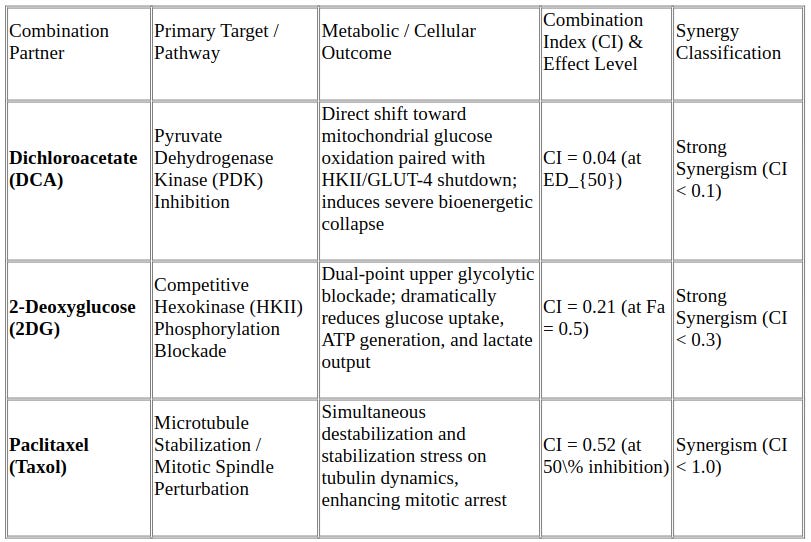
Quantitative Synergy Metrics: Formal iso-bologram and Combination Index (CI) analyses using the Chou-Talalay method reveal strong synergism for the FBZ + DCA combination, yielding a Combination Index of CI = 0.04 at the 50\% effective dose (ED_{50}). Because a CI < 1.0 reflects synergistic interaction (with CI < 0.1 indicating strong synergism), this combination demonstrates potent bioenergetic synergy.
Mechanistic Synergy with 2-Deoxyglucose (2DG)
2-Deoxyglucose (2DG) is a synthetic glucose analog that competitively inhibits upper glycolysis. Upon entering cells via GLUT transporters, 2DG is phosphorylated by hexokinase into 2-deoxyglucose-6-phosphate (2-DG-6-P). Unlike G6P, 2-DG-6-P cannot be processed by phosphoglucose isomerase, accumulating intracellularly and competitively inhibiting HKII.
Dual-Point Upper Glycolytic Blockade: Co-administration of 2DG and FBZ creates a dual inhibition mechanism targeting hexokinase. While 2DG competes directly with endogenous glucose for phosphorylation, FBZ occupies the catalytic pocket of HKII and represses its transcriptional expression. This dual-action blockade halts early glycolytic processing, leading to reduced ATP production and suppressed lactate efflux.
Quantitative Synergy Metrics: Quantitative interaction analysis confirms strong synergy between FBZ and 2DG at effective concentrations, yielding a Combination Index of CI = 0.21 at an affected fraction of Fa = 0.5.
Comparative Combination Metric Analysis
The table below summarizes quantitative synergy parameters, enzymatic targets, bioenergetic outcomes, and interaction classifications for FBZ paired with metabolic and microtubule-directed agents:
Section Transition
These robust preclinical combination metrics demonstrate clear in vitro synergistic efficacy. Examining how these multi-target metabolic mechanisms translate into whole-organism xenograft models and clinical self-administration protocols provides essential context for evaluating FBZ’s therapeutic potential.
4. Translational In Vivo Evidence and Clinical Case Synthesis
Context & Strategic Importance
Translating preclinical bioenergetic concepts into potential oncologic therapies requires evaluation in whole-organism tumor models and human case studies. Assessing oral bioavailability, systemic safety, tumor growth inhibition, and biomarker responses in these settings helps clarify the clinical viability of repurposed FBZ protocols.
Preclinical Xenograft Tumor Suppression
The in vivo therapeutic efficacy of oral FBZ was established using female athymic nu/nu mice bearing human A549 NSCLC xenografts (established tumor size 2\text{--}3\,\text{mm}).
Experimental Dosing Protocol: Tumored animals received oral FBZ at 1.0\,\text{mg/mouse} every second day for 12 days.
Tumor Volume and Weight Reduction: FBZ administration significantly reduced both gross tumor volume and total excised tumor mass compared with vehicle-treated controls.
Anti-Angiogenic Activity: We evaluated intratumoral vascularization spectrophotometrically by measuring hemoglobin content (A_{590\text{nm}}) and histologically by CD31 endothelial staining. FBZ-treated xenografts showed a marked decrease in hemoglobin content and reduced CD31-positive vessel density, demonstrating clear in vivo anti-angiogenic activity.
Intratumoral Apoptosis and p53 Induction: TUNEL staining revealed a high density of apoptotic cells in excised FBZ-treated tumor tissues. Immunohistochemical analyses confirmed increased intratumoral p53 expression, aligning with in vitro observations of p53-dependent apoptotic induction.
Clinical Real-World Translation (Case Series Analysis)
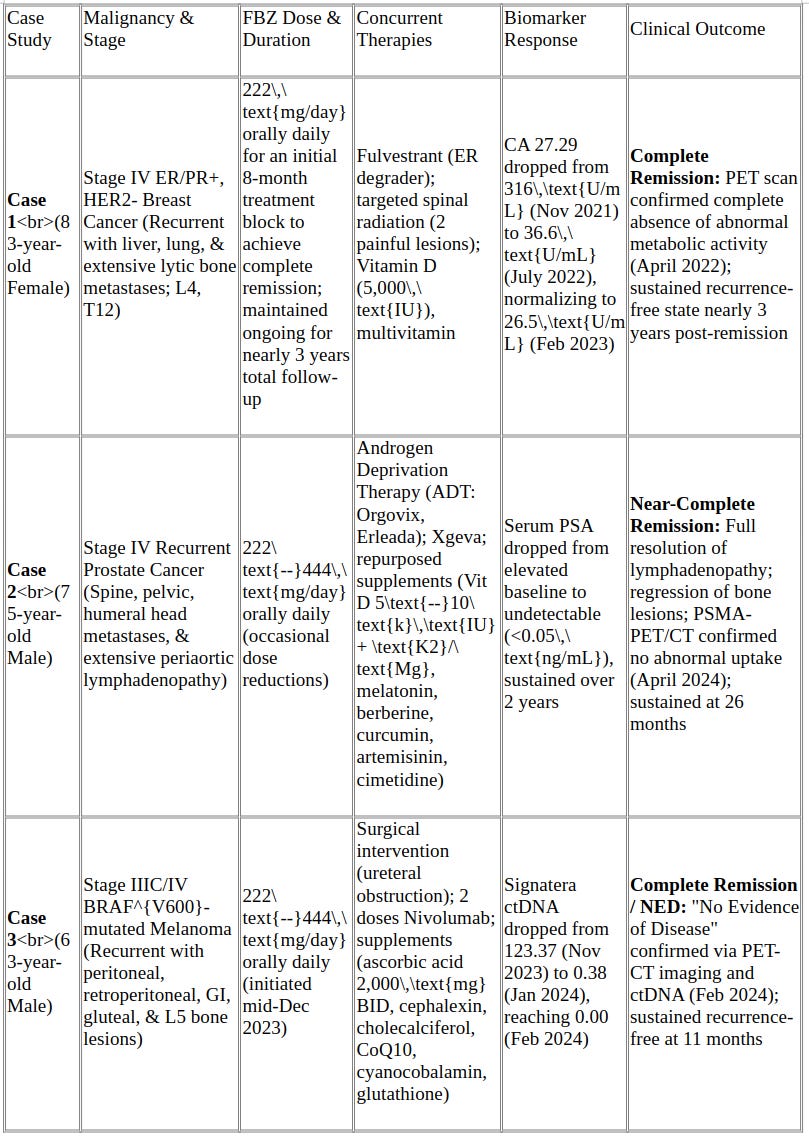
A clinical case series detailed advanced stage IV cancer patients who self-administered oral FBZ alongside their prescribed regimens (excluding conventional cytotoxic chemotherapy). The detailed clinical courses, biomarker dynamics, and follow-up metrics from these cases are summarized below:
Safety, Tolerability, and Methodological Limitations
Across both animal models and clinical self-administration reports, FBZ was generally well tolerated at oral doses ranging from 222\,\text{mg/day} to 444\,\text{mg/day}, without producing the systemic toxicities typical of conventional cytotoxic chemotherapy.
Hepatic Safety Profile: In Case 1, routine blood testing revealed transient elevations in serum liver transaminases (ALT and AST) in July 2022. However, these enzyme levels normalized within weeks without medical intervention. It remains unclear whether this transient hepatic stress resulted from FBZ, fulvestrant, or an interaction between the two compounds. Case 2 reported no hepatic transaminase elevations or other drug-related side effects over 26 months of continuous therapy.
Methodological Critique and Confounding Factors: While these clinical responses are encouraging, interpreting self-administered patient series requires careful analytical scrutiny:
Confounding Therapeutic Modalities: All three patients received potent concurrent anti-neoplastic treatments. Case 1 received Fulvestrant (a selective estrogen receptor degrader) and targeted spinal radiotherapy; Case 2 received dual androgen deprivation therapy (Orgovix + Erleada) along with bone-modifying Xgeva; Case 3 underwent surgical tumor debulking and received two doses of Nivolumab (an anti-PD-1 immune checkpoint inhibitor). Because these concurrent treatments can induce disease responses on their own, we cannot attribute complete remissions solely to FBZ monotherapy.
Observational Limitations: These data are limited by a small sample size (n=3), retrospective reporting, self-selection bias, and the absence of a control group.
Need for Formal Clinical Evaluation: Patient-initiated self-medication occurs outside regulated trial settings, where drug purity, optimal dosing, and systematic toxicity monitoring cannot be guaranteed. Standardized Phase I/II clinical trials are necessary to define FBZ pharmacokinetics, long-term safety, and single-agent efficacy in human oncology.
Section Transition Summary
Preclinical studies and real-world case reports suggest that Fenbendazole represents an intriguing candidate for drug repurposing in oncology. Its multi-target mechanism—combining tubulin destabilization, p53 activation, proteasomal inhibition, and direct glycolytic disruption—provides a strong biological rationale for formal clinical evaluation. Well-designed, prospective clinical trials remain essential to definitively assess its safety, quantify its therapeutic efficacy, and establish standardized combination protocols for advanced malignancies.
Sources:
Armando, R. G., Mengual Gómez, D. L., & Gomez, D. E. (2020). Drug repositioning in oncology: Benzimidazole derivatives. International Journal of Oncology, 56(3), 651–684. [suspicious link removed]
(Source files:Benzimidazole-derivatives.pdf&Benzimidazole-derivatives222.pdf)Dogra, N., Kumar, A., & Mukhopadhyay, T. (2018). Fenbendazole acts as a moderate microtubule destabilizing agent and causes cancer cell death by modulating multiple cellular pathways. Scientific Reports, 8(1), Article 11926. https://doi.org/10.1038/s41598-018-30158-6
(Source file:41598_2018_Article_30158.pdf)Ellison, A. (2026, July). Fenbendazole for lung cancer: Comprehensive research review 2026. Sanare Lab Science.
(Source:Fenbendazole for Lung Cancer: Research Review 2026)Hulscher, N., Victory, K., Thorp, J. A., Pinsky, D., Diaz-Villalobos, A., Gillooly, P., Coulson, F., Annazone, M., Radesi, C., Brooks, J., McCullough, P. A., & Risch, H. (2026). Real-world clinical outcomes of ivermectin and mebendazole in cancer patients: Results from a prospective observational cohort. Anticancer Research, 46(6), 3243–3255. [suspicious link removed]
(Source file:3243.full.pdf)Ioakeim-Skoufa, I., Tobajas-Ramos, N., Menditto, E., Aza-Pascual-Salcedo, M., Gimeno-Miguel, A., Orlando, V., González-Rubio, F., Fanlo-Villacampa, A., Lasala-Aza, C., Ostasz, E., & Vicente-Romero, J. (2023). Drug repurposing in oncology: A systematic review of randomized controlled clinical trials. Cancers, 15(11), Article 2972. [suspicious link removed]
(Source file:cancers-15-02972.pdf)OneDayMD Editorial Team. (2026, September). Ivermectin, fenbendazole, mebendazole, niclosamide and atovaquone for cancer: Evidence, science, clinical trials & safety (F. Yap, Med. Rev.). One Day MD’s Newsletter.
(Source:Fenbendazole and Ivermectin for Cancer: Real Stories, Science & Protocols (2025 Guide))Tang, M., Hu, X., Wang, Y., Yao, X., Zhang, W., Yu, C., Cheng, F., Li, J., & Fang, Q. (2021). Ivermectin, a potential anticancer drug derived from an antiparasitic drug. Pharmacological Research, 163, Article 105207. https://doi.org/10.1016/j.phrs.2020.105207
(Source file:1-s2.0-S1043661820315152-main.pdf)Thorat, M. A. (2025). Aspirin prevents metastasis by limiting platelet TXA2 suppression of T cell immunity. BJC Reports. https://doi.org/10.1038/S41586-025-08626-7
(Source file:44276_2025_Article_138.pdf)Wallis, B., Bowman, K. R., Lu, P., & Lim, C. S. (2023). The challenges and prospects of p53-based therapies in ovarian cancer. Biomolecules, 13(1), Article 159. [suspicious link removed]
(Source file:biomolecules-13-00159.pdf)