
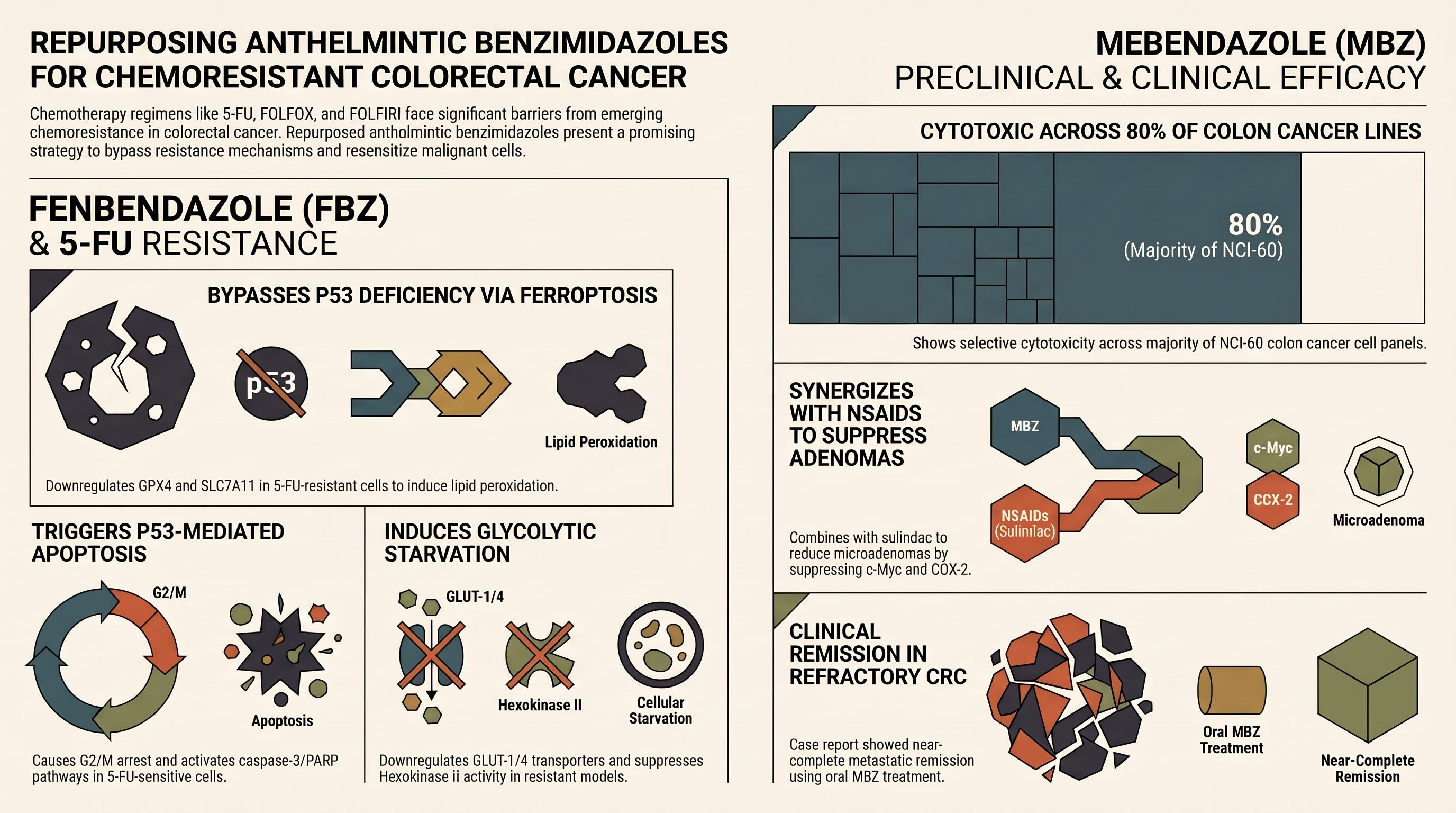
Chemotherapy is the cornerstone of systemic treatment for advanced and metastatic colorectal cancer (CRC). While standard first-line regimens significantly improve survival, chemoresistance remains the primary barrier to long-term cure. In response, research has increasingly focused on repurposed anthelmintic benzimidazoles (such as Fenbendazole, Mebendazole, and Albendazole) to resensitize refractory CRC cells and enhance conventional chemotherapy. This article discusses in vitro and in vivo preclinical testing (lab and animal).
1. Standard Chemotherapy Regimens & Chemoresistance
Standard-of-Care Regimens: Standard systemic chemotherapy for advanced CRC typically relies on fluoropyrimidine-based combinations, primarily 5-Fluorouracil (5-FU) combined with oxaliplatin (FOLFOX / FOLFOX4) or irinotecan (FOLFIRI), often administered alongside biological agents like bevacizumab (anti-VEGF).
Mechanisms of Resistance: Malignant colon cells frequently develop resistance to 5-FU, oxaliplatin, and irinotecan. Chemoresistance is driven by genetic mutations (such as p53 loss or mutation), altered MAPK/p38 signaling pathways, upregulation of anti-apoptotic proteins, and multidrug resistance efflux pumps.
2. Fenbendazole (FBZ) & Overcoming 5-FU Resistance
Fenbendazole has emerged as a promising agent for targeting chemoresistant CRC cells due to its distinct mechanisms in wild-type versus resistant lines:
p53-Mediated Apoptosis in Sensitive CRC: In 5-FU-sensitive cells (SNU-C5), FBZ causes G2/M phase cell cycle arrest and activates wild-type p53. This triggers mitochondrial membrane depolarization, cytochrome c release, and activation of the caspase-3/PARP apoptotic pathway.
p53-Independent Apoptosis & Ferroptosis in 5-FU-Resistant CRC: In 5-FU-resistant cells (SNU-C5/5-FUR), FBZ bypasses p53 deficiency. It induces cell death without altering p53 expression by downregulating GPX4 (glutathione peroxidase 4) and SLC7A11 (a key component of system xc−), driving iron-dependent lipid peroxidation (ferroptosis) and ferroptosis-augmented apoptosis.
Glycolytic Starvation: Because 5-FU-resistant CRC cells rely heavily on accelerated glycolysis, FBZ’s ability to downregulate GLUT-1/4 transporters and suppress Hexokinase II (HK II) activity gives it an advantage over other benzimidazoles in glycolytic CRC models.
3. Mebendazole (MBZ) as a Repurposed Adjuvant
Mebendazole has demonstrated significant preclinical and clinical activity in colorectal cancer models:
In vitro & Preclinical Synergy: MBZ shows selective cytotoxicity in 80% of colon cancer cell lines in the NCI-60 panel. In ApcMin/+ mouse models of familial adenomatous polyposis (FAP), combining MBZ with non-steroidal anti-inflammatory drugs (e.g., sulindac) significantly reduced the number and size of intestinal microadenomas by suppressing c-Myc, COX-2, and pro-tumorigenic cytokines.
Clinical Evidence & Remission: A documented case report revealed that a 74-year-old patient with refractory metastatic colon cancer achieved near-complete remission of lung and lymph node metastases and partial remission of liver metastases after receiving oral MBZ (100 mg b.i.d.).
Clinical Trial Evaluations: MBZ has progressed into formal clinical studies (including Phase 3 trials such as NCT03925662 and randomized evaluations), assessing the incremental benefit of adding MBZ (500 mg b.i.d.) to standard FOLFOX4 + bevacizumab chemotherapy in stage IV CRC patients.
4. Albendazole, Flubendazole & Other Anthelmintics
Albendazole (ABZ): Inhibits proliferation and induces cytostatic effects in CRC lines (HT-29, SW480, Caco2), suppressing tumor growth in peritoneal carcinomatosis models. Combining ABZ with agents such as paclitaxel or 2-methoxyestradiol further improves survival in tumor-bearing models.
Flubendazole (FLBZ): Alters cyclin B1 and D1 levels, impairs NF-κB phosphorylation, and downregulates key adhesion/metastatic markers (ICAM-1, EpCAM, integrins α5/β1), thereby blocking colon cancer migration and invasion.
Targeted Non-Benzimidazoles: Other antiparasitic drugs target CRC pathways—Rafoxanide selectively induces ER stress and inhibits mutated BRAF V600E CRC cells; Nitazoxanide inhibits Wnt/β-catenin signaling and synergizes with irinotecan; and Ivermectin suppresses colon cancer stem cell self-renewal by blocking Wnt/TCF signaling.
References
Di Grazia, A., Laudisi, F., Di Fusco, D., Franzè, E., Ortenzi, A., Monteleone, I., Monteleone, G., & Stolfi, C. (2020). Rafoxanide induces immunogenic death of colorectal cancer cells. Cancers, 12(5), Article 1314.
Hanušová, V., Skálová, L., Králová, V., & Matoušková, P. (2018). The effect of flubendazole on adhesion and migration in SW480 and SW620 colon cancer cells. Anti-Cancer Agents in Medicinal Chemistry, 18(6), 837–846.
Hegazy, S. K., El-Azab, G. A., Zakaria, F., Mostafa, M. F., & El-Ghoneimy, R. A. (2022). Mebendazole; from an anti-parasitic drug to a promising candidate for drug repurposing in colorectal cancer. Life Sciences, 297, Article 120536.
Králová, V., Hanušová, V., Rudolf, E., Čáňová, K., & Skálová, L. (2016). Flubendazole induces mitotic catastrophe and senescence in colon cancer cells in vitro. Journal of Pharmacy and Pharmacology, 68(2), 208–218.
Laudisi, F., Marônek, M., Di Grazia, A., Monteleone, G., & Stolfi, C. (2020). Repositioning of anthelmintic drugs for the treatment of cancers of the digestive system. International Journal of Molecular Sciences, 21(14), Article 4957.
Nguyen, J., Nguyen, T. Q., Han, B., & Hoang, B. X. (2024). Oral fenbendazole for cancer therapy in humans and animals. Anticancer Research, 44(9), 3725–3735.
Nygren, P., Fryknäs, M., Ågerup, B., & Larsson, R. (2013). Repositioning of the anthelmintic drug mebendazole for the treatment for colon cancer. Journal of Cancer Research and Clinical Oncology, 139(12), 2133–2140. https://doi.org/10.1007/s00432-013-1539-5
Park, D., Lee, J.-H., & Yoon, S.-P. (2022). Anti-cancer effects of fenbendazole on 5-fluorouracil-resistant colorectal cancer cells. Korean Journal of Physiology & Pharmacology, 26(5), 377–387. https://doi.org/10.4196/kjpp.2022.26.5.377
Pourgholami, M. H., Akhter, J., Wang, L., Lu, Y., & Morris, D. L. (2005). Antitumor activity of albendazole against the human colorectal cancer cell line HT-29: In vitro and in a xenograft model of peritoneal carcinomatosis. Cancer Chemotherapy and Pharmacology, 55(5), 425–432.
Son, D.-S., Lee, E.-S., & Adunyah, S. E. (2020). The antitumogenicity of benzimidazole anthelmintics. Immune Network, 20(4), Article e29. https://doi.org/10.4110/in.2020.20.e29
Williamson, T., Bai, R.-Y., Staedtke, V., Huso, D., & Riggins, G. J. (2016). Mebendazole and a non-steroidal anti-inflammatory combine to reduce tumor initiation in a colon cancer preclinical model. Oncotarget, 7(42), 68571–68584.