

1. Strategic Rationale for Mebendazole Repurposing
The strategic repurposing of mebendazole (MBZ) from a broad-spectrum anthelmintic to an oncological candidate is predicated on its role as a multi-modal biologic adjunct. Rather than serving as a replacement for standard cytotoxic or targeted therapies, MBZ’s value lies in its potential as a chemosensitizer that exploits distinct vulnerabilities in the tumor microenvironment. Its profile as a microtubule-disrupting agent—historically used to disrupt helminthic structural integrity—offers a low-toxicity mechanism to enhance the efficacy of established regimens such as FOLFOX or bevacizumab.
The mechanistic foundations for mebendazole’s application in oncology include:
Microtubule Inhibition: Interference with tubulin polymerization, leading to mitotic arrest and apoptosis in rapidly dividing malignant cells.
Metabolic Interference: Inhibition of glucose uptake, effectively targeting the high glycolytic demands characteristic of the Warburg effect.
Oncogenic Signaling Modulation: Suppression of key survival pathways that drive tumor progression and resistance to standard care.
This transition from antiparasitic use to oncology requires a fundamental shift in framing; MBZ is now viewed as a “chemosensitizer” that potentially lowers the threshold for cell death when used in combination. However, the success of this transition depends heavily on translating biological rationale into indication-specific performance, a challenge underscored by the current divergence in adult clinical trial outcomes.
2. Adult Clinical Trial Outcomes: Efficacy and Response Benchmarks
Clinical outcomes in adult populations demonstrate a sharp divide between gastrointestinal and central nervous system (CNS) indications. While metastatic colorectal cancer (mCRC) has yielded a robust efficacy signal, glioblastoma trials highlight the clinical failure to translate early-phase signals into a definitive survival benefit, likely due to the drug’s inability to consistently cross the blood-brain barrier (BBB) at therapeutic concentrations.
Metastatic Colorectal Cancer (NCT03925662) Analysis
The NCT03925662 trial represents the most significant efficacy signal to date. This prospective, randomized study evaluated MBZ as an adjunct to bevacizumab and FOLFOX4.
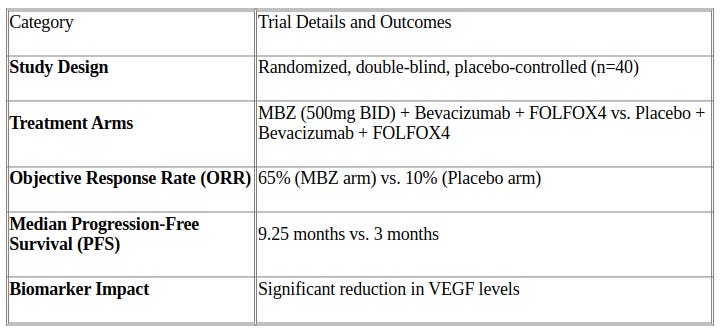
While the 65% ORR is statistically striking, a senior clinical appraisal must note the small sample size (n=40) as a significant caveat. Nevertheless, the concomitant reduction in VEGF provides mechanistic proof of concept for MBZ’s role in enhancing the anti-angiogenic effects of bevacizumab.
Recurrent Glioblastoma (CTRI/2018/01/011542) Evaluation
In contrast, the Phase II trial in recurrent glioblastoma (88 patients) failed to meet its prespecified 9-month overall survival (OS) benchmark of 55%. Despite median PFS figures of 4.1–4.3 months, which appear promising in a recurrent setting, the drug did not provide the necessary survival “tail.” This underscores a critical pharmacological limitation: the failure to maintain sustained therapeutic thresholds in the CNS. Notably, however, three patients completed 12 full cycles of TMZ-MBZ, providing evidence of long-term tolerability even if the efficacy benchmark remained elusive.
The “strong efficacy signal” in colorectal cancer stands in stark contrast to the “negative” survival results in glioblastoma, suggesting that MBZ’s performance is highly indication-specific. Therefore, the focus must shift to understanding the unique dosing and safety thresholds observed in pediatric populations, where extreme dose escalation has been explored.
3. Pediatric Oncology Experiences: Monotherapy vs. Combination Strategies
Pediatric phase I studies have been instrumental in establishing high-dose safety thresholds, proving that the pediatric population can tolerate doses that far exceed traditional anthelmintic protocols.
Monotherapy Assessment (NCT01837862)
In a dose-escalation study of 17 patients with recurrent or refractory brain tumors (including DIPG and HGG), researchers established a staggering dose ceiling of 2500 mg/m²/day. This represents an extreme escalation compared with standard antiparasitic dosing; yet, single-agent efficacy was negligible, with a median PFS of only 7.6 weeks. This confirms that MBZ lacks sufficient potency to function as a monotherapy in aggressive CNS malignancies.
High-Grade Glioma (HGG) Combination Therapy
The superiority of combination regimens is evidenced by a separate Phase I study involving MBZ, bevacizumab, and irinotecan:
Dose-limiting toxicity (DLT) status: None reported, even at doses up to 200 mg/kg/day.
ORR: 33%, featuring two partial responses and one durable complete response.
Survival metrics: Mean PFS of 4.7 months and Mean OS of 11.4 months.
The discrepancy between the 33% ORR in combination and the near-zero response in monotherapy suggests that MBZ’s value in pediatric CNS tumors is strictly adjunctive. Because monotherapy efficacy is virtually non-existent in these settings, the clinical focus must pivot to the underlying pharmacokinetic (PK) limitations that currently hinder therapeutic success.
4. Pharmacokinetic (PK) Challenges and Formulation Strategies
The translation of mebendazole to the oncology clinic is fundamentally obstructed by its abysmal oral bioavailability. For oncology applications, systemic exposure requirements are orders of magnitude higher than those for treating luminal parasites, yet current delivery methods remain inadequate.
Barriers to Exposure
Mebendazole’s PK profile is defined by:
Poor GI Absorption and First-Pass Metabolism: Inherent insolubility and rapid hepatic degradation limit systemic reach.
The “Food Effect”: A mandatory requirement for fatty meals to facilitate absorption complicates patient compliance and leads to erratic dosing.
Long-term Exposure Decay: Critically, evidence indicates that plasma concentrations actually decrease over long-term continuous administration in compliant patients, suggesting potential auto-induction of metabolism or other compensatory clearance mechanisms.
The Liver Metastasis Paradox: Interestingly, liver metastases may increase drug concentrations by reducing the liver’s first-pass metabolic capacity, effectively narrowing the therapeutic window in a counterintuitive way.
Formulation Innovation and Critique
Preclinical models using HP-beta-cyclodextrin complexation in dogs have shown significant increases in solubility and exposure. However, we are currently “flying blind” in human oncology; many high-dose reports provide no PK measurements. The lack of robust human PK data represents a significant barrier to establishing a clear exposure-response relationship, leaving clinicians to guess whether failures are due to the drug’s mechanism or simply a failure of delivery.
This chronic lack of pharmacokinetic proof directly influences the safety profile, as we must rely on clinical observation of hepatic function to navigate these absorption challenges.
5. Safety, Tolerability, and Hepatic Monitoring
Mebendazole is remarkably well tolerated compared with traditional cytotoxic agents, supporting its role as a low-toxicity adjunct in long-term treatment designs.
Adverse Event Profile
Toxicities are generally manageable but vary by regimen:
Combination Therapies: Higher incidence of hematologic stressors, including neutropenia and lymphopenia.
Monotherapy: Primarily mild gastrointestinal distress and transient hematologic shifts.
Hepatic Toxicity Warning
The liver is the primary site of first-pass metabolism, making hepatic monitoring a clinical necessity. In the adult glioblastoma trial, one patient discontinued treatment because of prolonged abnormalities in AST, ALT, and bilirubin levels. Given that liver metastases can alter systemic exposure by reducing first-pass metabolism, regular laboratory monitoring is essential to distinguish between disease progression and drug-induced liver injury.
These safety findings support mebendazole’s role as a manageable adjunct, but only if clinicians remain vigilant regarding the hepatic complexities inherent in its metabolism.
6. Conclusion and Future Clinical Directions
The landscape of mebendazole repurposing is characterized by a drug at a crossroads. While its safety profile and mechanistic rationale as a chemosensitizer are robust, its clinical journey is currently hampered by uneven efficacy and a lack of pharmacological oversight.
To move the needle, the following research imperatives are mandatory:
Prioritize Large-Scale Controlled Trials in mCRC: The “High” confidence efficacy signal in colorectal cancer must be validated in larger cohorts to account for the small sample size of current data.
Implement PK-Guided Trial Designs: Future trials must stop “flying blind” and incorporate mandatory PK monitoring to address the food effect and the observed decrease in plasma levels over time.
Mandatory Shift to Advanced Formulations: We must move beyond simple dose escalation of standard tablets—which has already hit a pediatric ceiling of 2500 mg/m²/day without curative effect—and transition to cyclodextrin-based or other improved delivery systems.
Ultimately, we must align clinical outcomes with pharmacokinetic proof. Until we can guarantee therapeutic exposure, MBZ’s true potential as an oncology adjunct will remain speculative.
Preclinical evidence
Beyond the clinical (human) evidence presented above, preclinical evidence (cell and animal studies) shows anticancer responses and/or longer survival in these cancer types:
Adrenocortical carcinoma
Advanced cancer
Brain and nervous system cancer
Breast cancer, including triple-negative breast cancer
Colorectal cancer
Gallbladder cancer (cholangiocarcinoma)
Head and neck squamous cell carcinoma
Intestinal cancer
Leukemia
Liver cancer
Lung cancer
Melanoma
Oral squamous carcinoma
Ovarian cancer
Pancreatic cancer
Peritoneal cancer
Stomach (gastric) cancer
Thyroid cancer
Sources:
C., Ding, Charles (Keck School of Medicine of USC, United States), Y., Ding, Yili (Department of Chemistry, China), Z., Xu, Zhe (Mathematics and Technology, China), P., Wang, Peini (Mathematics and Technology, China), & S., Xu, Shufeng (Department of Life Science, China). (2025). Preparation and pharmacokinetic study of mebendazole complex with HP-beta-cyclodextrin. Frontiers in Veterinary Science, 12. https://doi.org/10.3389/fvets.2025.1611154
C.B., Blum, Ciara B. (School of Medicine and Dentistry, Australia), M., McMenamin, Milli (School of Medicine and Dentistry, Australia), T., Khoo, Tessa (School of Medicine and Dentistry, Australia), P., Jose, Prathibha (Faculty of Health Sciences & Medicine, Australia), & L.A., O’Callaghan, Liam A. (Faculty of Health Sciences & Medicine, Australia). (2026). From anthelmintic to neuro-oncology: A systematic review of mebendazole repurposing for brain tumour therapy. British Journal of Clinical Pharmacology. https://doi.org/10.1002/bcp.70565
J.I., Krystal, Julie I. (Division of Pediatrics Hematology/Oncology, United States), D.R., Hanson, Derek R. (Hackensack University Medical Center, United States), D., Donnelly, Danielle (Division of Pediatric Hematology-Oncology and Stem Cell Transplant, United States), & M.P., Atlas, Mark P. (Northwell Health System, United States). (2024). A phase 1 study of mebendazole with bevacizumab and irinotecan in high-grade gliomas. Pediatric Blood and Cancer, 71(4). https://doi.org/10.1002/pbc.30874
P., Mukherjee, Purna (Department of Biology, United States), J., Maurer, Jack (Department of Biology, United States), S.A., Stopka, Sylwia A. (Department of Neurosurgery, United States), M.A., Kiebish, Michael A. (BPGbio, United States), & T.N., Seyfried, Thomas N. (Department of Biology, United States). (2026). Ketogenic diet as a metabolic vehicle enhancing the therapeutic efficacy of mebendazole and devimistat in juvenile syngeneic high-grade glioma. Cell Reports Medicine, 7(6). https://doi.org/10.1016/j.xcrm.2026.102845
P., Phan, Paul (Department of Surgery, United States), S.L., Stapleton, Stacie L. (Johns Hopkins All Children’s Hospital, United States), G.J., Riggins, Gregory Joseph (Department of Oncology, United States), E.H., Raabe, Eric H. (Department of Oncology, United States), & K.J., Cohen, Kenneth J. (Department of Pediatrics, United States). (2025). Phase 1 study of mebendazole therapy for refractory/progressive or recurrent pediatric brain tumors. Neuro-Oncology Practice, 12(6), 1092–1098. https://doi.org/10.1093/nop/npaf060
S., Pournajaf, Safura (Hearing Disorders Research Center, Iran), M.H., Pourgholami, M. H. (Tarbiat Modares University, Iran), & D.L., Morris, David Lawson (St George Hospital, Australia). (2026). Repurposing monepantel in oncology: A conceptual mini-review of proposed mechanisms. Biomedicine and Pharmacotherapy, 200. https://doi.org/10.1016/j.biopha.2026.119528
S.K., Hegazy, Sahar Kamal (Tanta University, Egypt), G.A., El-Azab, Gamal A. (Department of Clinical Pharmacy, Egypt), F., Zakaria, Fatma (Department of Medical Oncology, Egypt), M.F., Mostafa, Mohamed Farouk (Faculty of Medicine, Egypt), & R.A., El-Ghoneimy, Reham A. (Clinical Pharmacy Department, Egypt). (2022). Mebendazole; from an anti-parasitic drug to a promising candidate for drug repurposing in colorectal cancer. Life Sciences, 299. https://doi.org/10.1016/j.lfs.2022.120536
V.M., Patil, Vijay Maruti (SunAct Cancer Institute Private Limited, India), N.S., Menon, Nandini Sharrel (Department of Medical Oncology, India), A., Chatterjee, Abhishek (Homi Bhabha National Institute, India), S.D., Banavali, Shripad Dinanath (Tata Memorial Hospital, India), & R., Jalali, Rakesh (Department of Radiation Oncology, India). (2022). Mebendazole plus lomustine or temozolomide in patients with recurrent glioblastoma: A randomised open-label phase II trial. eClinicalMedicine, 49. https://doi.org/10.1016/j.eclinm.2022.101449