

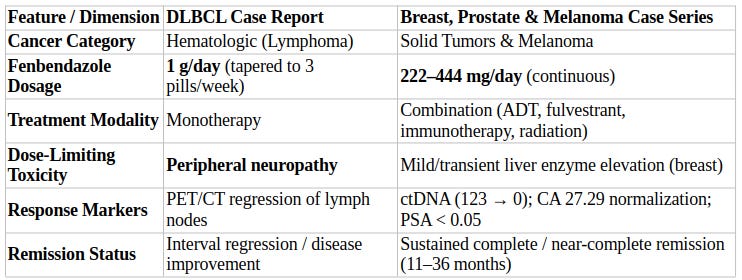
Comparing the Stage IVa Diffuse Large B-Cell Lymphoma (DLBCL) case report with the three-patient solid tumor case series (breast, prostate, and melanoma) reveals key differences in disease type, dosing regimens, concomitant therapies, side-effect profiles, and overall response durability:
1. Malignancy Type & Staging
DLBCL Case: A hematologic (blood/lymphoid) malignancy presenting as aggressive Stage IVa DLBCL involving duodenal, gastric, peri-aortic lymph node, and pulmonary hypermetabolic lesions.
Case Series: Solid organ carcinomas and melanoma, all presenting as Stage IV metastatic disease:
Breast Cancer: Recurrent ER+/PR+ metastatic breast adenocarcinoma with extensive bone, liver, and lung metastases.
Prostate Cancer: Recurrent metastatic prostate adenocarcinoma involving bone and periaortic lymph nodes.
Melanoma: Recurrent BRAF-V600 mutated melanoma with abdominal, muscle, bone, and ureteral metastases.
2. Monotherapy vs. Concomitant Standard Therapies
DLBCL Case (Monotherapy Model): The patient declined conventional chemotherapy due to toxicity concerns and initiated Fenbendazole as a stand-alone monotherapy.
Case Series (Multimodal Combination Model): None of the three solid tumor cases used Fenbendazole strictly as a sole treatment:
Breast Cancer: Combined Fenbendazole with fulvestrant (estrogen receptor antagonist), targeted palliative spinal radiation, and vitamin supplements.
Prostate Cancer: Combined Fenbendazole with Androgen Deprivation Therapy (ADT) (Orgovix + Erleada), bone protection (Xgeva), and an extensive supplement regimen.
Melanoma: Combined Fenbendazole with localized surgical resection of a ureteral lesion, regular supplements, and two doses of nivolumab (anti-PD-1 immunotherapy).
3. Dosing Schedules & Dose-Limiting Toxicity
DLBCL Case (High Dose → Neuropathy Taper):
Initiated at a high dose of 1 g/day (fluctuating between 1 and 6 tablets daily).
Developed dose-limiting peripheral neuropathy at 6 months, requiring a dose reduction to 1–3 tablets daily and eventually tapering to a maintenance schedule of 3 pills weekly.
Case Series (Low/Moderate Continuous Dosing):
Utilized lower, continuous daily schedules of 222 mg/day (breast) or 222–444 mg/day (prostate and melanoma).
Tolerability: These lower levels did not cause high-dose peripheral neuropathy. The breast cancer patient experienced a transient, self-limiting elevation in liver transaminases (ALT/AST), which normalized within weeks.
4. Disease Remission & Marker Tracking
DLBCL Case: Serial PET/CT scans over 12 months demonstrated progressive, interval regression of lymphadenopathy and hypermetabolic lesions without new disease sites.
Case Series: Achieved complete or near-complete metabolic remissions confirmed by imaging and objective circulating tumor biomarkers:
Breast: Achieved complete remission (”no evidence of disease”), with CA 27.29 tumor markers falling from 316 to 26.5.
Prostate: Achieved a near-complete response, with PSA levels remaining undetectable (<0.05 ng/mL) for over 26 months.
Melanoma: Achieved complete remission (”no evidence of disease”), with circulating tumor DNA (Signatera ctDNA) dropping from 123.37 to 0.
Summary Comparison Table
References
Abughanimeh, O., Evans, T., & Kallam, A. (2020). Fenbendazole as a treatment for diffuse large B-cell lymphoma. Annals of Hematology & Oncology, 7(2), Article 1284.
Bai, R.-Y., Staedtke, V., Aprhys, C. M., Gallia, G. L., & Riggins, G. J. (2011). Antiparasitic mebendazole shows survival benefit in 2 preclinical models of glioblastoma multiforme. Neuro-Oncology, 13(9), 974–982. https://doi.org/10.1093/neuonc/nor077
Bai, R.-Y., Staedtke, V., Rudin, C. M., Bunz, F., & Riggins, G. J. (2015). Effective treatment of diverse medulloblastoma models with mebendazole and its impact on tumor angiogenesis. Neuro-Oncology, 17(4), 545–554.
Bai, R.-Y., Staedtke, V., Wanjiku, T., Rudek, M. A., Joshi, A., Gallia, G. L., & Riggins, G. J. (2015). Brain penetration and efficacy of different mebendazole polymorphs in a mouse brain tumor model. Clinical Cancer Research, 21(15), 3462–3470. https://doi.org/10.1158/1078-0432.CCR-14-2681
Bieging, K. T., & Attardi, L. D. (2012). Deconstructing p53 transcriptional networks in tumor suppression. Trends in Cell Biology, 22(2), 97–106.
de la Torre-Iglesias, P. M., García-Rodriguez, J. J., Torrado, G., Torrado, S., Torrado-Santiago, S., & Bolás-Fernández, F. (2014). Enhanced bioavailability and anthelmintic efficacy of mebendazole in redispersible microparticles with low-substituted hydroxypropylcellulose. Drug Design, Development and Therapy, 8, 1467–1479.
De Witt, M., Gamble, A., Hanson, D., Markowitz, D., Powell, C., Al-Ahmadie, H. A., & Symons, M. (2017). Repurposing mebendazole as a replacement for vincristine for the treatment of brain tumors. Molecular Medicine, 23, 50–56.
Di Grazia, A., Laudisi, F., Di Fusco, D., Franzè, E., Ortenzi, A., Monteleone, I., Monteleone, G., & Stolfi, C. (2020). Rafoxanide induces immunogenic death of colorectal cancer cells. Cancers, 12(5), Article 1314.
Ding, Y., Zhang, Z., Ding, C., Xu, S., & Xu, Z. (2024). Preparation and evaluation of fenbendazole methyl-β-cyclodextrin inclusion complexes. BMC Veterinary Research, 20(1), Article 214.
Dogra, N., Kumar, A., & Mukhopadhyay, T. (2018). Fenbendazole acts as a moderate microtubule destabilizing agent and causes cancer cell death by modulating multiple cellular pathways. Scientific Reports, 8(1), Article 11926. https://doi.org/10.1038/s41598-018-30158-6
Duan, Q., Liu, Y., & Rockwell, S. (2013). Fenbendazole as a potential anticancer drug. Anticancer Research, 33(2), 355–362.
Freisleben, F., Modemann, F., Muschhammer, J., Stamm, H., Brauneck, F., Krispien, A., Bokemeyer, C., Kirschner, K. N., Wellbrock, J., & Fiedler, W. (2021). Mebendazole mediates proteasomal degradation of GLI transcription factors in acute myeloid leukemia. International Journal of Molecular Sciences, 22(19), Article 10670. [suspicious link removed]
Gao, P., Dang, C. V., & Watson, J. (2008). Unexpected antitumorigenic effect of fenbendazole when combined with supplementary vitamins. Journal of the American Association for Laboratory Animal Science, 47(6), 37–40.
Garona, J., Pifano, M., Scursoni, A. M., Gomez, D. E., Alonso, D. F., & Ripoll, G. V. (2020). Repurposing of anthelmintic and antiparasitic drugs in oncology. International Journal of Oncology, 56(3), 651–680.
Golla, U., Patel, S., Shah, N., Talamo, S., Bhalodia, R., Claxton, D., Dovat, S., & Sharma, A. (2024). From deworming to cancer therapy: Benzimidazoles in hematological malignancies. Cancers, 16(19), Article 3454.
Guerini, A. E., Triggiani, L., Maddalo, M., Bonù, M. L., Frassine, F., Baiguini, A., Alghisi, A., Tomasini, D., Borghetti, P., Pasinetti, N., Biti, G., & Magrini, S. M. (2019). Mebendazole as a candidate for drug repurposing in oncology: An extensive review of current literature. Cancers, 11(9), Article 1284. https://doi.org/10.3390/cancers11091284
Hanahan, D., & Weinberg, R. A. (2011). Hallmarks of cancer: The next generation. Cell, 144(5), 646–674.
Hanušová, V., Skálová, L., Králová, V., & Matoušková, P. (2018). The effect of flubendazole on adhesion and migration in SW480 and SW620 colon cancer cells. Anti-Cancer Agents in Medicinal Chemistry, 18(6), 837–846.
Hegazy, S. K., El-Azab, G. A., Zakaria, F., Mostafa, M. F., & El-Ghoneimy, R. A. (2022). Mebendazole; from an anti-parasitic drug to a promising candidate for drug repurposing in colorectal cancer. Life Sciences, 297, Article 120536.
Huang, L., Zhang, L., Zhang, J., Zhao, L., He, F., Wang, H., Liu, Q., Shi, D., Ni, N., Shu, Y., Zeng, Z., Huang, B., Huang, S., Lei, Y., Ye, Z., Cao, D., Yang, L., Wu, D., Feng, Y., ... He, T.-C. (2021). Mebendazole sensitizes chemoresistant human ovarian cancer cells to cisplatin-induced cytotoxicity and tumor growth inhibition. Aging (Albany NY), 13(18), 22305–22325.
Joe, N. S., Wang, Y., Oza, H. H., Godet, I., Milki, N., Riggins, G. J., & Gilkes, D. M. (2023). Mebendazole treatment disrupts the transcriptional activity of hypoxia-inducible factors 1 and 2 in breast cancer cells. Cancers, 15(4), Article 1330.
Karimi, A., Barea, P., Benito-Román, Ó., Blanco, B., Sanz, M. T., Higginbotham, C. L., & Lyons, J. G. (2025). Investigation of fenbendazole solubility using particle size reduction methods in the presence of Soluplus®. Pharmaceutics, 17(9), Article 1163.
Khattab, M., & Al-Karmalawy, A. A. (2021). Revisiting activity of some nocodazole analogues as a potential anticancer drugs using molecular docking and DFT calculations. Frontiers in Chemistry, 9, Article 628398.
Králová, V., Hanušová, V., Rudolf, E., Čáňová, K., & Skálová, L. (2016). Flubendazole induces mitotic catastrophe and senescence in colon cancer cells in vitro. Journal of Pharmacy and Pharmacology, 68(2), 208–218.
Larsen, A. R., Bai, R.-Y., Chung, J. H., Borodovsky, A., Rudin, C. M., Riggins, G. J., & Bunz, F. (2015). Repurposing the antihelmintic mebendazole as a hedgehog inhibitor. Molecular Cancer Therapeutics, 14(1), 3–13.
Laudisi, F., Marônek, M., Di Grazia, A., Monteleone, G., & Stolfi, C. (2020). Repositioning of anthelmintic drugs for the treatment of cancers of the digestive system. International Journal of Molecular Sciences, 21(14), Article 4957.
Lei, X., Wang, Y., Chen, Y., Duan, J., Gao, X., & Cong, Z. (2025). Fenbendazole exhibits antitumor activity against cervical cancer through dual targeting of cancer cells and cancer stem cells: Evidence from in vitro and in vivo models. Molecules, 30(11), Article 2377.
Li, Y., Thomas, D., Deutzmann, A., Majeti, R., Felsher, D. W., & Dill, D. L. (2019). Mebendazole for differentiation therapy of acute myeloid leukemia identified by a lineage maturation index. Scientific Reports, 9(1), Article 16775. https://doi.org/10.1038/s41598-019-53290-3
Makis, W., Baghli, I., & Martinez, P. (2025). Fenbendazole as an anticancer agent? A case series of self-administration in three patients. Case Reports in Oncology, 18(1), 864–875. https://doi.org/10.1159/000546362
Meco, D., Attinà, G., Mastrangelo, S., Navarra, P., & Ruggiero, A. (2023). Emerging perspectives on the antiparasitic mebendazole as a repurposed drug for the treatment of brain cancers. International Journal of Molecular Sciences, 24(2), Article 1334.
Messaritakis, J., Psychou, P., Nicolaidou, P., Karpathios, T., Syriopoulou, B., Fretzayas, A., Krikos, F., & Matsaniotis, N. (1991). High mebendazole doses in pulmonary and hepatic hydatid disease. Archives of Disease in Childhood, 66(4), 532–533.
Mukhopadhyay, T., Sasaki, J., Ramesh, R., & Roth, J. A. (2002). Mebendazole elicits a potent antitumor effect on human cancer cell lines both in vitro and in vivo. Clinical Cancer Research, 8(9), 2963–2969.
Nguyen, J., Nguyen, T. Q., Han, B., & Hoang, B. X. (2024). Oral fenbendazole for cancer therapy in humans and animals. Anticancer Research, 44(9), 3725–3735.
Nguyen, T. Q., Phan, U. T. T., Can, M. V., Nguyen, D. H., Han, B., & Hoang, B. X. (2025). Synergistic anti-tumor effect of fenbendazole and diisopropylamine dichloroacetate in immunodeficient BALB/c nude mice transplanted with A549 lung cancer cells. Translational Lung Cancer Research, 14(7), 2509–2521.
Nygren, P., Fryknäs, M., Ågerup, B., & Larsson, R. (2013). Repositioning of the anthelmintic drug mebendazole for the treatment for colon cancer. Journal of Cancer Research and Clinical Oncology, 139(12), 2133–2140. https://doi.org/10.1007/s00432-013-1539-5
Park, D., Lee, J.-H., & Yoon, S.-P. (2022). Anti-cancer effects of fenbendazole on 5-fluorouracil-resistant colorectal cancer cells. Korean Journal of Physiology & Pharmacology, 26(5), 377–387. https://doi.org/10.4196/kjpp.2022.26.5.377
Pourgholami, M. H., Akhter, J., Wang, L., Lu, Y., & Morris, D. L. (2005). Antitumor activity of albendazole against the human colorectal cancer cell line HT-29: In vitro and in a xenograft model of peritoneal carcinomatosis. Cancer Chemotherapy and Pharmacology, 55(5), 425–432.
Rockwell, S., Liu, Y., & Higgins, S. A. (2012). Evaluation of fenbendazole as a potential antitumor agent and radiosensitizer in EMT6 mouse mammary tumor models. Journal of the American Association for Laboratory Animal Science, 51(2), 224–230.
Sasaki, J., Ramesh, R., Chada, S., Gomyo, Y., Roth, J. A., & Mukhopadhyay, T. (2002). The anthelmintic drug mebendazole induces mitotic arrest and apoptosis by depolymerizing tubulin in non-small cell lung cancer cells. Molecular Cancer Therapeutics, 1(13), 1201–1209.
Semkova, S., Nikolova, B., Tsoneva, I., Antov, G., Ivanova, D., Angelov, A., Zhelev, Z., & Bakalova, R. (2023). Redox-mediated anticancer activity of anti-parasitic drug fenbendazole in triple-negative breast cancer cells. Anticancer Research, 43(3), 1207–1212.
Son, D.-S., Lee, E.-S., & Adunyah, S. E. (2020). The antitumogenicity of benzimidazole anthelmintics. Immune Network, 20(4), Article e29. https://doi.org/10.4110/in.2020.20.e29
Spagnuolo, P. A., Hu, J., Hurren, R., Wang, X., Gronda, M., Sukhai, M. A., Di Meo, A., Boss, J., Ashali, I., Zavareh, R. B., Fine, N., Simpson, C. D., Sharmeen, S., Rottapel, R., & Schimmer, A. D. (2010). The antihelmintic flubendazole inhibits microtubule function through a mechanism distinct from vinca alkaloids and displays preclinical activity in leukemia and myeloma. Blood, 115(23), 4824–4833.
Vítová, B., Špaček, J., Pospíšilová, A., Čermáková, K., Hodač, R., Šimánek, V., Radochová, E., & Rudolf, E. (2023). Flubendazole inhibits STAT3 signaling and proliferation in primary human glioblastoma cells. Scientific Reports, 13(1), Article 5991.
Williamson, T., Bai, R.-Y., Staedtke, V., Huso, D., & Riggins, G. J. (2016). Mebendazole and a non-steroidal anti-inflammatory combine to reduce tumor initiation in a colon cancer preclinical model. Oncotarget, 7(42), 68571–68584.