

Proposed minimum data set and study design outlined for potential future prospective clinical trials. [This is an example]
Goal: To convert the anecdotal breast cancer archive into a scientifically rigorous research platform, the analysis outlines a comprehensive prospective study framework, including a mandatory minimum data set, evidentiary upgrades, and prioritized trial models.
1. Proposed Minimum Data Set
To eliminate the missing data (”NR”) and vague timelines that weaken retrospective testimonials, the author specifies that future prospective registries and trials must record a standardized set of clinical variables:
Patient & Tumor Baseline:
Age and sex
Exact histological diagnosis and clinical stage
Comprehensive receptor and molecular status: ER, PR, HER2, and TNBC status
Tumor grade and Ki-67 proliferation index (when available)
Specific metastatic anatomical compartments (e.g., bone, CNS, visceral)
Treatment & Exposure Chronology:
Prior systemic lines received and documented reasons for discontinuation/switching
Exact repurposed agent, dose, and formulation (human pharmaceutical vs. compounded/other)
Documented start and stop dates
Concurrent anticancer therapies (chemotherapy, endocrine, targeted, ADCs, radiation)
Concurrent nutraceuticals, supplements, metabolic diets, or off-protocol interventions
Standardized Response Endpoints & Clinical Outcomes:
Pre-treatment baseline imaging paired with scheduled serial interval imaging
Formal RECIST (Response Evaluation Criteria in Solid Tumors) measurements where applicable
Standardized surgical pathology and Residual Cancer Burden (RCB) scoring whenever surgery occurs
Serial circulating tumor markers (CA15-3, CA27-29, CEA) and circulating tumor DNA (ctDNA) where clinically indicated
Structured adverse-event tracking (hepatic, neurological, gastrointestinal)
Time-to-event outcomes: Progression-Free Survival (PFS) and Overall Survival (OS)
Validated Patient-Reported Outcomes (PROs) for symptom and quality-of-life changes
2. Proposed Evidence Upgrades: Moving from Testimonials to Clinical Data
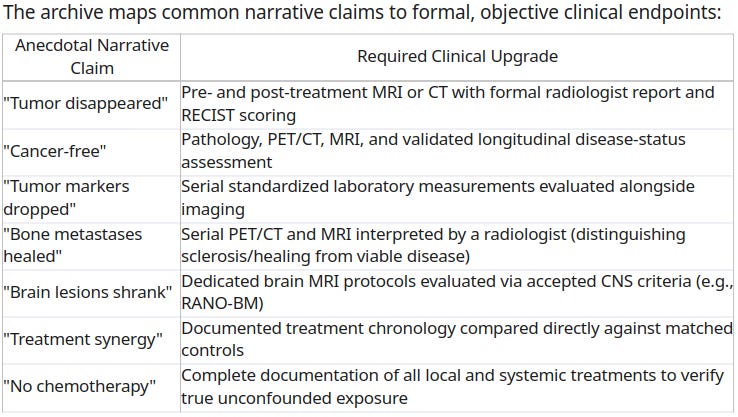
3. Prioritized Trial Designs
Rather than compiling additional retrospective testimonials, the framework urges researchers to focus on several specific clinical trial architectures:
Randomized Add-On Trials: Evaluating conventional standard-of-care alone versus standard-of-care plus an antiparasitic agent (ivermectin, mebendazole, or fenbendazole) to isolate whether the repurposed drug provides synergistic survival or response benefits.
Prospective Neoadjuvant Cohorts: Enrolling early-stage patients before surgery with mandatory core biopsies, baseline breast MRIs, documented drug exposure, and standardized surgical RCB pathology assessment.
Dedicated CNS and TNBC Cohorts: Conducting focused studies in high-unmet-need populations—specifically patients with triple-negative breast cancer (TNBC) and active brain/leptomeningeal metastases.
Pharmacokinetic (PK) & Interaction Studies: Testing whether these agents alter the metabolism, absorption, or clearance of concurrent chemotherapy, CDK4/6 inhibitors, or endocrine drugs.
Prospective Safety Registries: Systematically recording liver enzyme changes (transaminitis), neurotoxicity, and drug interactions across larger populations.
The article outlines the proposed minimum clinical data set, the evidentiary upgrade matrix from testimonials to objective endpoints, and the prioritized clinical trial designs—including randomized add-on trials, prospective neoadjuvant cohorts, dedicated CNS/TNBC registries, and pharmacokinetic/safety studies.
Primary Source Documents
Structured Case-Series Analysis (Source for Trial Framework & Minimum Data Set): Cancer Advisor | OneDayMD. (2026, September 1). Ivermectin, mebendazole and fenbendazole for breast cancer: A structured case-series analysis of 130 reports. Cancer Advisor. https://cancer.aestheticsadvisor.com/2026/09/ivermectin-mebendazole-fenbendazole-breast-cancer.html (The primary document proposing the prospective clinical trial architecture, the mandatory minimum clinical data set, the evidence upgrade framework, and the call to transition from retrospective testimonials to controlled prospective cohorts).
Comprehensive Case Repository & Patient Treatment Data: OneDayMD Editorial Team. (2026, November 10). Fenbendazole, ivermectin and mebendazole for cancer: Case series of 800+ case reports (November 2026 update) (F. Yap, Med. Rev.). The Medical Advisor. https://www.onedaymd.com/2024/02/fenbendazole-cancer-success-stories.html (Source for recurring multi-agent regimens, dosage exposures, and clinical patterns informing trial candidate selection).
2. Clinical Endpoint Criteria & Standardized Assessment Methodologies
Solid Tumor Radiological Measurement Criteria (RECIST v1.1): Eisenhauer, E. A., Therasse, P., Bogaerts, J., Schwartz, L. H., Sargent, D., Ford, R., Dancey, J., Arbuck, S., Gwyther, S., Mooney, M., Rubinstein, L., Shankar, L., Dodd, L., Kaplan, R., Lacombe, D., & Verweij, J. (2009). New response evaluation criteria in solid tumours: Revised RECIST guideline (version 1.1). European Journal of Cancer, 45(2), 228–247. (The validated oncologic standard specified in the trial design to replace narrative tumor descriptions with formal pre- and post-treatment RECIST scoring).
Surgical Residual Cancer Burden (RCB) Scoring Methodology: Symmans, W. F., Peintinger, F., Hatzis, C., Rajan, R., Kuerer, H., Valero, V., Erdogan, L., Patel, R., Azad, N., Morandi, P., Hsu, L., Ross, J. S., Hortobagyi, G. N., & Pusztai, L. (2007). Measurement of residual breast cancer for the calculation of the Residual Cancer Burden (RCB) after neoadjuvant therapy. Journal of Clinical Oncology, 25(28), 4414–4422. (The pathological index and scoring criteria required for prospective neoadjuvant cohorts to measure surgical response).
Neuro-Oncology Response Criteria for Brain Metastases (RANO-BM): Lin, N. U., Lee, E. Q., Aoyama, H., Barani, I. J., Baumert, B. G., Brown, P. D., Camidge, D. R., Chang, S. M., Dancey, J., Gaspar, L. E., Harris, G. J. R., Hodi, F. S., Kalkanis, S. N., Linskey, M. E., Macdonald, D. R., Margolin, K., Mehta, M. P., Schiff, D., Soffietti, R., … Wen, P. Y. (2015). Response assessment in neuro-oncology brain metastases (RANO-BM) criteria: A consensus proposal. The Lancet Oncology, 16(6), e270–e278. (Standardized intracranial imaging criteria for evaluating parenchymal brain metastases in the dedicated CNS cohort).
Standardized Adverse Event Grading (CTCAE v5.0): National Cancer Institute. (2017). Common Terminology Criteria for Adverse Events (CTCAE) version 5.0. U.S. Department of Health and Human Services, National Institutes of Health. (The regulatory toxicity scale used to systematically track adverse events, transaminitis, and neuropathy in prospective safety registries).
3. Benchmark Clinical Trials & Preclinical Translational Foundations
Neoadjuvant Benchmark Trial in High-Risk Early TNBC (KEYNOTE-522): Schmid, P., Cortés, J., Dent, R., Pusztai, L., McArthur, H., Kümmel, S., Bergh, J., Denkert, C., Park, Y. H., Hui, R., Harbeck, N., Takahashi, M., Untch, M., Fasching, P. A., Cardoso, F., Andersen, J., Patt, D., Danso, M., Ferreira, M., … O’Shaughnessy, J. (2020). Pembrolizumab for early triple-negative breast cancer. New England Journal of Medicine, 382(9), 810–821. (Provides the standard chemo-immunotherapy backbone and control baseline pCR rates against which add-on neoadjuvant trials are evaluated).
Endocrine Resistance Reversal & Wnt/EMT Downregulation: Rujimongkon, K., Adchariyasakulchai, P., Boonyaratsewee, C., Horpratraporn, K., & Ketchart, W. (2026). Ivermectin inhibits ER, HER2, and TGF-β pathways in ER-positive and endocrine-resistant breast cancer cells. PLoS ONE, 21(4), Article e0348260. https://doi.org/10.1371/journal.pone.0348260 (Preclinical biological foundation supporting the proposed treatment-resistant/CDK4/6 progression cohort design).
Immunogenic Cell Death & T-Cell Infiltration in TNBC: Draganov, D., Gopalakrishnan, S., et al. (2021). Ivermectin converts cold tumors hot and synergizes with immune checkpoint blockade for treatment of breast cancer. npj Breast Cancer, 7, Article 22. (Preclinical rationale for prospective combination trials pairing antiparasitics with checkpoint blockade in triple-negative disease).
Blood-Brain Barrier Penetration & Neuro-Oncology Efficacy: Bai, R. Y., Staedtke, V., Aprhys, C. M., Gallia, G. L., & Riggins, G. J. (2011). Antiparasitic mebendazole shows survival benefit in 2 preclinical models of glioblastoma multiforme. Neuro-Oncology, 13(9), 974–982. (Translational evidence supporting mebendazole selection in dedicated CNS and brain metastasis cohorts).