

Colorectal cancer (CRC) is the third most common cancer diagnosed and the second leading cause of cancer death worldwide. While 5-fluorouracil (5-FU) remains the mainstay chemotherapeutic agent for CRC, treatment success is often limited by drug resistance driven by genetic alterations such as p53 mutations, p38α MAPK pathway modifications, or Akt signaling upregulation.
1. Repurposing Benzimidazoles for Colorectal Cancer
Repurposing anthelmintic benzimidazole derivatives has emerged as a promising strategy to overcome chemoresistance in CRC:
Broad In Vitro Efficacy: Screening studies demonstrate that mebendazole and albendazole exhibit anti-cancer activity across 80% of evaluated CRC cell lines.
Suppression of Proliferation & Migration: Benzimidazoles inhibit cell proliferation in HCT116 cells and induce apoptosis via JNK signaling. Flubendazole triggers mitotic catastrophe and exerts anti-migratory effects by downregulating nuclear factor kappa B (NF-κB p65) in primary and metastatic CRC cells.
Reduction of Tumor Initiation: Combining mebendazole with nonsteroidal anti-inflammatory drugs (NSAIDs) significantly reduces tumor initiation in ApcMin/+ mouse models of familial adenomatous polyposis by suppressing c-Myc expression and stimulating apoptosis.
2. Fenbendazole Activity in 5-FU-Resistant CRC Cells
Research comparing wild-type (SNU-C5) and 5-FU-resistant (SNU-C5/5-FUR) colorectal cancer cells reveals that fenbendazole exerts potent, time- and dose-dependent antiproliferative effects:
Comparative Potency ((\text{IC}_{50}\)): Fenbendazole demonstrates an \(\text{IC}{50}\) of 0.50 µM in wild-type SNU-C5 cells and 4.09 µM in 5-FU-resistant SNU-C5/5-FUR cells (showing slightly higher susceptibility than albendazole, which has an \(\text{IC}{50}\) of 4.23 µM in resistant cells).
G2/M Phase Cell Cycle Arrest: Fenbendazole significantly increases the proportion of cells arrested in the G2/M phase in both 5-FU-sensitive and resistant lines. This arrest is accompanied by marked upregulation of p21 and p27 cell cycle inhibitors and downregulation of c-Myc.
Mitochondrial Apoptotic Cascade: Fenbendazole induces apoptosis through mitochondrial injury, evidenced by elevated cytochrome-C release, caspase-3 activation, and PARP cleavage.
3. Divergent Cell Death Mechanisms: Sensitive vs. Resistant CRC
While fenbendazole triggers apoptosis in both sensitive and resistant CRC cells, its underlying molecular cell death pathways differ significantly between the two phenotypes:
5-FU-Sensitive Cells (p53-Dependent Apoptosis): In wild-type SNU-C5 cells, fenbendazole increases the phosphorylation/activation of p53, driving p53-mediated apoptosis alongside modest activation of autophagy (via Beclin-1 and Atg7) and caspase-8-dependent signaling.
5-FU-Resistant Cells (p53-Independent & Ferroptosis-Augmented Apoptosis): In 5-FU-resistant SNU-C5/5-FUR cells, fenbendazole induces apoptosis without altering p53 expression or activation. Instead, apoptosis is heavily augmented by ferroptosis—an iron-dependent cell death pathway—driven by the marked downregulation of GPX4 (glutathione peroxidase 4) and SLC7A11 (cysteine/glutamate transporter), along with increased release of the damage marker HMGB1.
Fenbendazole in Colorectal Cancer (CRC) Therapy
Fenbendazole, a benzimidazole anthelmintic agent, demonstrates potent antiproliferative and apoptotic effects against both wild-type and 5-fluorouracil-resistant (5-FU-resistant) colorectal cancer (CRC) cells. Studies of wild-type (SNU-C5) and 5-FU-resistant (SNU-C5/5-FUR) human colorectal cancer cells highlight fenbendazole as a potential repurposed therapy that can overcome chemoresistance through distinct cell death pathways.
1. Anti-Proliferative Potency & Susceptibility
In Vitro Potency (IC50): Fenbendazole exerts dose- and time-dependent cytotoxic effects on both cell lines. Following 3 days of treatment, the IC50 values are 0.50 µM in 5-FU-sensitive SNU-C5 cells and 4.09 µM in 5-FU-resistant SNU-C5/5-FUR cells.
Superiority over Albendazole: Compared to albendazole (IC50 of 4.23 µM in resistant cells), fenbendazole exhibits higher susceptibility and greater effectiveness in reducing the viability of 5-FU-resistant CRC cells.
2. G2/M Cell Cycle Arrest
Mitotic Arrest: Fenbendazole significantly increases the proportion of cells arrested in the G2/M phase. In 5-FU-resistant cells, the G2/M fraction rises dramatically from 24.24% to 84.30% after treatment.
Cell Cycle Regulators: This arrest is driven by significant increases in key cyclin-dependent kinase inhibitors—p21 (1.98-fold in SNU-C5; 1.68-fold in SNU-C5/5-FUR) and p27 (2.82-fold in SNU-C5; 2.43-fold in SNU-C5/5-FUR)—alongside marked downregulation of the oncogene c-Myc. Cyclin B1 levels remain unchanged.
3. Apoptosis via Mitochondrial Injury (Caspase-3/PARP Pathway)
Mitochondrial Cascade: Fenbendazole triggers intrinsic apoptosis characterized by mitochondrial damage, leading to a 1.37-fold increase in cytochrome-C release in both cell types.
Caspase & PARP Activation: Apoptotic cell death is driven by the activation of caspase-3 (1.44-fold in SNU-C5; 2.18-fold in SNU-C5/5-FUR) and increased cleavage of PARP (1.79-fold in SNU-C5; 2.28-fold in SNU-C5/5-FUR).
4. Divergent Mechanisms: 5-FU-Sensitive vs. Resistant Cells
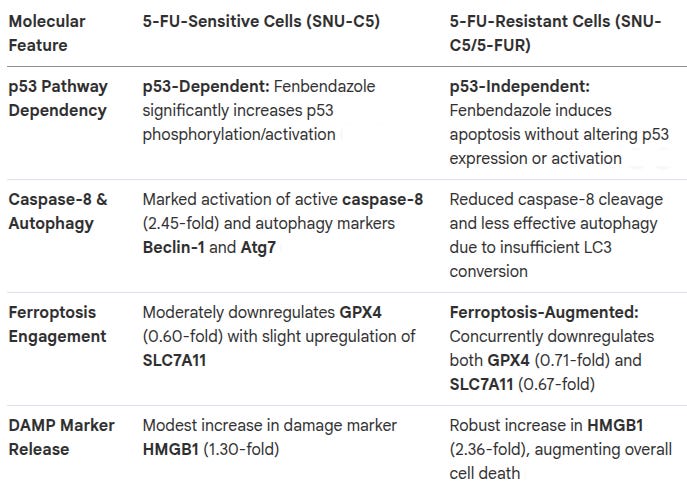
5. Other Evaluated Signaling & Cell Death Pathways
Necroptosis: Fenbendazole does not alter MLKL activation, indicating that necroptosis is not effectively activated in either CRC cell line.
MAPK Signaling: Fenbendazole treatment produces no significant changes in the activation of p38, ERK, or JNK MAPKs in either sensitive or resistant cells.
Anti-cancer effects of fenbendazole on 5-fluorouracil-resistant colorectal cancer cells
Park D, Lee J, Yoon S. Anti-cancer effects of fenbendazole on 5-fluorouracil-resistant colorectal cancer cells. Korean J Physiol Pharmacol 2022;26:377-387. https://doi.org/10.4196/kjpp.2022.26.5.37
https://www.kjpp.net/journal/view.html?doi=10.4196/kjpp.2022.26.5.377
What do fenbendazole mebendazole ivermectin and cannabis oil all have in common including albendazole they are all antifungal in a way that most other antifungal substances aren't, they are all microtubule disruptors. Near all pharmaceutical antifungals other than griseofulvin work by attacking the cell wall of fungal organisms and some of those are excellent also in combination with microtubule disruptors. The pharmaceutical cancer drugs paclitaxel vincristine and vinblastine work as microtubule disruptors also. Coincidence not the chance of a snowball in hell. Other microtubule disruptors in nature are soursop Curcumin ashwagandah Curcumin lemon grass oil and wormwood all potent antifungal/anticancer substances. Can you name a substance that isn't antifungal that has an effect on cancer ? I've been looking for twenty years and haven't found one.