
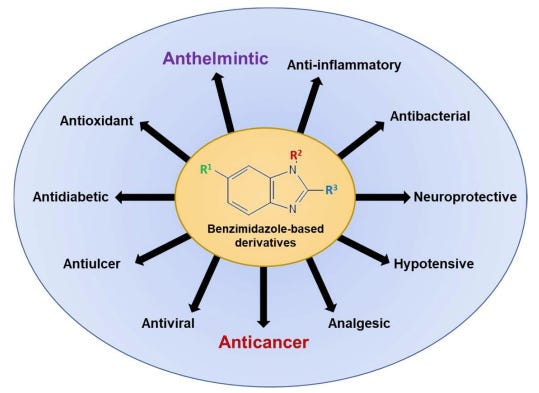
Focus: Leukemia, Lymphoma, and Multiple Myeloma
A comprehensive overview of the molecular mechanisms and preclinical evidence that position benzimidazoles as a promising, cost-effective frontier in the fight against blood cancers.
Hematological malignancies are the fourth most common type of cancer and the leading cause of cancer-related deaths, encompassing leukemias, lymphomas, and multiple myeloma. Although numerous therapies are approved, patients frequently develop drug resistance and experience toxic side effects, driving a critical need for novel, safer therapies.
This guide synthesizes current research on the repurposing of anthelmintic benzimidazoles—specifically mebendazole, albendazole, flubendazole, and fenbendazole—as targeted therapies for hematological malignancies. It details the biochemical pathways and molecular mechanisms used to bypass conventional chemotherapy resistance and eliminate cancer stem cells.
Through systematic drug repurposing—which offers a faster, cheaper development track than conventional drug discovery—anthelmintic benzimidazole derivatives (including mebendazole, albendazole, flubendazole, and fenbendazole) have emerged as potent therapeutic candidates for blood cancers. Based on peer-reviewed preclinical and clinical observations, here is how these repurposed compounds target specific hematological malignancies:
1. Acute Myeloid Leukemia (AML): Stem Cell Disruption and Differentiation
AML is characterized by abnormally differentiated hematopoietic cells. Standard cytarabine-based chemotherapies for AML frequently cause severe toxicities, such as myelosuppression and infection. Benzimidazoles target AML by promoting proteasomal degradation of key transcription factors and inducing terminal differentiation. Repurposed benzimidazoles selectively target AML cells through several distinct mechanisms:
Mebendazole (MBZ): The HSP70/c-MYB and GLI Axis
Potently impairs AML cell lines and primary patient samples, inducing mitotic arrest and catastrophe while exhibiting low toxicity toward healthy cord blood-derived cells and peripheral blood mononuclear cells.
MBZ interferes with AML cell survival by targeting the protein-folding machinery, specifically the Heat Shock Protein 70 (HSP70) chaperone system. MBZ disrupts leukemia progression and prolongs in vivo survival by targeting two major transcriptional pathways:
c-MYB Degradation Pathway:
The transcription factor c-MYB drives oncogene expression in AML, especially in mixed lineage leukemia (MLL)-fusion gene cases.
MBZ blocks the HSP70 chaperone system.
This blockade inhibits the proper folding of the transcription factor c-MYB (crucial for MLL-fusion gene expression and stem cell self-renewal).
Unfolded c-MYB undergoes proteasomal degradation.
Result: Reduced colony formation and impaired leukemia progression with negligible impact on normal CD34+ cord blood cells.
GLI1/2 Degradation:
GLI transcription factors sustain chemotherapy-resistant leukemia-initiating cells.
MBZ inhibits both HSP70 and HSP90 chaperone activities.
This leads to the proteasomal degradation of GLI1 and GLI2 transcription factors (effectors of the Hedgehog pathway).
Targeting GLI eliminates leukemia-initiating cells responsible for chemotherapy resistance and tumor relapse.
Albendazole (ABZ): The KLF4-DPYSL2A Axis
Functions as a non-toxic candidate for differentiation therapy. Unlike traditional cytotoxic chemotherapy, ABZ functions via differentiation therapy in non-APL AML. This action forces non-acute promyelocytic leukemia (non-APL) AML cells to differentiate into mature monocytes. It demonstrates wide anti-leukemic efficacy across multiple AML subtypes with negligible toxicity to normal bone marrow cells
Mechanism: ABZ stimulates the Krüppel-like factor 4 (KLF4) – dihydropyrimidinase-like 2A (DPYSL2A) axis.
Outcome: This axis triggers the differentiation of malignant blasts into mature monocytes, effectively clearing the tumor bulk through maturation.
Flubendazole (FLBZ) and Fenbendazole (FBZ): Tubulin and Granulocytes
Induces leukemia cell death at nanomolar concentrations. FLBZ disrupts tubulin polymerization by binding to a site distinct from the conventional chemotherapy drug vinblastine. As a result, vinblastine-resistant cells remain fully sensitive to FLBZ, and combining the two drugs yields synergistic tumor growth delay in vivo.
FLBZ: Binds to tubulin at a site distinct from vinblastine. This allows FLBZ to remain effective in cells that have developed resistance to standard Vinca alkaloids.
FBZ: Induces terminal maturation of HL60 cells into granulocytes (confirmed by nitroblue tetrazolium reduction assays). FBZ shows 14.5-fold higher selectivity for leukemia cells than for human bone marrow stem cells.
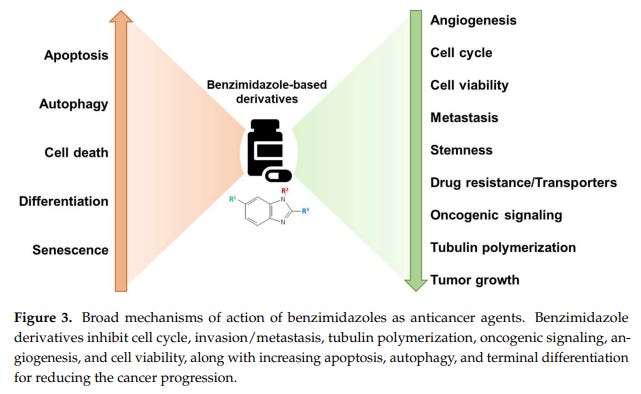
2. Acute Lymphoblastic Leukemia (ALL) and Chronic Myeloid Leukemia (CML)
T-cell acute lymphoblastic leukemia (T-ALL) represents a significant fraction of pediatric and adult ALL cases, but conventional chemotherapy frequently results in high relapse rates. Benzimidazoles address lymphoid and myeloid malignancies by suppressing proliferative signaling and overcoming gatekeeper mutations.
Acute Lymphoblastic Leukemia (ALL)
MBZ targets T-ALL by suppressing the Notch1 signaling pathway, which is typically overactivated in these malignancies. Dose-dependently suppresses the proliferation of both standard CCRF-CEM cells and chemoresistant CEM/C1 cells
Downstream Targets: Treatment with MBZ reduces Notch1 downstream targets, specifically c-Myc and Hes1.
Cellular Impact: Induction of G2/M phase cell cycle arrest and elevated Caspase 3/7 activity, even in chemoresistant T-ALL derivatives (e.g., CEM/C1).
Chronic Myeloid Leukemia (CML)
CML treatment often fails due to the T315I gatekeeper mutation in ABL1.
Synergy with TKIs: MBZ synergizes with Tyrosine Kinase Inhibitors (TKIs) like imatinib and dasatinib to disrupt the cell cycle in resistant K562 cell lines.
MicroRNA Modulation: MBZ modulates the miR-150-5p / MYB axis. By inactivating the proto-oncogene MYB, MBZ reduces cell cycle progression and induces apoptosis in CML cells.
3. Multiple Myeloma (MM): Bypassing Efflux and Stem-like Cells
Multiple myeloma cells frequently develop acquired resistance to standard proteasome inhibitors and corticosteroids through successive treatments. Multiple Myeloma is often marked by relapse due to this acquired drug resistance, frequently mediated by P-glycoprotein (P-gp) or ALDH+ stem-like cells.
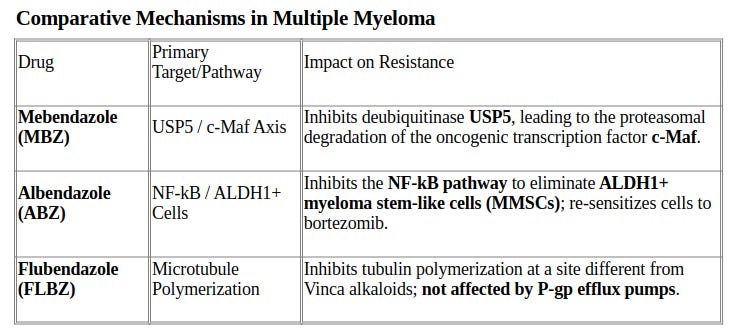
Mebendazole (MBZ): Overcomes resistance by targeting the USP5/c-Maf axis 24. Upregulation of the transcription factor c-Maf frequently drives myeloma cell proliferation 24. MBZ suppresses the deubiquitinase USP5, triggering the proteasomal degradation of c-Maf and inducing apoptosis 24. MBZ acts synergistically when combined with the chemotherapy drug daunorubicin or the USP5 inhibitor WP1130 24.
Albendazole (ABZ): Blocks MM cell proliferation in vitro and in vivo by inhibiting the NF-κB pathway (specifically decreasing p65 and phospho-p65 levels) 2526. This signaling blockade allows ABZ to eliminate ALDH1+ multiple myeloma stem-like cells (MMSCs), successfully re-sensitizing resistant cells to the proteasome inhibitor bortezomib 2526.
Flubendazole (FLBZ): MM cells commonly develop resistance to standard Vinca alkaloids (vincristine, vinblastine) by upregulating the P-glycoprotein (P-gp) efflux pump. Because FLBZ inhibits tubulin polymerization through a site distinct from Vinca alkaloids, its cytotoxicity is unaffected by P-gp overexpression, successfully inducing cell death in vinblastine-resistant myeloma cells and delaying tumor growth in vivo.
4. Lymphomas: Novel Conjugates and Synergies
Repurposed benzimidazoles have demonstrated unique chemical, cellular, and clinical efficacy against aggressive lymphomas.
Diffuse Large B-Cell Lymphoma (DLBCL) Regression: A published clinical case study reports an 83-year-old male DLBCL patient who refused standard chemotherapy 30. After self-administering fenbendazole, successive PET/CT scans revealed notable interval disease regression with no new lesions emerging.
Lymphoma research highlights the potential for benzimidazoles to act as both standalone agents and metabolic synergists.
Fenbendazole (FBZ) Synergy: FBZ demonstrates significant tumor regression when combined with dietary vitamin supplementation. In SCID mouse models, this combination inhibited human lymphoma xenograft growth more effectively than FBZ or vitamins alone.
Flubendazole (FLBZ) Sensitivity: In large-scale screenings, lymphoid cell lines demonstrated extreme sensitivity to FLBZ, with 82% of leukemia/lymphoma lines and 100% of MM lines displaying an IC_{90} < 1 \mu M.
Halogenated Derivatives: Benzimidazole-substituted derivatives target integrin \alpha4\beta1. Fluoro, iodo, chloro, and bromo derivatives are being explored as high-affinity ligands for both therapy and radiodiagnostic applications.
Zinc Phthalocyanine Derivatives: These substituted benzimidazoles exert cytotoxicity in B-cell lymphoma via minor groove binding and intercalation between DNA bases.
⚠️ A Key Safety Paradox: Spindle Poisoning and LOH
While these compounds are highly effective, researchers highlight a critical genetic caution regarding albendazole (ABZ). Because ABZ acts as a potent spindle poison, even low doses accelerate mammalian chromosomal missegregation and induce Loss of Heterozygosity (LOH). In vivo testing in Msh2-heterozygous mice (a model for Lynch Syndrome) showed that continuous ABZ administration significantly increased the formation of mismatch repair-deficient crypt foci. This suggests that while ABZ is highly cytotoxic to cancer cells, its spindle-disrupting nature could theoretically predispose healthy, haploinsufficient tissue to genomic instability or tumor progression, underlining the need to carefully monitor genetic contexts during clinical translation.
Source:
Deworming to Cancer Therapy: Benzimidazoles in Hematological Malignancies.
Cancers 2024, 16, 3454. https://doi.org/10.3390/cancers16203454