

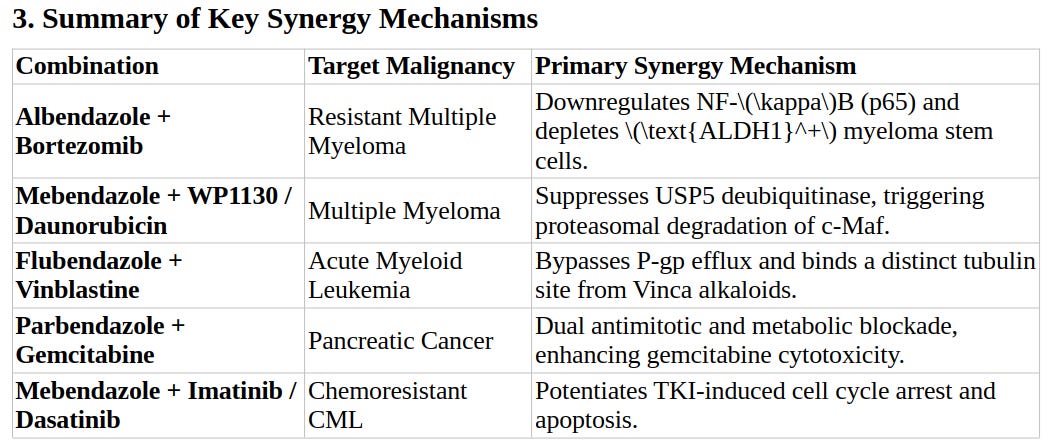
Combining benzimidazole anthelmintics with standard chemotherapeutics produces synergistic cytotoxicity in chemo-resistant leukemia, multiple myeloma, and pancreatic cancer models. These compounds overcome acquired resistance by evading P-glycoprotein (P-gp) efflux pumps, targeting distinct sites on β-tubulin, and suppressing critical survival signaling nodes—such as NF-κB, c-Maf, and USP5—that normally protect resistant cells and cancer stem cell subpopulations.
1. Resistant Leukemia & Multiple Myeloma Models
Albendazole + Bortezomib (BTZ) in Multiple Myeloma:
NF-κB Inhibition & Stem Cell Depletion: Aberrant activation of the NF-κB pathway drives drug resistance and maintains self-renewing cancer stem cells. Albendazole (ABZ) suppresses NF-κB signaling by downregulating p65 and phospho-p65 levels.
Re-Sensitizing BTZ-Resistant Cells: By inhibiting NF-κB, ABZ selectively eliminates rare ALDH1+ myeloma stem cells. When combined with bortezomib, ABZ re-sensitizes bortezomib-resistant myeloma cells (ANBL6-BR) to BTZ therapy and displays potent synergistic cell killing in vitro and in vivo.
Mebendazole + Proteasomal/USP5 Inhibitors in Myeloma & CML:
Disrupting the USP5 / c-Maf Axis: Upregulation of the transcription factor c-Maf promotes myeloma cell proliferation and survival. Mebendazole (MBZ) inhibits the deubiquitinase USP5, leading to the proteasomal degradation of c-Maf.
Synergy with WP1130 & Daunorubicin: Combining MBZ with the USP5 inhibitor WP1130 or the chemotherapeutic daunorubicin yields synergistic increases in apoptosis in myeloma cells and significantly delays tumor growth in human myeloma xenograft models.
Tyrosine Kinase Inhibitor (TKI) Synergy in CML: In chronic myeloid leukemia (CML) models—including the chemoresistant FEPS line—MBZ induces cell-cycle arrest and apoptosis, showing strong synergistic cytotoxicity when combined with TKIs such as imatinib and dasatinib.
Flubendazole + Vinca Alkaloids (Vinblastine / Vincristine) in AML:
Distinct Tubulin Binding Site: Flubendazole (FLBZ) binds β-tubulin at a site distinct from Vinca alkaloids and is not a substrate for P-gp efflux. Consequently, vinblastine-resistant leukemia cells remain fully sensitive to FLBZ.
Combinatorial Efficacy: Combining FLBZ with vinblastine or vincristine produces synergistic reductions in cell viability in OCI-AML2 leukemia cells and greater tumor growth delay in leukemia xenografts than either drug alone.
2. Pancreatic Cancer Models
Parbendazole + Gemcitabine:
Overcoming Chemotherapy Refractoriness: Pancreatic ductal adenocarcinoma is notoriously resistant to standard cytotoxic agents. Screening benzimidazole derivatives revealed that parbendazole (PBZ) exerts exceptional sub-micromolar antiproliferative activity against pancreatic cancer cell lines (such as AsPC-1 and Capan-2).
Synergistic Combination: When combined with gemcitabine (the standard-of-care chemotherapeutic), parbendazole produces marked synergistic growth inhibition, enhancing gemcitabine’s cytotoxic potency while maintaining a favorable safety window.
Polypharmacological Kinase Blockade:
Target prediction and biochemical profiling indicate that benzimidazoles engage secondary non-tubulin targets in pancreatic cancer, including p38α MAP kinase (for fenbendazole) and VEGFR-2 / KDR kinase (for mebendazole). Simultaneous disruption of tumor angiogenesis and stress response kinases sensitizes recalcitrant pancreatic tumors to gemcitabine-induced metabolic and DNA-damage stress.
The Antitumor Potentials of Benzimidazole Anthelmintics as Repurposing Drugs
Son DS, Lee ES, Adunyah SE. The Antitumor Potentials of Benzimidazole Anthelmintics as Repurposing Drugs. Immune Netw. 2020 Aug 4;20(4):e29. doi: 10.4110/in.2020.20.e29. PMID: 32895616; PMCID: PMC7458798.
https://pmc.ncbi.nlm.nih.gov/articles/PMC7458798/pdf/in-20-e29.pdf