
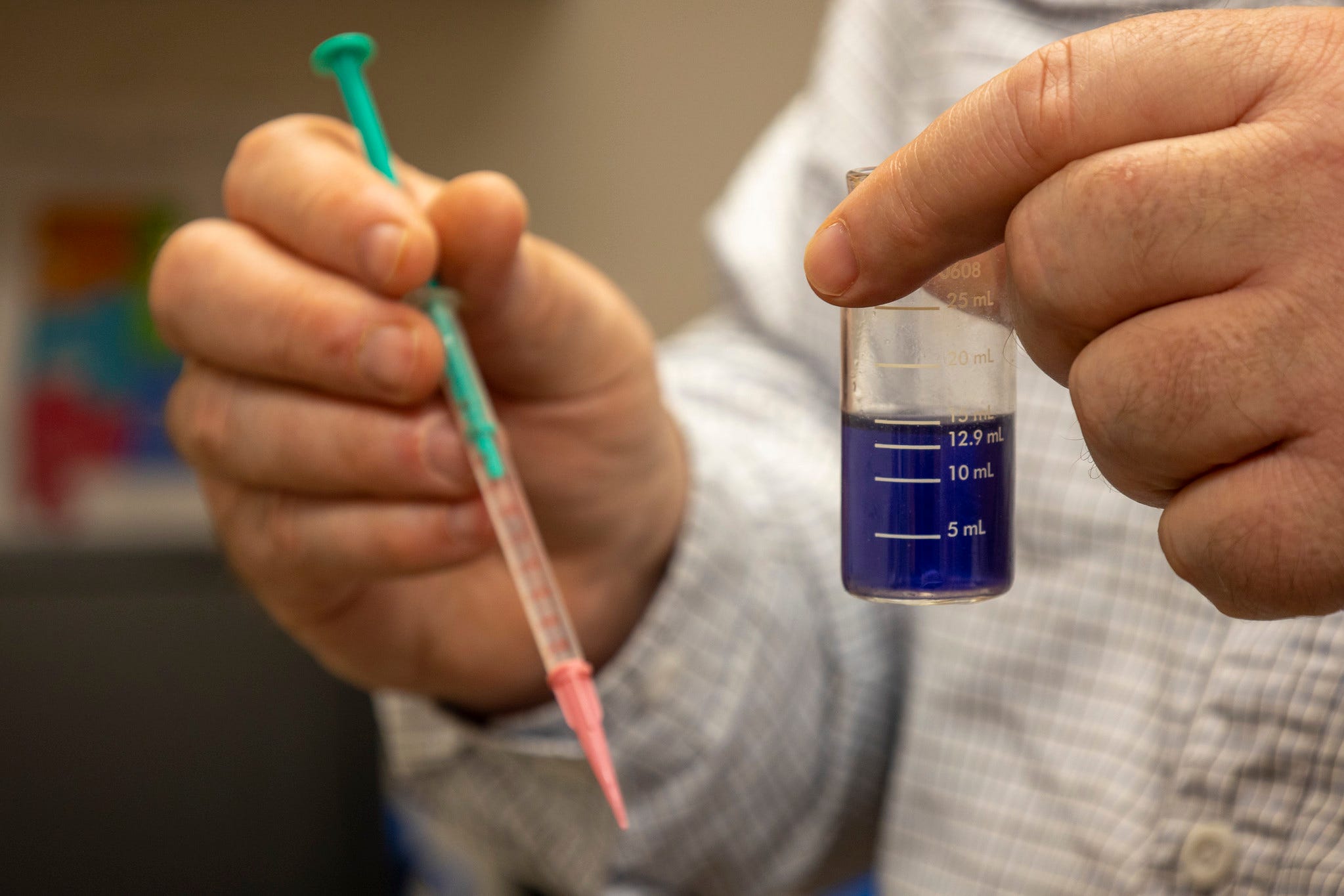
To overcome the low aqueous solubility and limited gastrointestinal absorption of benzimidazole anthelmintics, researchers have developed engineered formulated delivery systems. These nanocarriers transform hydrophobic benzimidazoles into stable, bioavailable therapeutics that reach effective systemic concentrations in vivo.
1. Albumin Nanoparticles (Nab Platform & BSA Complexes)
Albumin-based nano-formulations utilize natural endocytic transport pathways (such as gp60/caveolin-1 receptor-mediated transcytosis) to accumulate in tumor tissue:
Ovarian Cancer Control: Unformulated, free albendazole shows little antitumor activity in ovarian cancer models, whereas bovine serum albumin-conjugated albendazole (BSA-ABZ) and nano-albumin albendazole (Nab-ABZ) significantly reduce tumor weight, suppress malignant ascites accumulation, and inhibit VEGF-driven angiogenesis in vivo.
Photothermal Bladder Cancer Therapy (FBZ@BSA@PDA): Thermally encapsulating fenbendazole in bovine serum albumin, followed by in situ polydopamine polymerization, creates FBZ@BSA@PDA nanoparticles. Used as a localized intravesical instillation for bladder cancer, this platform enhances drug retention and triggers localized photothermal-enhanced ferroptosis, glutathione (GSH) depletion, and immunogenic cell death (ICD) markers (calreticulin exposure, HMGB1 release, and ATP secretion).
2. Cyclodextrin Inclusion Complexes
Cyclodextrins form host-guest inclusion complexes that encapsulate lipophilic benzimidazole molecules within their hydrophobic cavities while exposing a hydrophilic outer surface:
Methyl-\(\beta\)-Cyclodextrin (Methyl-\(\beta\)-CD): Complexing fenbendazole with methyl-\(\beta\)-cyclodextrin at a 1:1 ratio increases water solubility to 20.21 mg/mL—a 60,000-fold enhancement over pure drug powder. This inclusion complex elevates the initial 15-minute drug release rate from 5% to 75%.
Hydroxypropyl-\(\beta\)-Cyclodextrin (HP-\(\beta\)-CD): Complexing albendazole with HP-\(\beta\)-CD markedly improves its systemic pharmacokinetic profile, enhancing in vitro cell cytotoxicity and in vivo antitumor efficacy in tumor-bearing mice.
3. Polymeric Micelles & Amorphous Solid Dispersions
Dispersing benzimidazoles into amphiphilic polymer matrices disrupts their stable crystal lattice, locking the drug into an amorphous state with rapid dissolution kinetics:
Soluplus® Amorphous Solid Dispersions: Formulating fenbendazole with the amphiphilic copolymer Soluplus® via hot-melt extrusion (HME) converts crystalline fenbendazole into an amorphous solid dispersion. In acidic media (pH 1.2), a 5% Soluplus® extrudate elevates cumulative drug dissolution from 20% (neat drug) to ~85%. Injectable Soluplus® polymeric micelles also reduce total systemic clearance while increasing overall AUC.
mPEG-b-PCL Co-Loaded Micelles (M-FR): Freeze-dried mPEG-b-PCL polymeric micelles co-encapsulating fenbendazole and rapamycin (M-FR) significantly improve systemic bioavailability and reduce ovarian cancer cell proliferation compared to unformulated dual-drug suspensions.
4. PLGA & Chitosan Polymeric Nanoparticles
Biodegradable synthetic and natural polymers provide sustained, targeted release profiles:
PLGA Nanoparticles (FZ-PLGA-NPs): Encapsulating fenbendazole into poly(D, L-lactide-co-glycolide) acid nanoparticles (FZ-PLGA-NPs) enables intravenous administration, producing marked tumor weight reductions and antiproliferative activity across epithelial ovarian cancer (EOC) xenografts and patient-derived xenograft (PDX) models.
Chitosan-Tripolyphosphate Nanoparticles: Chitosan-based nanoparticulate systems loaded with albendazole enhance cellular uptake and mucosal adhesion.
5. Lipid Nanocarriers, Nanoemulsions & Nanocrystals
Solid Lipid Nanoparticles (SLNs): Albendazole-loaded solid lipid nanoparticles demonstrate enhanced cellular uptake and cytotoxicity against U-87 MG human glioblastoma cells.
Flubendazole Nanoemulsions & Nanocrystals: Engineering flubendazole into high-oil nanoemulsions or nanocrystals significantly improves systemic drug exposure and successfully inhibits tumor progression in A549 lung cancer xenograft mouse models.
6. Supramolecular Containers & Mesoporous Silica
Acyclic Cucurbit[n]uril Containers: Supramolecular acyclic cucurbit[n]uril molecular containers solubilize albendazole, enabling systemic intravenous delivery of effective therapeutic doses that suppress SK-OV-3 ovarian xenograft tumors.
PEGylated Mesoporous Silica (MCM-41): \(\beta\)-Lactoglobulin-modified and PEGylated mesoporous silica nanoparticles serve as nanostructured vehicles for targeted delivery of fenbendazole into prostate cancer cells.
The Antitumor Potentials of Benzimidazole Anthelmintics as Repurposing Drugs
Son DS, Lee ES, Adunyah SE. The Antitumor Potentials of Benzimidazole Anthelmintics as Repurposing Drugs. Immune Netw. 2020 Aug 4;20(4):e29. doi: 10.4110/in.2020.20.e29. PMID: 32895616; PMCID: PMC7458798.
https://pmc.ncbi.nlm.nih.gov/articles/PMC7458798/pdf/in-20-e29.pdf