
When comparing Fenbendazole (FBZ) with human-approved analogs like Mebendazole (MBZ), Albendazole (ABZ), and Flubendazole (FLBZ), all benzimidazoles target tumor bioenergetics, but they differ in how they disrupt the Warburg effect (aerobic glycolysis) and cellular glucose uptake.
1. Fenbendazole (FBZ): GLUT Transporter & Hexokinase II Suppression
Direct Glycolytic Blockade: FBZ downregulates GLUT-1 and GLUT-4 glucose transporters and inhibits Hexokinase II (HK II) catalytic activity, reducing intracellular glucose uptake and lactate output.
p53-Mediated Metabolic Translocation: FBZ induces mitochondrial translocation of p53, activating the p53–p21 axis to suppress GLUT expression and deprive cancer cells of glycolytic intermediates.
Cell-Type Specificity: FBZ’s metabolic blockade can depend on the cell line. For example, while FBZ potently blocks glucose uptake in lung (A549), HeLa, and colorectal cells, it caused no change in glucose uptake in OCI-AML2 leukemia cells, showing that its metabolic effect depends on the tissue context.
2. Mebendazole (MBZ): Hypoxia-Inducible Factor (HIF) & Vesicular Blockade
Vesicle Transport & Glycogen Depletion: Historically, MBZ’s primary metabolic action was thought to inhibit microtubule-mediated transport of secretory vesicles, preventing glucose uptake and forcing cells to consume stored glycogen until ATP is depleted.
Disrupting Hypoxic Adaptation: MBZ potently inhibits the protein induction of HIF-1α, HIF-2α, and HIF-1β under hypoxic conditions. By preventing HIF activation, MBZ blocks the transcription of downstream glycolytic enzymes (such as carbonic anhydrase IX and GLUT1), reversing hypoxia-induced chemoresistance.
3. Albendazole (ABZ): Microtubule-Independent Metabolic Suppression
ATP Depletion & Angiogenic Blockade: ABZ interferes with glucose transport and depletes glycogen stores similarly to MBZ. It also suppresses HIF-1α accumulation and VEGF production under hypoxic conditions.
Primary Metabolic/Signaling Action: In certain colorectal cancer models (e.g., HCT116), ABZ significantly reduces cell viability without directly depolymerizing tubulin, suggesting that its metabolic and signaling disruption can operate independently of structural microtubule loss.
4. Flubendazole (FLBZ): Microtubule-Dominant (Glucose-Independent) Action
Independence from Glucose Uptake: In hematological malignancies (such as OCI-AML2 leukemia), FLBZ-induced cytotoxicity is completely independent of glucose uptake. Experiments showed that FLBZ did not alter 3H-deoxy-D-glucose uptake up to 4 μM, and altering extracellular glucose levels did not affect FLBZ-induced cell death.
Mechanism Shift: Unlike FBZ and MBZ, FLBZ’s primary anticancer drive stems from direct microtubule polymerization inhibition, STAT3 signaling blockade, and targeting cancer stem-like cells rather than direct glycolytic starvation.
Summary Comparison Matrix
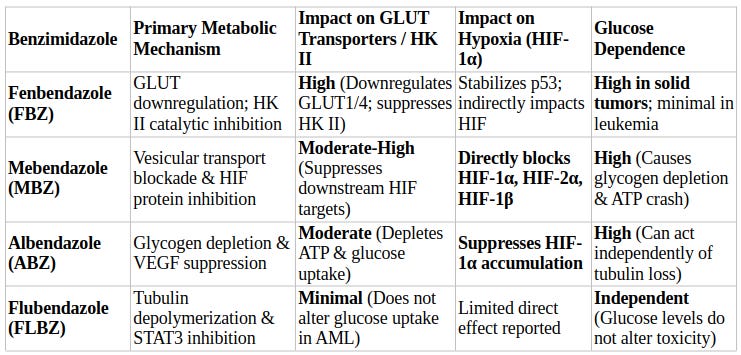
References
Abughanimeh, O., Evans, T., & Kallam, A. (2020). Fenbendazole as a treatment for diffuse large B-cell lymphoma. Annals of Hematology & Oncology, 7(2), Article 1284.
Bai, R.-Y., Staedtke, V., Aprhys, C. M., Gallia, G. L., & Riggins, G. J. (2011). Antiparasitic mebendazole shows survival benefit in 2 preclinical models of glioblastoma multiforme. Neuro-Oncology, 13(9), 974–982. [suspicious link removed]
Bai, R.-Y., Staedtke, V., Rudin, C. M., Bunz, F., & Riggins, G. J. (2015). Effective treatment of diverse medulloblastoma models with mebendazole and its impact on tumor angiogenesis. Neuro-Oncology, 17(4), 545–554. [suspicious link removed]
Bai, R.-Y., Staedtke, V., Wanjiku, T., Rudek, M. A., Joshi, A., Gallia, G. L., & Riggins, G. J. (2015). Brain penetration and efficacy of different mebendazole polymorphs in a mouse brain tumor model. Clinical Cancer Research, 21(15), 3462–3470. https://doi.org/10.1158/1078-0432.CCR-14-2681
Bieging, K. T., & Attardi, L. D. (2012). Deconstructing p53 transcriptional networks in tumor suppression. Trends in Cell Biology, 22(2), 97–106. [suspicious link removed]
de la Torre-Iglesias, P. M., García-Rodriguez, J. J., Torrado, G., Torrado, S., Torrado-Santiago, S., & Bolás-Fernández, F. (2014). Enhanced bioavailability and anthelmintic efficacy of mebendazole in redispersible microparticles with low-substituted hydroxypropylcellulose. Drug Design, Development and Therapy, 8, 1467–1479. [suspicious link removed]
De Witt, M., Gamble, A., Hanson, D., Markowitz, D., Powell, C., Al-Ahmadie, H. A., & Symons, M. (2017). Repurposing mebendazole as a replacement for vincristine for the treatment of brain tumors. Molecular Medicine, 23, 50–56. [suspicious link removed]
Ding, Y., Zhang, Z., Ding, C., Xu, S., & Xu, Z. (2024). Preparation and evaluation of fenbendazole methyl-β-cyclodextrin inclusion complexes. BMC Veterinary Research, 20(1), Article 214. [suspicious link removed]
Duan, Q., Liu, Y., & Rockwell, S. (2013). Fenbendazole as a potential anticancer drug. Anticancer Research, 33(2), 355–362.
Freisleben, F., Modemann, F., Muschhammer, J., Stamm, H., Brauneck, F., Krispien, A., Bokemeyer, C., Kirschner, K. N., Wellbrock, J., & Fiedler, W. (2021). Mebendazole mediates proteasomal degradation of GLI transcription factors in acute myeloid leukemia. International Journal of Molecular Sciences, 22(19), Article 10670. [suspicious link removed]
Gao, P., Dang, C. V., & Watson, J. (2008). Unexpected antitumorigenic effect of fenbendazole when combined with supplementary vitamins. Journal of the American Association for Laboratory Animal Science, 47(6), 37–40.
Garona, J., Pifano, M., Scursoni, A. M., Gomez, D. E., Alonso, D. F., & Ripoll, G. V. (2020). Repurposing of anthelmintic and antiparasitic drugs in oncology. International Journal of Oncology, 56(3), 651–680. [suspicious link removed]
Golla, U., Patel, S., Shah, N., Talamo, S., Bhalodia, R., Claxton, D., Dovat, S., & Sharma, A. (2024). From deworming to cancer therapy: Benzimidazoles in hematological malignancies. Cancers, 16(19), Article 3454. [suspicious link removed]
Guerini, A. E., Triggiani, L., Maddalo, M., Bonù, M. L., Frassine, F., Baiguini, A., Alghisi, A., Tomasini, D., Borghetti, P., Pasinetti, N., Biti, G., & Magrini, S. M. (2019). Mebendazole as a candidate for drug repurposing in oncology: An extensive review of current literature. Cancers, 11(9), Article 1284. [suspicious link removed]
Huang, L., Zhang, L., Zhang, J., Zhao, L., He, F., Wang, H., Liu, Q., Shi, D., Ni, N., Shu, Y., Zeng, Z., Huang, B., Huang, S., Lei, Y., Ye, Z., Cao, D., Yang, L., Wu, D., Feng, Y., ... He, T.-C. (2021). Mebendazole sensitizes chemoresistant human ovarian cancer cells to cisplatin-induced cytotoxicity and tumor growth inhibition. Aging (Albany NY), 13(18), 22305–22325. [suspicious link removed]
Joe, N. S., Wang, Y., Oza, H. H., Godet, I., Milki, N., Riggins, G. J., & Gilkes, D. M. (2023). Mebendazole treatment disrupts the transcriptional activity of hypoxia-inducible factors 1 and 2 in breast cancer cells. Cancers, 15(4), Article 1330. [suspicious link removed]
Karimi, A., Barea, P., Benito-Román, Ó., Blanco, B., Sanz, M. T., Higginbotham, C. L., & Lyons, J. G. (2025). Investigation of fenbendazole solubility using particle size reduction methods in the presence of Soluplus®. Pharmaceutics, 17(9), Article 1163. [suspicious link removed]
Larsen, A. R., Bai, R.-Y., Chung, J. H., Borodovsky, A., Rudin, C. M., Riggins, G. J., & Bunz, F. (2015). Repurposing the antihelmintic mebendazole as a hedgehog inhibitor. Molecular Cancer Therapeutics, 14(1), 3–13. [suspicious link removed]
Laudisi, F., Marônek, M., Di Grazia, A., Monteleone, G., & Stolfi, C. (2020). Repositioning of anthelmintic drugs for the treatment of cancers of the digestive system. International Journal of Molecular Sciences, 21(14), Article 4957. [suspicious link removed]
Lei, X., Wang, Y., Chen, Y., Duan, J., Gao, X., & Cong, Z. (2025). Fenbendazole exhibits antitumor activity against cervical cancer through dual targeting of cancer cells and cancer stem cells: Evidence from in vitro and in vivo models. Molecules, 30(11), Article 2377. [suspicious link removed]
Li, Y., Thomas, D., Deutzmann, A., Majeti, R., Felsher, D. W., & Dill, D. L. (2019). Mebendazole for differentiation therapy of acute myeloid leukemia identified by a lineage maturation index. Scientific Reports, 9(1), Article 16775. https://doi.org/10.1038/s41598-019-53290-3