
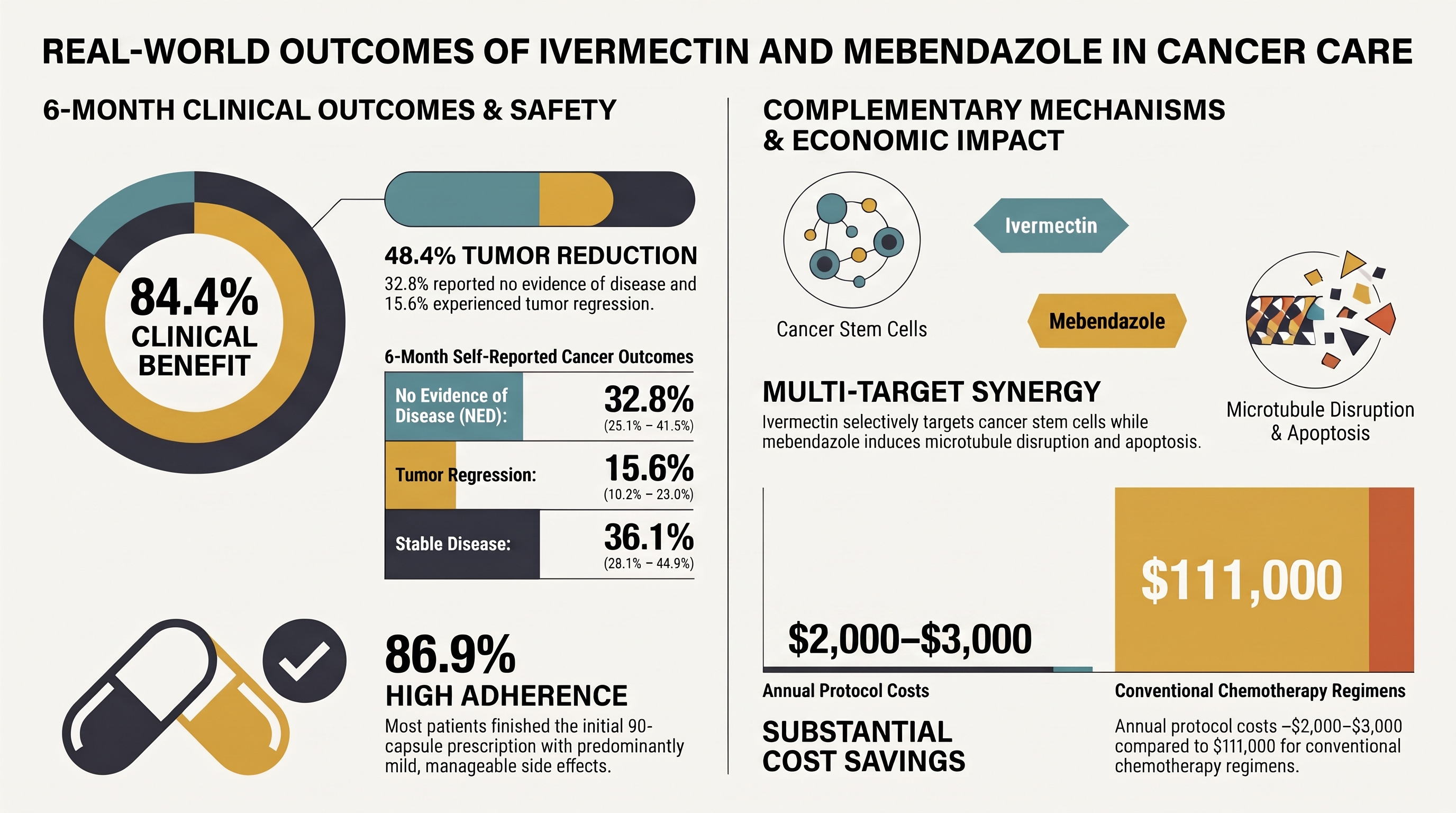
In the context of oncology, drug repurposing involves identifying new anti-cancer applications for established, non-oncology medications with well-known safety profiles. This approach seeks to accelerate therapeutic development and lower healthcare costs compared to standard chemotherapies, which average $111,000 annually.
1. Key Antiparasitic Repurposing Candidates
Ivermectin: Demonstrates multi-target anti-cancer activity across numerous tumor types by modulating oncogenic signaling cascades—including PAK1, Wnt/β-catenin, PI3K/Akt/mTOR, and STAT3—inducing mitochondrial dysfunction and eradicating cancer stem cells (CSCs).
Mebendazole: Functions primarily as a microtubule-destabilizing agent, causing G2/M cell-cycle arrest, triggering apoptosis, inhibiting angiogenesis, and blocking cellular glucose uptake.
Mechanistic Synergism: Combining ivermectin and mebendazole provides non-overlapping, complementary mechanisms aimed at depleting cancer stem cells, overcoming multidrug resistance, and inducing tumor regression.
2. Clinical Findings from the Hulscher et al. (2026) Cohort
Study Design & Dosing: Evaluated 197 cancer patients prescribed a compounded oral capsule containing 25 mg ivermectin and 250 mg mebendazole via a telemedicine platform, with 122 patients completing a 6-month follow-up.
Clinical Benefit Ratio (CBR): The cohort achieved a self-reported CBR of 84.4%. At follow-up, 32.8% reported no current evidence of disease (NED), 15.6% reported tumor regression, and 36.1% reported stable disease.
Adherence & Tolerability: 86.9% of participants completed the initial 90-capsule prescription. Mild adverse events (primarily gastrointestinal) were reported by 25.4% of patients, with 93.6% continuing therapy following minor dose adjustments.
Cost Factor: The estimated annual cost for the daily compounded ivermectin–mebendazole combination ranges from $2,000 to $3,000, representing a fraction of conventional oncologic treatment expenses.
3. Research Limitations & Future Directions
Hypothesis-Generating Status: Because outcomes were self-reported without centralized clinical/radiographic adjudication, a control group, or isolation from concurrent standard/integrative therapies (e.g., chemotherapy in 27.9%, supplements in 49.2%), the study authors emphasize that therapeutic benefit cannot be definitively inferred.
Need for Randomized Trials: The study highlights the urgent need for double-blind, placebo-controlled randomized trials (RCTs) to validate efficacy, establish optimal dosing, and clarify the role of this combination across specific cancer diagnoses.
Hulscher, N., Victory, K., Thorp, J. A., Pinsky, D., Diaz-Villalobos, A., Gillooly, P., Coulson, F., Annazone, M., Radesi, C., Brooks, J., McCullough, P. A., & Risch, H. (2026). Real-world clinical outcomes of ivermectin and mebendazole in cancer patients: Results from a prospective observational cohort. Anticancer Research, 46, 3243–3255.
This paper was later retracted but is still worth reading:
Hulscher N, Victory K, Thorp JA, Pinsky D, Diaz-Villalobos A, Gillooly P, Coulson F, Annazone M, Radesi C, Brooks J, McCullough PA, Risch H.Anticancer Res. 2026 Jun;46(6):3243-3255. doi: 10.21873/anticanres.18194.Retraction in: Anticancer Res. 2026 Oct;46(10):5877. doi: 10.21873/anticanres.18425.. Following post-publication review, independent expert assessments, and consideration of the authors’ appeal, responses, and proposed correction, the Editor of Anticancer Research retracts the above article because methodological and analytical problems und PMID: 42203321