
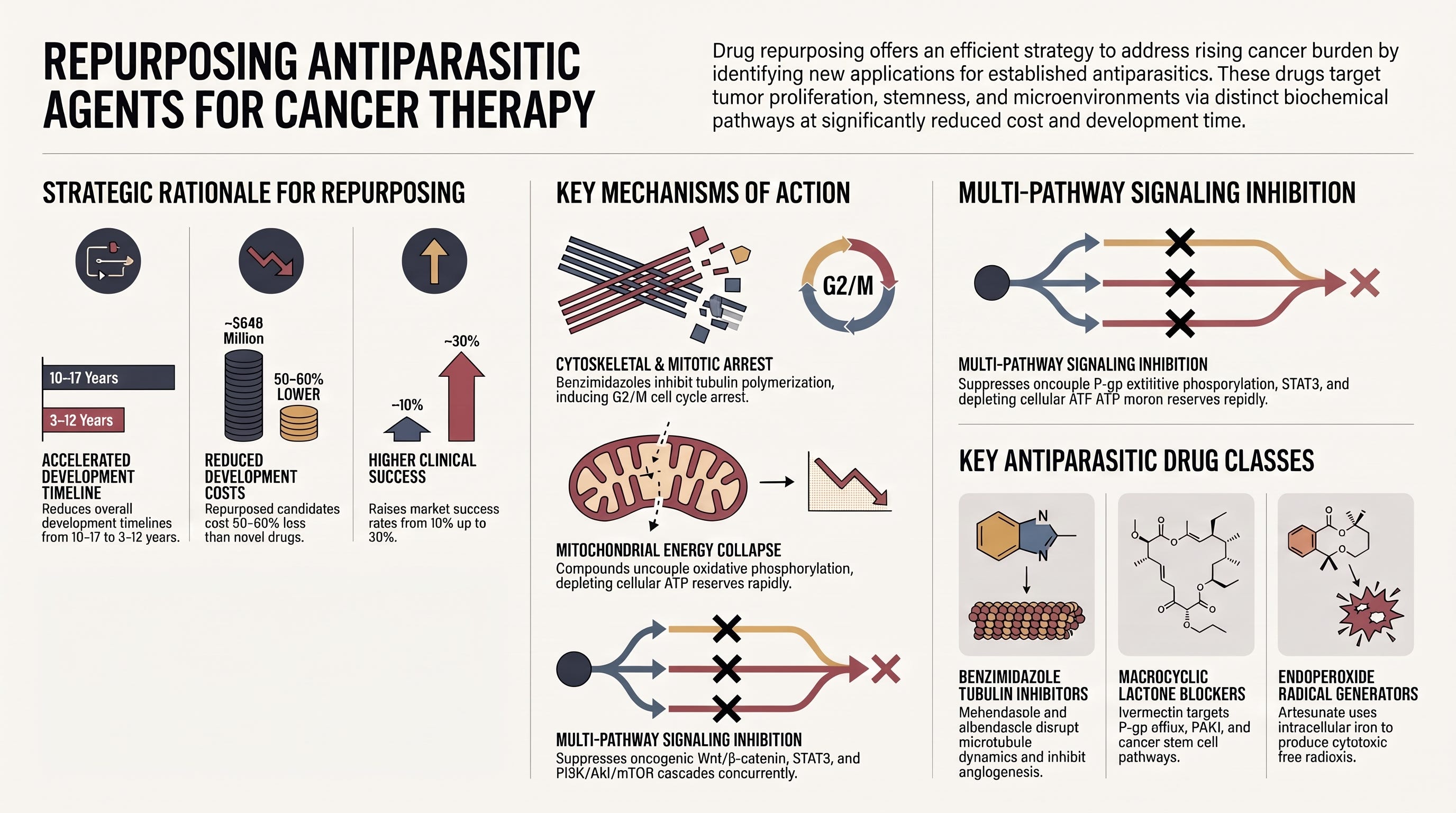
The repurposing of antiparasitic agents in oncology represents an active translational strategy that leverages existing pharmacological and safety profiles to identify cost-effective anticancer therapies. Because de novo cancer drug discovery typically requires 10–17 years and hundreds of millions of dollars with high attrition rates, repositioning approved drugs offers shorter development timelines, reduced development costs, and a higher translational success rate.
Antiparasitic compounds encompass diverse chemical classes that act through distinct, multi-layered mechanisms targeting tumor proliferation, metabolism, cancer stem cells, and the tumor microenvironment:
1. Major Classes and Mechanistic Profiles
Benzimidazoles (Mebendazole, Albendazole, Flubendazole, Fenbendazole)
Cytoskeletal Disruption & Mitotic Catastrophe: Benzimidazoles bind to the colchicine-binding domain of \(\beta\)-tubulin, preventing microtubule polymerization and arresting cancer cells in the G2/M cell-cycle phase, which triggers apoptosis.
Mebendazole: Beyond tubulin inhibition, mebendazole suppresses tumor invasion and cancer stemness (partially via downregulation of integrin \(\beta\)4), inhibits VEGFR-2 autophosphorylation to impair angiogenesis, and downregulates pathways including Wnt/\(\beta\)-catenin, BRAF/MEK/ERK, and STAT3. Due to its lipophilicity and blood–brain barrier penetration, it has generated specific interest in central nervous system malignancies such as glioblastoma.
Albendazole: Rapidly converted into its active metabolite albendazole sulfoxide, it suppresses HIF-1\(\alpha\) and VEGF, reduces glycolytic enzyme activity, and induces non-mitotic apoptosis through oxidative stress, mitochondrial ROS generation, and SIRT3/p38 MAPK pathways.
Flubendazole: Demonstrates high tubulin affinity and is not a P-glycoprotein substrate, minimizing multidrug resistance risks. It triggers caspase-mediated apoptosis, activates autophagy, and promotes p53-mediated ferroptosis via SLC7A11 repression and GPX4 inactivation.
Fenbendazole: While widely used in veterinary medicine, preclinical work indicates that it disrupts microtubules, activates p53, downregulates Mdm2/MdmX, and interferes with glucose uptake and glycolysis by targeting GLUT1 and hexokinase.
