

Repurposed antiparasitic drugs—most notably anthelmintics (such as benzimidazoles, niclosamide, and ivermectin)—have emerged as leading candidates in oncology drug repositioning. Originally developed to combat intestinal helminths, protozoa, and ectoparasites, these compounds have demonstrated multi-targeted antineoplastic activity across solid and hematologic malignancies by interfering with conserved cellular pathways.
1. Primary Classes of Repurposed Antiparasitics
A. Benzimidazoles
Benzimidazoles represent the most extensively investigated antiparasitic class in oncology. Members include human-approved drugs (mebendazole, albendazole) and veterinary agents (fenbendazole, flubendazole, parbendazole, oxibendazole, oxfendazole):
Mebendazole (MBZ): Approved since the 1970s for nematode infections, MBZ demonstrates broad preclinical activity against glioblastoma, medulloblastoma, breast cancer, colorectal carcinoma, melanoma, and non-small cell lung cancer (NSCLC). It penetrates the blood–brain barrier, inhibits angiogenesis, and has advanced into several Phase I/II clinical trials.
Albendazole (ABZ): Approved for systemic tissue cestode/nematode infections (e.g., hydatid disease, neurocysticercosis). ABZ suppresses vascular endothelial growth factor (VEGF), inhibits ascites formation in ovarian cancer, and overcomes multidrug resistance in paclitaxel- and epothilone-resistant cells.
Fenbendazole (FBZ): Extensively used in veterinary medicine, FBZ destabilizes mammalian microtubules at micromolar concentrations, suppresses aerobic glycolysis via hexokinase 2 (HK2) downregulation, and triggers GSDME-mediated pyroptosis and apoptosis in breast and lymphoma models. Published clinical case reports document complete radiographic remissions in genitourinary cancers and diffuse large B-cell lymphoma (DLBCL).
Flubendazole: Demonstrates potent nanomolar cytotoxicity against leukemia, myeloma, neuroblastoma, and breast cancer stem cells by disrupting microtubules, blocking STAT3, and inducing autophagy.
Parbendazole: Preclinical screens identified parbendazole as a potent benzimidazole against pancreatic cancer cell lines (inducing mitotic spindle abnormalities and G2/M arrest) with strong synergy when combined with gemcitabine.
B. Salicylanilides & Quinolines
Niclosamide: An anthelmintic tapeworm medication that uncouples oxidative phosphorylation and blocks key oncogenic signaling pathways, including Wnt/β-catenin, STAT3, Notch, and mTOR, while overcoming radio- and chemoresistance.
Clioquinol & Pyrimethamine: Clioquinol inhibits histone deacetylases (HDACs) and induces p53- and p21-dependent apoptosis in leukemia and myeloma. Pyrimethamine acts as a dihydrofolate reductase (DHFR) and STAT3 antagonist, suppressing tumor invasion in breast and lung cancer models.
C. Macrocyclic Lactones & Others
Ivermectin: An antiparasitic agent active against onchocerciasis and strongyloidiasis that inhibits the nuclear transporter KPNB1, blocks Wnt/β-catenin signaling, suppresses cancer stem-cell properties, and synergizes with paclitaxel and cisplatin.
Levamisole: Acts as an adjuvant to 5-fluorouracil (5-FU) in colon cancer models and downregulates cyclins to arrest cells in G0/G1.
Pyrvinium Pamoate: An anthelmintic that inhibits Wnt and Hedgehog signaling, specifically targeting colon and pancreatic cancer cells under hypoglycemic/hypoxic microenvironments.
2. Core Antineoplastic Mechanisms of Action
Repurposed antiparasitics act as “dirty” or polypharmacological agents, attacking multiple cancer survival pathways simultaneously:
Microtubule Destabilization: Benzimidazoles bind to the colchicine-binding domain of β-tubulin, depolymerizing microtubules, forming abnormal mitotic spindles, and arresting cells at the G2/M cell cycle transition.
Inhibition of Angiogenesis & Hypoxia Signaling: Multiple anthelmintics (ABZ, MBZ, FBZ) downregulate hypoxia-inducible factor 1-alpha (HIF-1α) and reduce VEGF secretion, thereby curbing tumor neovascularization and malignant ascites.
Reversal of Cancer Stemness & Metastasis: MBZ downregulates integrin β4 (ITGβ4), suppresses stemness markers (CD44, ALDH1), and restricts distant lung and liver metastases.
Protein Kinase & Oncogenic Signaling Blockade: MBZ and related benzimidazoles act as multityrosine kinase and signaling inhibitors, targeting VEGFR2, BRAF, MEK/ERK, TNIK (disrupting Wnt/β-catenin), MAPK14 (p38α), and Hedgehog/SMO pathways.
Metabolic Disruption: Benzimidazoles downregulate glucose transporters (GLUT) and hexokinase 2 (HK2), impairing aerobic glycolysis (the Warburg effect) and depleting intracellular ATP.
Immune Reprogramming: In tumor microenvironments, MBZ promotes the repolarization of immunosuppressive M2 macrophages into the proinflammatory, antitumoral M1 phenotype via TLR8- and ERK1/2-dependent pathways.
3. Clinical Evidence & Translational Status
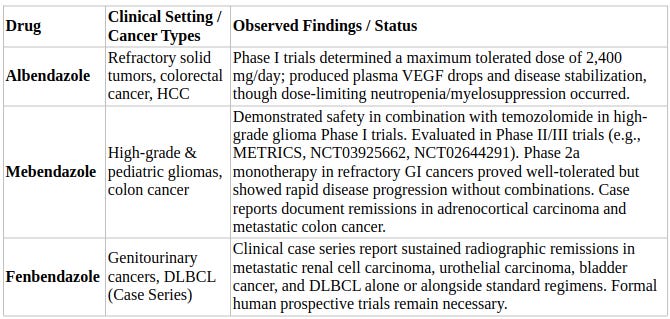
4. Key Translational Challenges
Poor Aqueous Solubility & Low Oral Bioavailability: Classical antiparasitics were engineered intentionally for poor systemic absorption to maximize gut retention against luminal parasites. In systemic cancer indications, oral absorption is low and variable.
Formulation Innovations: To reach therapeutic plasma and tissue concentrations, advanced delivery strategies are actively being developed, including nanoparticles (e.g., PLGA nanoparticles, albumin conjugates), polymeric micelles, cyclodextrin complexes, and lipid nanosuspensions.
Regulation & Human Dosing: Veterinary agents (such as fenbendazole) lack standardized human pharmacokinetic and toxicology trials, underscoring the distinction between human-approved candidates (MBZ, ABZ) and animal compounds.
Sources
1. Comprehensive Reviews on Antiparasitic & Anthelmintic Repurposing
(Providing the primary foundation for multi-target mechanisms, non-benzimidazole classes like niclosamide/ivermectin, and clinical trial landscapes)
Alavi, S. E., & Shahmabadi, H. E. (2021). Anthelmintics for drug repurposing: Opportunities and challenges. Saudi Pharmaceutical Journal, 29(5), 434–445.
Chai, J.-Y., Jung, B.-K., & Hong, S.-J. (2021). Albendazole and mebendazole as anti-parasitic and anti-cancer agents: An update. The Korean Journal of Parasitology, 59(3), 189–225. https://doi.org/10.3347/kjp.2021.59.3.189
Guerini, A. E., Triggiani, L., Maddalo, M., Bonù, M. L., Frassine, F., Baiguini, A., Alghisi, A., Tomasini, D., Borghetti, P., Pasinetti, N., Bresciani, R., Magrini, S. M., & Buglione, M. (2019). Mebendazole as a candidate for drug repurposing in oncology: An extensive review of current literature. Cancers, 11(9), Article 1284. https://doi.org/10.3390/cancers11091284
Mohi-ud-din, R., Chawla, A., Sharma, P., Mir, P. A., Potoo, F. H., Reiner, Ž., Reiner, I., Ateşşahin, D. A., Sharifi-Rad, J., Mir, R. H., & Calina, D. (2023). Repurposing approved non-oncology drugs for cancer therapy: A comprehensive review of mechanisms, efficacy, and clinical prospects. European Journal of Medical Research, 28(1), Article 345. https://doi.org/10.1186/s40001-023-01275-4
Son, D.-S., Lee, E.-S., & Adunyah, S. E. (2020). The antitumor potentials of benzimidazole anthelmintics as repurposing drugs. Immune Network, 20(4), Article e29. https://doi.org/10.4110/in.2020.20.e29
Aliabadi, A., Moradi, S. Z., Abdian, S., & Fakhri, S. (2025). Critical dysregulated signaling pathways in drug resistance: Highlighting the repositioning of mebendazole for cancer therapy. Frontiers in Pharmacology, 16, Article 1631419. https://doi.org/10.3389/fphar.2025.1631419
2. Clinical Case Reports & Clinical Trials
(Covering patient responses, tolerability, trial protocols, and translational outcomes)
Cheng, R., & Araujo, D. V. (2026). Case report: Metastatic melanoma with initial ctDNA decline and radiographic response during self-directed antiparasitic use: Treatment effect or spontaneous regression? Frontiers in Oncology, 16, Article 1907192.
Chiang, S. P.-H. (2021). Fenbendazole enhancing antitumor effect: A case series. Case Reports in Oncology, 14(2), 1094–1100.
Gallia, G. L., Holdhoff, M., Brem, H., Joshi, A. D., Hann, C. L., Bai, R.-Y., Staedtke, V., Blakeley, J. O., Sengupta, S., Jarrell, T. C., & Riggins, G. J. (2021). Mebendazole and temozolomide in patients with newly diagnosed high-grade gliomas: Results of a phase 1 clinical trial. Neuro-Oncology Advances, 3(1), Article vdaa154.
Mansoori, S., Fryknäs, M., Alvfors, C., Loskog, A., Larsson, R., & Nygren, P. (2021). A phase 2a clinical study on the safety and efficacy of individualized-dose mebendazole in patients with advanced gastrointestinal cancer. Scientific Reports, 11(1), Article 8981. https://doi.org/10.1038/s41598-021-88433-y
3. Key Preclinical Investigations & Target Mechanism Studies
(Validating specific molecular targets such as ITGβ4 stemness, HIF-1α, synergy with chemotherapy, and high-throughput screens)
Florio, R., Veschi, S., di Giacomo, V., Pagotto, S., Carradori, S., Verginelli, F., Cirilli, R., Casulli, A., Grassadonia, A., Tinari, N., Cataldi, A., Amoroso, R., Cama, A., & De Lellis, L. (2019). The benzimidazole-based anthelmintic parbendazole: A repurposed drug candidate that synergizes with gemcitabine in pancreatic cancer. Cancers, 11(12), Article 2042.
Joe, N. S., Godet, I., Milki, N., Ain, N. U. I., Oza, H. H., Riggins, G. J., & Gilkes, D. M. (2022). Mebendazole prevents distant organ metastases in part by decreasing ITGβ4 expression and cancer stemness. Breast Cancer Research, 24(1), Article 98. https://doi.org/10.1186/s13058-022-01591-3
Mansoori, S., Blom, K., Andersson, C., Loskog, A., Larsson, R., & Fryknäs, M. (2025). Characterization of the anticancer effect of mebendazole and its interaction with standard cytotoxic drugs in patient tumor cells ex vivo and in an in vivo mouse model. Oncology Reports, 55(1), Article 9014. https://doi.org/10.3892/or.2025.9014
Petersen, J. S. S. M., & Baird, S. K. (2021). Treatment of breast and colon cancer cell lines with anti-helmintic benzimidazoles mebendazole or albendazole results in selective apoptotic cell death. Journal of Cancer Research and Clinical Oncology, 147(10), 2945–2953. https://doi.org/10.1007/s00432-021-03698-0
Pourgholami, M. H., Cai, Z. Y., Badar, S., Wangoo, K., Poruchynsky, M. S., & Morris, D. L. (2010). Potent inhibition of tumoral hypoxia-inducible factor 1α by albendazole. BMC Cancer, 10(1), Article 143.
Varbanov, H. P., Kuttler, F., Banfi, D., Turcatti, G., & Dyson, P. J. (2017). Repositioning approved drugs for the treatment of problematic cancers using a screening approach. PLOS ONE, 12(2), Article e0171052.