
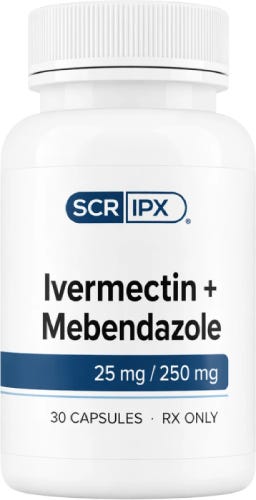
Discussions of alternative and off-label cancer treatments focused on repurposed antiparasitic medications—specifically fenbendazole, ivermectin, and mebendazole—integrated into metabolic protocols or used alongside standard oncology care.
1. Core Off-Label Antiparasitic Agents
Fenbendazole (FBZ): A veterinary benzimidazole dewormer popularized by the Joe Tippens Protocol. Mechanistically, it binds \(\beta\)-tubulin to disrupt mitotic spindles, inhibits GLUT1/3 glucose transporters, impairs mitochondrial respiration, and induces p53-dependent/independent apoptosis and ferroptosis.
Ivermectin (IVM): An FDA-approved macrocyclic lactone that targets cancer stem cells (CSCs) and downregulates oncogenic signaling pathways including Wnt/\(\beta\)-catenin, PAK1, and EGFR/Akt. Preclinical models indicate it can convert immunologically “cold” tumors into “hot” tumors by promoting T-cell infiltration.
Mebendazole (MBZ): An FDA-approved human antiparasitic with high lipophilicity, enabling it to cross the blood-brain barrier (BBB). It inhibits tubulin polymerization, blocks glucose and glutamine utilization, and triggers mitochondrial apoptosis in brain tumors and solid malignancies.
2. Multi-Pathway & Metabolic Protocols
Joe Tippens Protocol: Combines fenbendazole (commonly 222 mg to 1,000 mg daily) with bioavailable curcumin, berberine, CBD oil, and vitamin D3.
Hybrid Orthomolecular Protocols: Layer high-dose ivermectin and benzimidazoles with metabolic strategies—such as low-carbohydrate/ketogenic diets, periodic fasting, hyperbaric oxygen therapy (HBOT), modified citrus pectin (MCP), and high-dose intravenous vitamin C—to restrict fermentable fuels (glucose/glutamine) while stressing tumor mitochondria.
The METRICS Protocol: A 4-drug adjunctive regimen combining mebendazole (100 mg/day), metformin, atorvastatin, and doxycycline alongside standard chemoradiation in glioblastoma.
3. Clinical Case Series & Real-World Outcomes
760+ Case Compilation: Publicly reported case archives document outcomes across more than 20 tumor types (including breast, brain, lung, prostate, colorectal, lymphoma, leukemia, and sarcoma).
Hulscher et al. (2026) Cohort Study: In a prospective observational study of 122 patients completing a 6-month follow-up on compounded ivermectin (25 mg) and mebendazole (250 mg), 84.4% reported clinical benefit (defined as no evidence of disease, tumor shrinkage, or disease stabilization).
Intracranial Tumors (GBM): The METRICS study reported an increase in median overall survival from ~15 to ~27 months in glioblastoma. In a 38-case compilation of high-grade brain tumors, 97% reported tumor stability, partial regression, or complete remission.
Breast Cancer: Analysis of over 130 case reports documents pathological complete responses (pCR), radiographic regression of bone and visceral metastases, and clearance of circulating tumor DNA (ctDNA) across hormone-receptor-positive and Triple-Negative Breast Cancer (TNBC) subtypes.
4. Methodological Limitations & Scientific Caveats
Causal Ambiguity & Chemosensitization: Over 70–80% of reported success stories involve patients taking repurposed antiparasitics concurrently with standard chemotherapy, radiation, targeted agents, or immunotherapies. Consequently, responses cannot be definitively attributed to the antiparasitic agent alone; they suggest treatment synergy or a chemosensitization effect.
Selection & Survivorship Bias: Crowd-sourced and practitioner-shared registries naturally capture positive outcomes while omitting non-responders, dropouts, or disease progression.
Lack of Randomized Controlled Trials (RCTs): While laboratory and observational data provide biological plausibility, no completed Phase III randomized controlled trials establish these off-label regimens as standard or standalone cancer cures.
Safety & Interaction Risks: High-dose, long-term off-label use carries risks of transient liver enzyme elevation, drug-induced liver injury, and CYP3A4/P-glycoprotein drug interactions with standard chemotherapeutics, requiring medical supervision and regular bloodwork monitoring.
Hulscher N, Victory K, Thorp JA, Pinsky D, Diaz-Villalobos A, Gillooly P, Coulson F, Annazone M, Radesi C, Brooks J, McCullough PA, Risch H. Real-world Clinical Outcomes of Ivermectin and Mebendazole in Cancer Patients: Results from a Prospective Observational Cohort. Anticancer Res. 2026 Jun;46(6):3243-3255. doi: 10.21873/anticanres.18194. PMID: 42203321.
https://ar.iiarjournals.org/content/anticanres/46/6/3243.full.pdf