
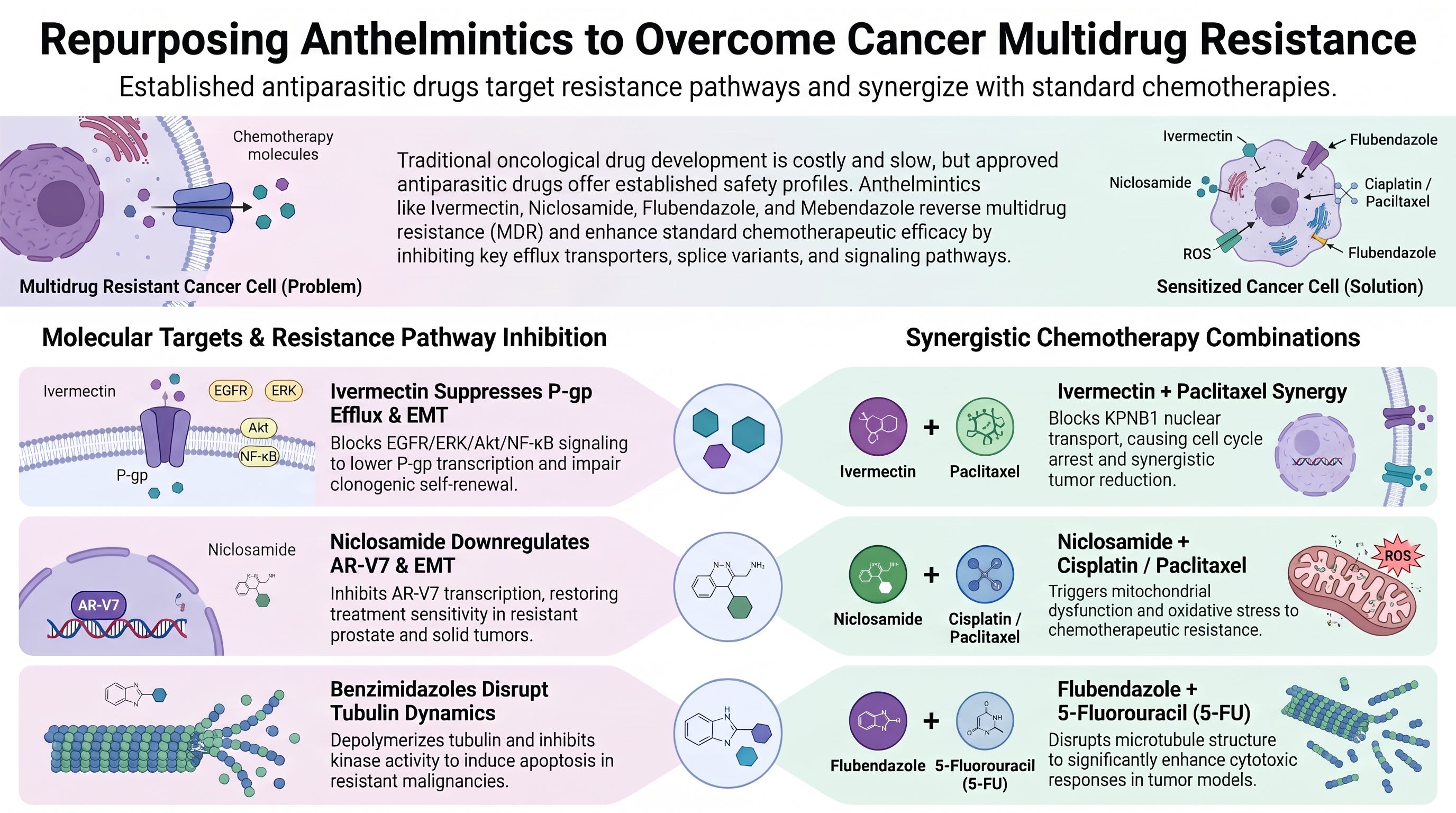
Combining anthelmintic and repurposed drugs with standard chemotherapeutic agents (such as 5-fluorouracil, oxaliplatin, cisplatin, and paclitaxel) is a leading strategy to overcome multidrug resistance (MDR)
Drug repositioning, which involves discovering novel clinical benefits of medications already approved for other diseases, serves as a promising alternative to the traditional, costly, and lengthy process of developing new cancer treatments. Because these established compounds already have well-documented safety, toxicity, pharmacokinetics, and pharmacodynamics profiles, researchers can significantly shorten timelines and reduce the financial burden of bringing new oncology therapies to clinical trials. This comprehensive review summarizes prominent examples of repurposed non-oncological drugs—ranging from antiparasitics and antibiotics to psychiatric medications—by detailing their primary medical uses, proposed anticancer mechanisms, and current development status. Ultimately, this strategy highlights how repurposing existing pharmaceutical assets can pave the way toward faster, more affordable, and more effective therapeutic solutions for patients battling cancer.
Repurposing anthelmintics and other non-oncology therapeutics reveals a diverse range of anticancer mechanisms that target key cellular structures, signaling networks, energy metabolism, and immune responses:
1. Tubulin Depolymerization & Mitotic Arrest
Microtubule Disruption: Benzimidazole derivatives—such as mebendazole, albendazole, and flubendazole—selectively bind tubulin subunits, inhibit microtubule polymerization, and compromise cellular structural integrity.
Cell Cycle Blockade: Disruption of microtubule dynamics induces G0/G1 or G2/M phase cell cycle arrest, alters cyclin B1 and cyclin D1 expression, and prevents successful mitotic division in malignant cells.
2. Targeting Key Oncogenic Signaling Cascades
Wnt/β-Catenin Pathway:
Niclosamide downregulates Dishevelled-2 (Dvl2) and disrupts the β-catenin–Bcl9–LEF/TCF complex via autophagy induction.
Nitazoxanide targets peptidyl arginine deiminase 2 (PADI2) to promote β-catenin citrullination and degradation.
Pyrvinium pamoate binds and activates casein kinase 1α (CK1α), phosphorylating β-catenin and degrading the transcriptional co-activator Pygopus.
Ivermectin represses β-catenin phosphorylation and blocks Wnt-TCF targets (e.g., AXIN2, LGR5, ASCL2) to suppress cancer stem-cell self-renewal.
STAT3 Pathway: Niclosamide and pimozide inhibit the phosphorylation and activation of the oncogenic transcription factor STAT3, downregulating pro-survival genes and restoring drug sensitivity.
MAPK/ERK & PI3K/Akt Pathways: Mebendazole suppresses p-MEK1/2 and p-ERK1/2 in liver cancer models, while rafoxanide inhibits the PI3K/Akt/mTOR pathway to induce cell death in gastric and colorectal cancers.
3. Induction of ER Stress, Apoptosis & Immunogenic Cell Death
Endoplasmic Reticulum (ER) Stress & Caspase Activation: Niclosamide triggers ER stress by elevating reactive oxygen species (ROS) and activating the PERK–ATF3 axis. Rafoxanide selectively induces ER stress, leading to cyclin D1 downregulation and caspase-dependent apoptosis.
Immunogenic Cell Death (ICD): Rafoxanide functions as an ICD inducer by triggering autophagy and promoting the release of damage-associated molecular patterns (DAMPs), including ecto-calreticulin exposure and ATP/HMGB1 release, which stimulates anti-tumor immune responses.
4. Metabolic Disruption & Mitochondrial Dysfunction
Uncoupling Oxidative Phosphorylation: Salicylanilides (e.g., niclosamide, rafoxanide) uncouple mitochondrial oxidative phosphorylation, dissipating membrane potential and depleting cellular ATP.
Mitochondrial Respiratory Chain Inhibition: Nitazoxanide and its derivatives target mitochondrial complex III, activating the AMPK energy-sensor pathway while suppressing mTOR and c-Myc.
Exploiting Glucose Starvation: Pyrvinium pamoate preferentially exerts severe toxicity under glucose deprivation by inhibiting Akt phosphorylation and suppressing unfolded protein response (UPR) chaperones such as GRP78 and GRP94.
Complex I Inhibition: Metformin inhibits mitochondrial complex I, triggering an energetic crisis through ATP depletion and AMPK activation.
5. Inhibition of Angiogenesis & Metastasis
VEGF Suppression: Albendazole inhibits vascular endothelial growth factor (VEGF) production and suppresses tumor neovascularization.
Adhesion & Migration Blockade: Flubendazole and mebendazole decrease the expression of cell adhesion and metastatic markers (ICAM-1, EpCAM, integrins, COX-2, MYC), impairing tumor cell motility and secondary lesion formation.
Combining anthelmintic and repurposed drugs with standard chemotherapeutic agents (such as 5-fluorouracil, oxaliplatin, cisplatin, and paclitaxel) is a leading strategy to overcome multidrug resistance (MDR), re-sensitize refractory tumor cells, and lower required chemotherapy dosages.
Overcoming Drug Resistance
1. Reversal of P-Glycoprotein (P-gp / MDR1) Efflux Pumps
Multidrug resistance frequently stems from overexpressed P-glycoprotein (P-gp) efflux pumps that actively transport chemotherapeutics out of tumor cells:
Ivermectin: Directly reverses drug resistance by binding the extracellular domain of EGFR, suppressing the downstream ERK/Akt/NF-κB signaling cascade, and downregulating P-gp transcription.
Albendazole & Mebendazole: Retain antiproliferative cytotoxicity in paclitaxel-resistant (e.g., 1A9PTX22 human ovarian cancer) and epothilone-resistant leukemia cell lines because their distinct tubulin-binding sites bypass taxane-binding site mutations and efflux mechanisms.
Pimozide & Chlorpromazine: Act as direct P-gp inhibitors, blocking efflux activity, preventing multidrug resistance, and increasing intracellular accumulation of co-administered chemotherapeutics.
2. Synergy with Fluoropyrimidines (5-FU & Capecitabine)
Flubendazole: Demonstrates marked chemosensitization, significantly enhancing the cytotoxic efficiency of 5-fluorouracil (5-FU), doxorubicin, vinblastine, and vincristine in combined regimens.
Zidovudine (AZT): Synergizes with 5-FU and leucovorin by accelerating telomere degradation and inducing DNA single-strand breaks in metastatic colorectal cancer models.
Valproic Acid: Potentiates capecitabine activity in breast cancer models by inducing the expression of thymidine phosphorylase, the key enzyme responsible for converting capecitabine to its active metabolite, 5-FU.
3. Sensitizing Tumors to Platinum Agents (Cisplatin & Oxaliplatin)
Niclosamide: Reverses cisplatin resistance in triple-negative breast cancer (TNBC) and renal cell carcinoma by suppressing the epithelial-mesenchymal transition (EMT) phenotype and inhibiting Akt, ERK, Src, and STAT3 signaling pathways.
Zidovudine & Disulfiram: Enhance the apoptotic activity of cisplatin and overcome DNA repair resistance mechanisms in solid tumor models.
4. Potentiating Taxanes (Paclitaxel & Docetaxel)
Ivermectin + Paclitaxel: Produces potent synergistic antitumor effects in ovarian cancer by blocking nuclear transport factor KPNB1 function, promoting apoptosis, and suppressing cell cycle progression.
Niclosamide + Paclitaxel: Sensitizes cervical cancer cells to paclitaxel by inducing mitochondrial dysfunction, increasing oxidative stress (ROS), and suppressing mTOR signaling.
Desmopressin + Docetaxel: Combines with docetaxel to inhibit cell proliferation and invasion mediated by urokinase-type plasminogen activator (uPA) in castration-resistant prostate cancer.
5. Overcoming Targeted Therapy Resistance
Erlotinib Resistance: Niclosamide suppresses radiation- and ligand-induced STAT3 activation, restoring sensitivity in erlotinib-resistant non-small cell lung cancer (NSCLC) cells.
Enzalutamide & Bicalutamide Resistance: Niclosamide downregulates androgen receptor splice variants (such as AR-V7), overcoming antiandrogen resistance in castration-resistant prostate cancer.
Vemurafenib & Temozolomide Resistance: Chloroquine and disulfiram override resistance to BRAF inhibitors (vemurafenib) and alkylating agents (temozolomide) in glioblastoma and melanoma models by blocking autophagic degradation and p97/NPL4 segregase pathways.
Armando, R. G., Mengual Gómez, D. L., & Gomez, D. E. (2020). New drugs are not enough—drug repositioning in oncology: An update. International Journal of Oncology, 56(3), 651–684.