
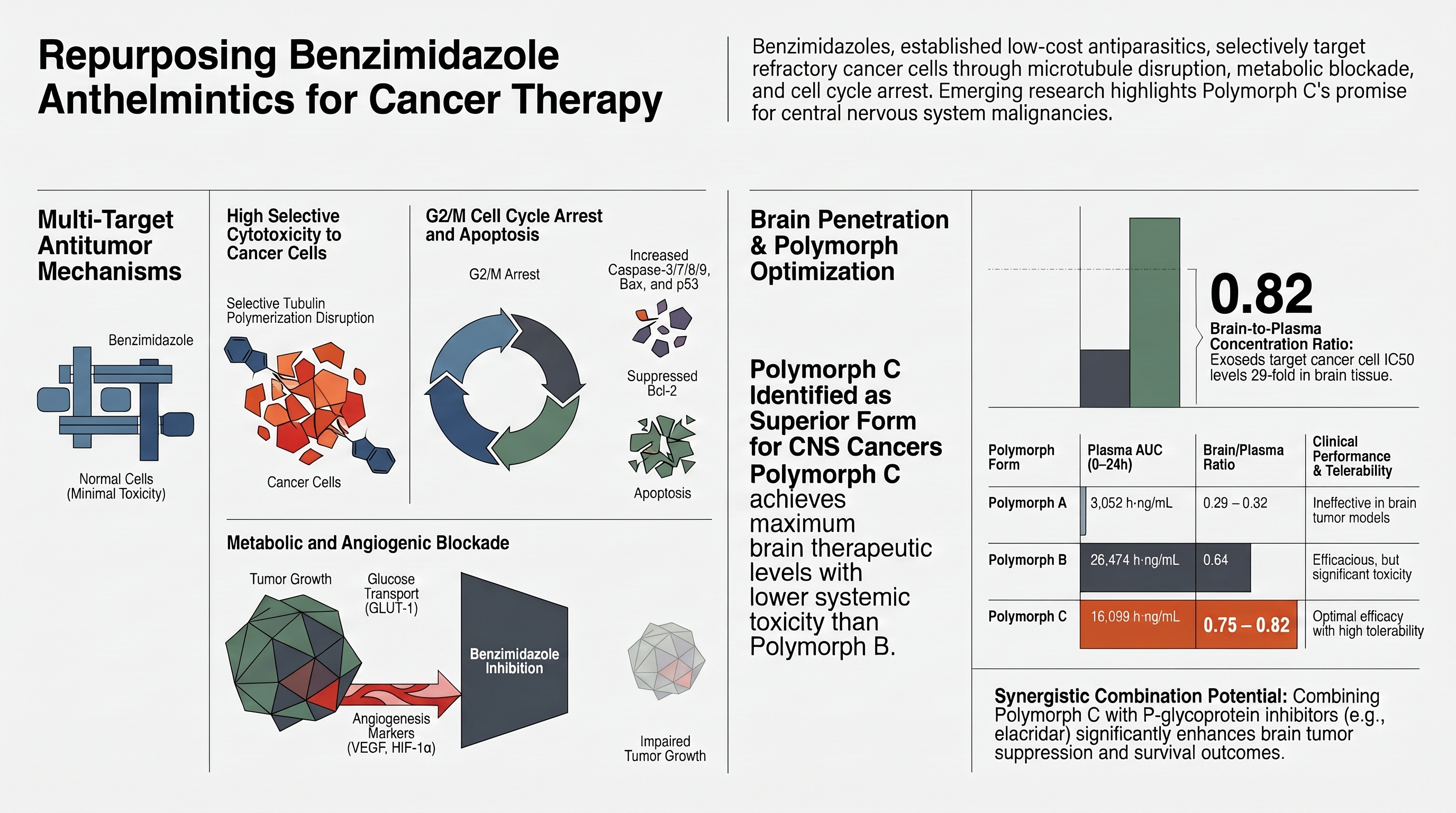
Anticancer Benzimidazoles
Benzimidazole anthelmintics are a class of broad-spectrum antiparasitic compounds developed since the 1960s and actively researched as repurposed anticancer therapeutics.
Originally designed to selectively target parasitic β-tubulin, these compounds use a multi-targeted (pleiotropic) mechanism that disrupts tumor progression, overcomes multidrug resistance, and spares normal, non-transformed host cells.
1. Classification & Key Representatives
Benzimidazoles are heterocyclic aromatic compounds with a fused benzene-imidazole ring. They are categorized based on regulatory approvals and target species:
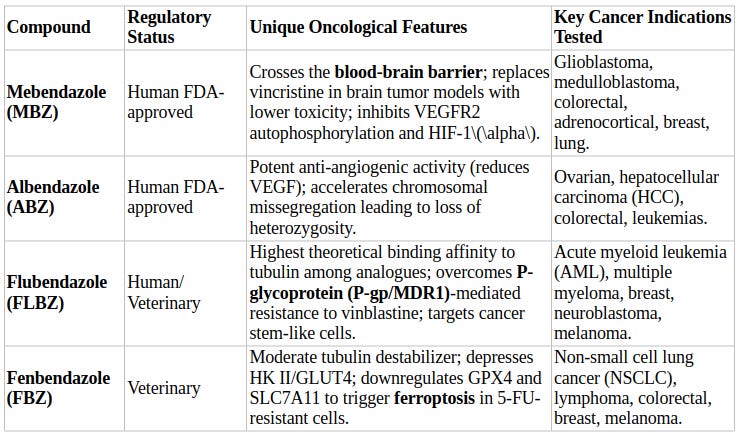
Human-Approved Anthelmintics: Mebendazole (MBZ), Albendazole (ABZ), Flubendazole (FLBZ), and Ricobendazole. Because of their established safety track records in human medicine, MBZ and ABZ are the primary focus of active oncology clinical trials.
Veterinary Anthelmintics: Fenbendazole (FBZ), Oxfendazole, Oxibendazole, and Parbendazole.
Primary Oncological Benzimidazole Derivatives: Synthetic derivatives specifically developed for cancer chemotherapy, including Bendamustine (FDA-approved for CLL and lymphoma), Selumetinib, Binimetinib, and Pracinostat.
2. Core Biological Mechanisms in Cancer
Benzimidazole anthelmintics interfere with multiple hallmark pathways of cancer:
Microtubule Disruption & G2/M Mitotic Arrest: Benzimidazoles bind to β-tubulin (predominantly at or near the colchicine-binding site), inhibiting microtubule polymerization and spindle assembly. This leads to a cell cycle block at the G2/M transition, marked by increased phospho-Histone H3 (pH3) and cyclin B1, triggering mitotic catastrophe and apoptotic cell death.
Disruption of Cancer Energy Metabolism & Hypoxia: They impair tumor bioenergetics by inhibiting cellular glucose uptake, downregulating GLUT-1/4 glucose transporters, and suppressing Hexokinase II (HK II) activity. Furthermore, compounds like MBZ and ABZ block HIF-1α, HIF-2α, and HIF-1β induction under hypoxic conditions, reversing hypoxia-mediated chemoresistance.
Selective Redox Modulation: They selectively induce cytotoxic spikes in reactive oxygen species (ROS) in cancer cells—surpassing the lethal apoptotic threshold—while suppressing ROS and preserving viability in normal epithelial cells.
Inhibition of Key Oncogenic Signaling Cascades:
Hedgehog / GLI Signaling: MBZ potently inhibits Hedgehog signaling and promotes GLI transcription factor degradation.
Wnt / β-Catenin Pathway: MBZ directly inhibits TNIK (TRAF2- and NCK-interacting kinase), disrupting the β-catenin/TCF4 transcriptional complex.
Pro-Survival & Metastatic Pathways: Downregulates NF-κB, pSTAT3, c-Src, c-Myb, HER2/3, and matrix metalloproteinases (MMP-2/9).
3. Key Compound Profiles
4. Overcoming Chemoresistance & Bioavailability Challenges
Bypassing Efflux Pumps: Unlike taxanes or vinca alkaloids, benzimidazole anthelmintics like FBZ and FLBZ are neither substrates nor inhibitors of P-glycoprotein (P-gp/MDR1), allowing them to remain effective against multidrug-resistant tumor cells.
Formulation Strategies for Low Bioavailability: All benzimidazoles exhibit poor aqueous solubility and low GI absorption. Administering them with fatty meals improves systemic exposure. Modern formulation strategies—such as β-cyclodextrin complexes, polymeric micelles (e.g., Soluplus, PLGA), nano-albumin formulations (Nab-ABZ), and solid lipid nanoparticles—are currently utilized to enhance systemic drug delivery and tumor uptake.
References
Abughanimeh, O., Evans, T., & Kallam, A. (2020). Fenbendazole as a treatment for diffuse large B-cell lymphoma. Annals of Hematology & Oncology, 7(2), Article 1284.
Bai, R.-Y., Staedtke, V., Aprhys, C. M., Gallia, G. L., & Riggins, G. J. (2011). Antiparasitic mebendazole shows survival benefit in 2 preclinical models of glioblastoma multiforme. Neuro-Oncology, 13(9), 974–982. [suspicious link removed]
Bai, R.-Y., Staedtke, V., Rudin, C. M., Bunz, F., & Riggins, G. J. (2015). Effective treatment of diverse medulloblastoma models with mebendazole and its impact on tumor angiogenesis. Neuro-Oncology, 17(4), 545–554. [suspicious link removed]
Bai, R.-Y., Staedtke, V., Wanjiku, T., Rudek, M. A., Joshi, A., Gallia, G. L., & Riggins, G. J. (2015). Brain penetration and efficacy of different mebendazole polymorphs in a mouse brain tumor model. Clinical Cancer Research, 21(15), 3462–3470. https://doi.org/10.1158/1078-0432.CCR-14-2681
Bieging, K. T., & Attardi, L. D. (2012). Deconstructing p53 transcriptional networks in tumor suppression. Trends in Cell Biology, 22(2), 97–106. [suspicious link removed]
de la Torre-Iglesias, P. M., García-Rodriguez, J. J., Torrado, G., Torrado, S., Torrado-Santiago, S., & Bolás-Fernández, F. (2014). Enhanced bioavailability and anthelmintic efficacy of mebendazole in redispersible microparticles with low-substituted hydroxypropylcellulose. Drug Design, Development and Therapy, 8, 1467–1479. [suspicious link removed]
De Witt, M., Gamble, A., Hanson, D., Markowitz, D., Powell, C., Al-Ahmadie, H. A., & Symons, M. (2017). Repurposing mebendazole as a replacement for vincristine for the treatment of brain tumors. Molecular Medicine, 23, 50–56. [suspicious link removed]
Ding, Y., Zhang, Z., Ding, C., Xu, S., & Xu, Z. (2024). Preparation and evaluation of fenbendazole methyl-β-cyclodextrin inclusion complexes. BMC Veterinary Research, 20(1), Article 214. [suspicious link removed]
Duan, Q., Liu, Y., & Rockwell, S. (2013). Fenbendazole as a potential anticancer drug. Anticancer Research, 33(2), 355–362.
Freisleben, F., Modemann, F., Muschhammer, J., Stamm, H., Brauneck, F., Krispien, A., Bokemeyer, C., Kirschner, K. N., Wellbrock, J., & Fiedler, W. (2021). Mebendazole mediates proteasomal degradation of GLI transcription factors in acute myeloid leukemia. International Journal of Molecular Sciences, 22(19), Article 10670. [suspicious link removed]
Gao, P., Dang, C. V., & Watson, J. (2008). Unexpected antitumorigenic effect of fenbendazole when combined with supplementary vitamins. Journal of the American Association for Laboratory Animal Science, 47(6), 37–40.
Garona, J., Pifano, M., Scursoni, A. M., Gomez, D. E., Alonso, D. F., & Ripoll, G. V. (2020). Repurposing of anthelmintic and antiparasitic drugs in oncology. International Journal of Oncology, 56(3), 651–680. [suspicious link removed]
Golla, U., Patel, S., Shah, N., Talamo, S., Bhalodia, R., Claxton, D., Dovat, S., & Sharma, A. (2024). From deworming to cancer therapy: Benzimidazoles in hematological malignancies. Cancers, 16(19), Article 3454. [suspicious link removed]
Guerini, A. E., Triggiani, L., Maddalo, M., Bonù, M. L., Frassine, F., Baiguini, A., Alghisi, A., Tomasini, D., Borghetti, P., Pasinetti, N., Biti, G., & Magrini, S. M. (2019). Mebendazole as a candidate for drug repurposing in oncology: An extensive review of current literature. Cancers, 11(9), Article 1284. [suspicious link removed]
Huang, L., Zhang, L., Zhang, J., Zhao, L., He, F., Wang, H., Liu, Q., Shi, D., Ni, N., Shu, Y., Zeng, Z., Huang, B., Huang, S., Lei, Y., Ye, Z., Cao, D., Yang, L., Wu, D., Feng, Y., ... He, T.-C. (2021). Mebendazole sensitizes chemoresistant human ovarian cancer cells to cisplatin-induced cytotoxicity and tumor growth inhibition. Aging (Albany NY), 13(18), 22305–22325. [suspicious link removed]
Joe, N. S., Wang, Y., Oza, H. H., Godet, I., Milki, N., Riggins, G. J., & Gilkes, D. M. (2023). Mebendazole treatment disrupts the transcriptional activity of hypoxia-inducible factors 1 and 2 in breast cancer cells. Cancers, 15(4), Article 1330. [suspicious link removed]
Karimi, A., Barea, P., Benito-Román, Ó., Blanco, B., Sanz, M. T., Higginbotham, C. L., & Lyons, J. G. (2025). Investigation of fenbendazole solubility using particle size reduction methods in the presence of Soluplus®. Pharmaceutics, 17(9), Article 1163. [suspicious link removed]
Larsen, A. R., Bai, R.-Y., Chung, J. H., Borodovsky, A., Rudin, C. M., Riggins, G. J., & Bunz, F. (2015). Repurposing the antihelmintic mebendazole as a hedgehog inhibitor. Molecular Cancer Therapeutics, 14(1), 3–13. [suspicious link removed]
Laudisi, F., Marônek, M., Di Grazia, A., Monteleone, G., & Stolfi, C. (2020). Repositioning of anthelmintic drugs for the treatment of cancers of the digestive system. International Journal of Molecular Sciences, 21(14), Article 4957. [suspicious link removed]
Lei, X., Wang, Y., Chen, Y., Duan, J., Gao, X., & Cong, Z. (2025). Fenbendazole exhibits antitumor activity against cervical cancer through dual targeting of cancer cells and cancer stem cells: Evidence from in vitro and in vivo models. Molecules, 30(11), Article 2377. [suspicious link removed]
Li, Y., Thomas, D., Deutzmann, A., Majeti, R., Felsher, D. W., & Dill, D. L. (2019). Mebendazole for differentiation therapy of acute myeloid leukemia identified by a lineage maturation index. Scientific Reports, 9(1), Article 16775. https://doi.org/10.1038/s41598-019-53290-3