

Focus:
Brain Tumors (Glioblastoma): Using lipid systems capable of crossing the blood-brain barrier to target aggressive, temozolomide-resistant cerebral tumors.
Colorectal Cancer: Bypassing traditional therapy resistance by localized colonic release.
Ovarian Cancer: Overcoming systemic administration barriers via nab-nanoparticles and intraperitoneal tumor target designs.
Hepatocellular Carcinoma: Utilizing liver-selective uptake vectors (such as glucan or chitosan-lipid carriers) to concentrate the active drug directly inside hepatic lesions.
This academic review explores the therapeutic evolution of Albendazole, a traditional medication used to treat global parasitic infections. The authors address a critical pharmacological hurdle: the drug’s low aqueous solubility and oral bioavailability, which currently limit its clinical effectiveness. To overcome these barriers, the text details innovative nanomedicine approaches, such as nanocarriers, lipid systems, and solid dispersions, designed to improve drug absorption and targeting. Beyond its role as an anthelmintic, the source emphasizes the significant potential for drug repurposing, providing evidence that Albendazole can be repositioned as an anticancer agent for treating tumors in the brain, breast, and colon. Ultimately, the paper consolidates recent scientific advances to show how modern delivery systems can maximize the medicinal impact of this versatile compound.
Albendazole Repurposing and Nanomedicine Strategies in Oncology
The clinical development of repurposed therapeutics offers a powerful, fast-tracked route in oncology. Because these compounds are already approved for other indications, their safety, tolerability, and toxicological profiles are well established, dramatically reducing early-stage discovery risks and clinical timelines.
The selected source highlights the anti-parasitic drug albendazole (ABZ) as a premier candidate for cancer repurposing. Preclinical and clinical models demonstrate that albendazole targets multiple hallmark pathways of cancer cell survival and proliferation:
1. Broad-Spectrum Molecular Mechanisms of Repurposed Albendazole
While originally designed to disrupt parasite tubulin, albendazole possesses a highly multi-targeted (polypharmacological) mechanism of action against cancer cells:
Mitotic Spindle Collapse: Albendazole binds to (\beta)-tubulin to inhibit microtubule polymerization. This structural collapse prevents mitotic spindle assembly, trapping rapidly dividing cancer cells in the G2/M phase of the cell cycle and driving them into intrinsic apoptosis.
Targeting the RNF20/Eg5 Axis: Albendazole directly downregulates the E3 ubiquitin ligase RNF20, preventing the monoubiquitination and stabilization of the motor protein Eg5. This triggers the proteasomal degradation of Eg5, a critical protein required for proper mitotic spindle assembly.
AMPK/mTORC1 Blockade: In cholangiocarcinoma, albendazole activates the metabolic sensor AMPK and actively disrupts mTORC1 signaling (by targeting the Raptor-containing complex). This blocks autophagic flux and forces tumor cells into programmed cell death.
Suppression of STAT3/STAT5 Signaling: In gastric cancer lines, albendazole suppresses the phosphorylation of STAT3 and STAT5, shutting down downstream survival and proliferative signaling.
SIRT3/ROS Induction in Leukemia: In human leukemia (U937) cells, albendazole triggers SIRT3 knockdown, activating a SIRT3/ROS/p38 MAPK/TTP signaling axis that upregulates tumor necrosis factor-alpha (TNF-(\alpha)) to induce cancer cell death. In other leukemia profiles (K562), it can modulate SIRT3 expression to sensitize cells to target therapies.
Glucose and Glycolysis Starvation: By downregulating glycolytic pathways, albendazole directly blocks cancer cells from importing and processing energy.
Anti-Angiogenesis: Albendazole restricts a tumor’s ability to recruit blood vessels by decreasing HIF-1(\alpha) and VEGF levels. In preclinical models, combining albendazole with the VEGF-inhibitor bevacizumab achieved a synergistic reduction in vascular development.
2. The Biopharmaceutical Barrier: Overcoming BCS Class II Status
Despite its high efficacy in laboratory dishes, albendazole’s clinical translation as an oral cancer drug has been severely hindered by its Biopharmaceutics Classification System (BCS) Class II status—meaning it has extremely poor water solubility (41 mg/L) and low oral bioavailability.
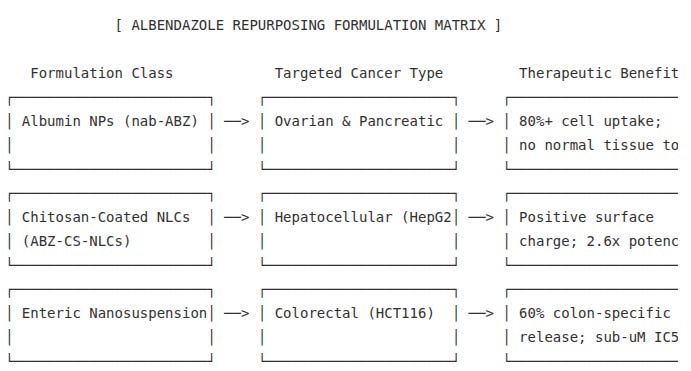
To bridge this gap, modern drug-repurposing research is heavily focused on pairing albendazole with nanomedicine-based drug delivery systems to improve systemic absorption and tumor-specific targeting:
Albumin Nanoparticles (nab-ABZ): Similar to the design of nab-paclitaxel, encapsulating albendazole in bovine serum albumin (BSA) or BSA-polycaprolactone nanoparticles dramatically increases solubility. In ovarian (OVCAR3, SKOV3) and pancreatic (AsPC-1) models, nab-ABZ achieved over 80% cellular uptake and penetrated dense 3D multicellular tumor spheroids without toxicity to healthy cells.
Chitosan-Coated Nanostructured Lipid Carriers (ABZ-CS-NLCs): Coating lipid carriers with chitosan flips the nanoparticle surface charge to positive (+24.61 mV). This positive charge facilitates a strong electrostatic attraction to the negatively charged membranes of cancer cells, lowering the (\text{IC}_{50}) to 8.89 (\mu\text{M}) in HepG2 liver cancer cells.
Enteric-Coated Nanosuspensions: By using Kollidon VA64 stabilizers and coating granules with microcrystalline cellulose encapsulated in EUDRACAP, researchers achieved colon-targeted drug release. This delivery system yielded strong localized release (60% colonic release) and outstanding cytotoxic potencies against colorectal lines, with (\text{IC}_{50}) values of 1.18 (\mu\text{M}) and 3.59 (\mu\text{M}) in HCT116 and HT-29 cells.
Mesoporous Silica Nanoparticles (ABZ-M MCM-41): Loading albendazole into mesoporous silica structures increased cellular internalization, boosting tumor-killing potency by 2.9-fold compared to free albendazole in liver cancer cell lines.
Polymeric Mixed Micelles: Formulations combining albendazole and paclitaxel inside folic acid/TPGS/Soluplus mixed micelles showed a sustained, controlled release over 90 hours and demonstrated superior synergistic toxicity in SKOV3 ovarian cancer cells.
3. Clinically Studied Cancer Entities
Through the aid of these advanced formulation strategies, repurposed albendazole is being actively translated and assessed across several major clinical oncological targets:
Colorectal Cancer: Bypassing traditional therapy resistance by localized colonic release.
Ovarian Cancer: Overcoming systemic administration barriers via nab-nanoparticles and intraperitoneal tumor target designs.
Hepatocellular Carcinoma: Utilizing liver-selective uptake vectors (such as glucan or chitosan-lipid carriers) to concentrate the active drug directly inside hepatic lesions.
Brain Tumors (Glioblastoma): Using lipid systems capable of crossing the blood-brain barrier to target aggressive, temozolomide-resistant cerebral tumors.
Drug Delivery and Repurposing Approaches for Albendazole Formulations
April 2026 7(1) DOI: 10.15212/bioi-2025-0045
This is interesting but are these formulations commercially available or feasible at home? The absorption remains an issue with several of these drugs and it’s a pity patients can’t find the optimal formulations on the repurposed drug market . Thanks for providing this research.