
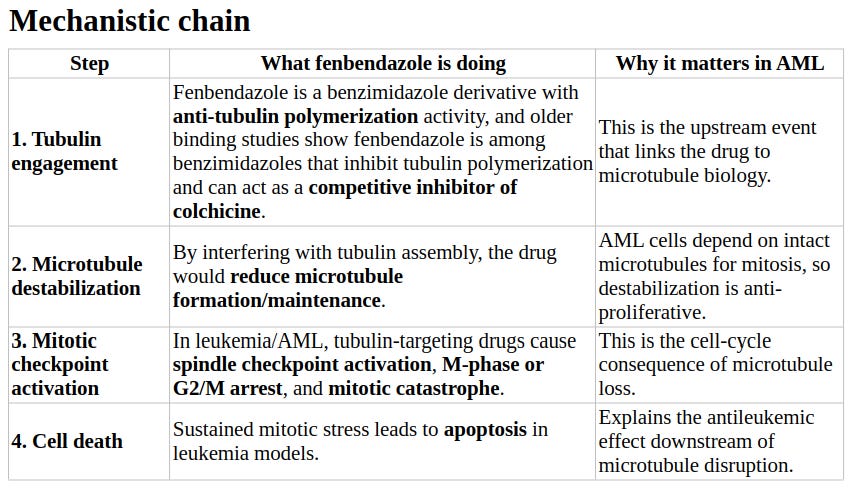
Fenbendazole is linked to microtubule disruption in AML cells through the same core benzimidazole-tubulin mechanism: it acts as a tubulin polymerization inhibitor, with evidence that fenbendazole binds tubulin and competitively inhibits the colchicine-binding interaction, destabilizing microtubules and blocking mitotic progression. In leukemia, benzimidazole carbamates are potent inhibitors of tubulin polymerization, and microtubule-targeting agents in AML are shown to work by binding β-tubulin, disrupting the microtubule network, activating the spindle assembly checkpoint, and driving M-phase/G2/M arrest and apoptosis.
Bottom line
The most supportable mechanism is that fenbendazole disrupts AML microtubules by binding tubulin and inhibiting polymerization, likely through colchicine-site interference, which then triggers spindle checkpoint activation, mitotic arrest, and apoptosis. This is an inference for AML specifically, because the retrieved evidence directly documents fenbendazole’s tubulin effects in general, while the AML microtubule-disruption phenotype is shown more directly for other tubulin inhibitors and benzimidazole-related compounds in leukemia/AML models.
Confidence level: Medium — the tubulin/microtubule mechanism is well supported for fenbendazole as a drug class effect, but the AML-specific link is inferred rather than shown by a direct fenbendazole-in-AML primary study in the provided evidence.
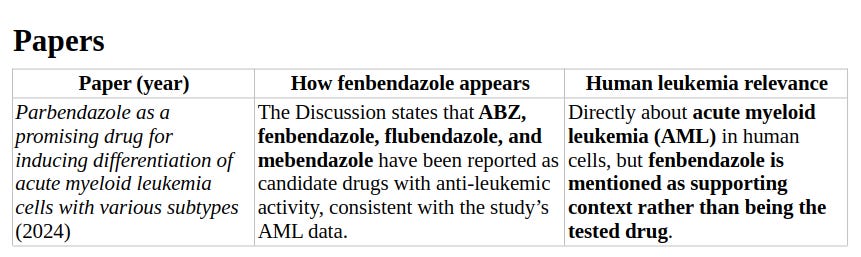
The only 2024+ paper available that discusses human leukemia and fenbendazole is a parbendazole AML study whose discussion mentions fenbendazole as a reported anti-leukemic candidate; no primary fenbendazole-in-human-leukemia papers were found online.
Bottom line
No published papers directly tested fenbendazole in human leukemia.
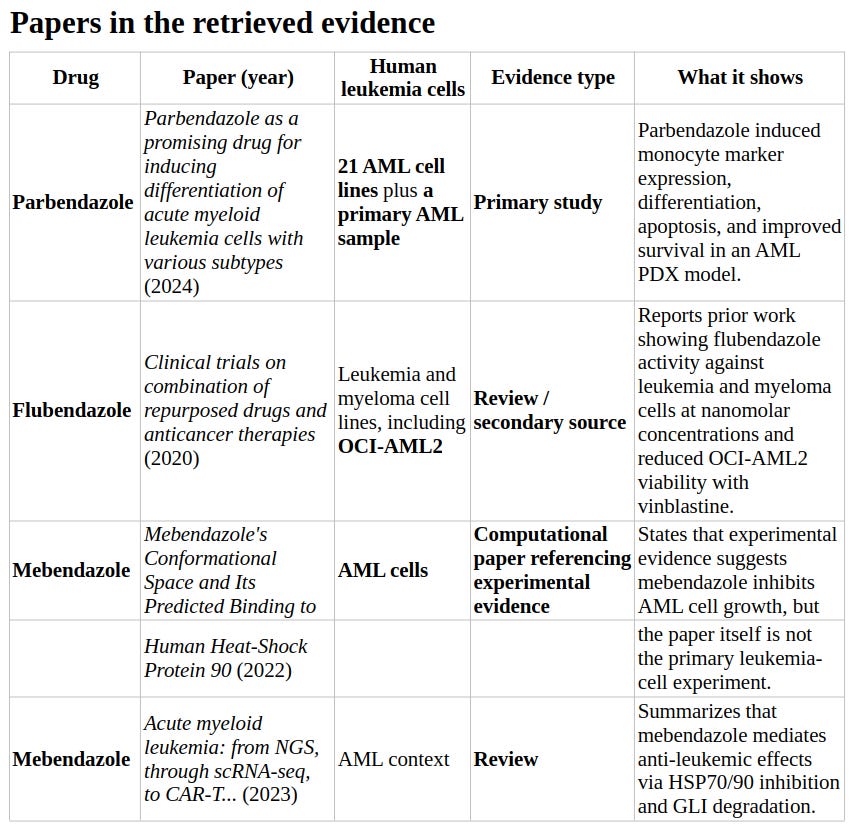
The retrieved evidence supports only one primary 2020+ human-leukemia cell paper on a benzimidazole carbamate in this set—parbendazole in AML cells—while flubendazole and mebendazole appear in leukemia-related papers mainly as reviewed or secondary evidence, not as directly reported primary leukemia-cell studies here.
What is not supported in this evidence set
No direct 2020+ primary human leukemia-cell papers were found for albendazole, fenbendazole, thiabendazole, oxfendazole, or triclabendazole.
The leukemia-related mentions for mebendazole and flubendazole are mostly in reviews or mechanistic summaries, except for the primary AML paper on parbendazole.
Bottom line: A strict list of primary 2020+ human leukemia cell studies in this evidence shows only parbendazole (2024); the other named benzimidazole carbamates appear in reviews or indirect sources rather than direct leukemia-cell papers.
Confidence level: High — the retrieved references clearly separate one primary AML study from several review/secondary mentions, and no other direct human-leukemia-cell papers on the named carbamates appeared.
Which benzimidazoles show promise against specific leukemia subtypes like AML?
We investigated the anticancer properties and mechanisms of various benzimidazole carbamates, focusing primarily on their effects against human leukemia and other cancer cell lines. Research highlights that drugs such as parbendazole and flubendazole frequently target tubulin and microtubules, triggering processes like G2/M cell-cycle arrest, mitotic catastrophe, and apoptosis. While albendazole, mebendazole, and fenbendazole inhibit tumor growth and induce reactive oxygen species across multiple malignancies, other compounds like thiabendazole lack direct human cancer studies in this literature. Overall, the data suggest that these repurposed anthelmintics have significant therapeutic potential, though findings vary on whether direct experimental trials or secondary reviews support them.
Benzimidazole drugs eliminate human leukemia cells through several distinct mechanisms:
1. Induction of Monocytic Differentiation (The KLF4/DPYSL2A Axis)
Stimulation of Differentiation Signaling: Benzimidazole anthelmintics—including parbendazole, albendazole, fenbendazole, flubendazole, mebendazole, and oxibendazole—reactivate the transcription factor KLF4 in acute myeloid leukemia (AML) cells.
Maturation into Monocytes: KLF4 directly transactivates its downstream target DPYSL2A (CRMP2), forcing immature leukemic blasts to overcome differentiation arrest and mature into monocyte-like cells, marked by elevated surface expression of CD11b and CD14.
Terminal Apoptosis: Following differentiation, the mature leukemic cells rapidly undergo apoptosis (marked by elevated Annexin V positivity within 12–24 hours).
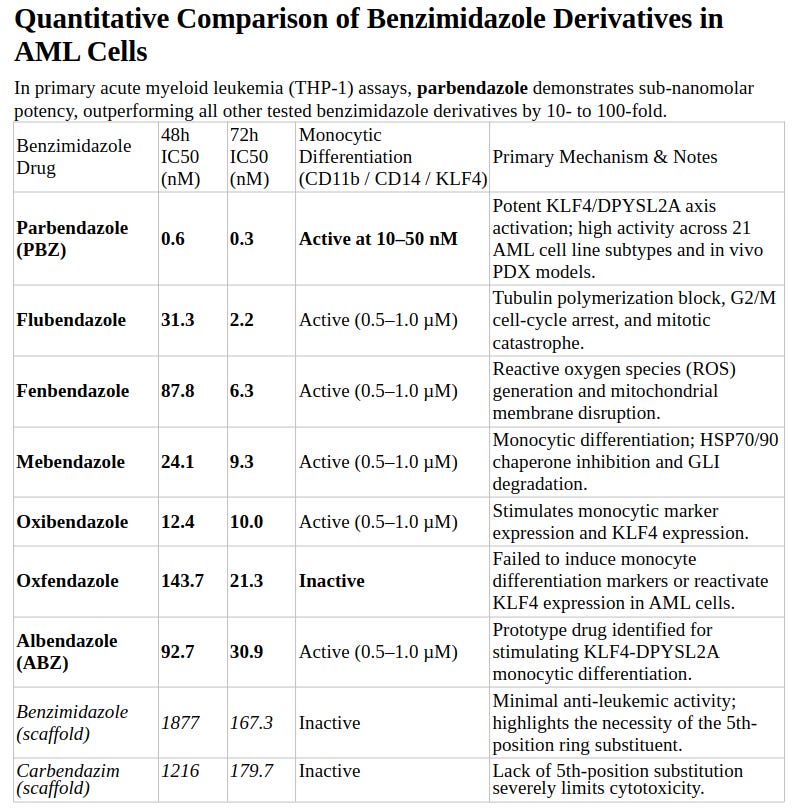
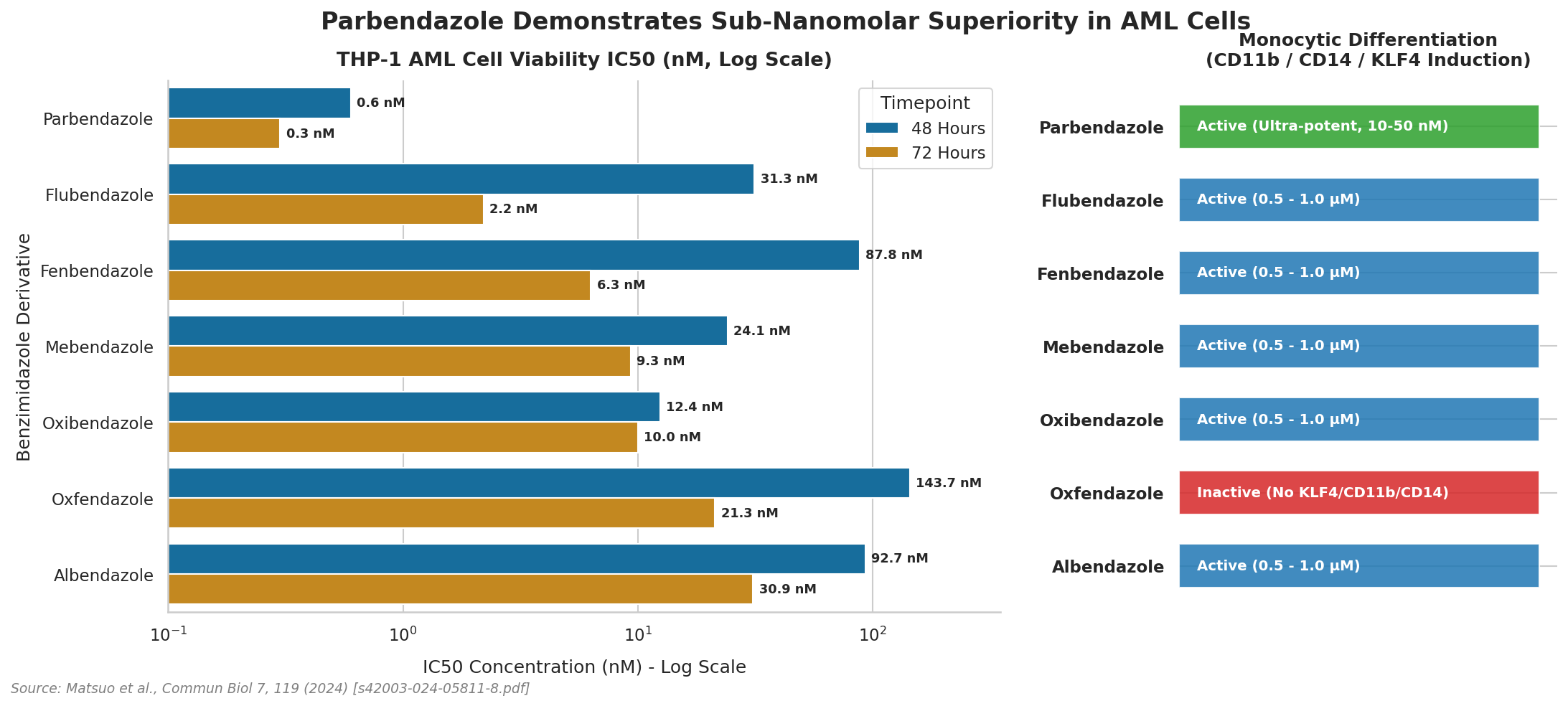
Potency of Parbendazole: Parbendazole exhibits superior differentiation activity at low nanomolar concentrations (IC50 of 0.3–0.6 nM) across 21 AML cell line subtypes and in patient-derived xenograft (PDX) models. Evidence indicates this differentiation mechanism operates independently of standard microtubule polymerization inhibition.
2. Microtubule Disruption & Cell-Cycle Arrest
Tubulin Polymerization Block: Derivatives such as flubendazole and fenbendazole bind directly to tubulin and inhibit tubulin polymerization, disrupting microtubule dynamics and mitotic spindle assembly.
G2/M Arrest and Mitotic Catastrophe: This loss of spindle function causes leukemia cells to arrest in the G2/M phase of the cell cycle, leading to mitotic catastrophe and cell death.
3. Mitochondrial Dysfunction & ROS Generation
Oxidative Stress: Compounds like fenbendazole induce reactive oxygen species (ROS) generation in leukemic cells (such as HL-60).
Mitochondrial Collapse: ROS accumulation reduces metabolic activity and disrupts the mitochondrial membrane potential, driving cells toward apoptosis and necrosis.
4. Chaperone Protein & Signaling Inhibition
HSP70/90 and GLI Degradation: Certain benzimidazoles, such as mebendazole, have also been reported to mediate anti-leukemic activity by inhibiting heat-shock proteins (HSP70/HSP90) and downstream GLI degradation.
Several benzimidazole drugs show promise against specific leukemia subtypes, with Acute Myeloid Leukemia (AML) being the primary focus of this direct research.
1. Parbendazole (PBZ) — The Leading Candidate in AML
Broad Subtype Efficacy: Parbendazole is the most extensively validated compound, evaluated in a 2024 primary study across 21 distinct AML cell line subtypes representing various French–American–British (FAB) classifications and genetic abnormalities. Tested models include Kasumi1, Kasumi3, Kasumi6, THP-1, KG-1, HL-60, OCI-AML2/3, MOLM13, MV4-11, and ATRA-resistant acute promyelocytic leukemia (APL) lines NB4 and UF-1.
Patient-Derived Xenograft (PDX) Models: Parbendazole demonstrated potent anti-leukemic activity against primary patient-derived AML cells harboring a KMT2A rearrangement (lineage-switched FAB M5 subtype) both in vitro and in vivo, significantly reducing bone marrow chimerism and extending survival in mouse models.
Unmatched Nanomolar Potency: It exhibits the highest potency among evaluated benzimidazoles in AML cells, with a THP-1 IC50 of 0.6 nM at 48 h and 0.3 nM at 72 h.
2. Albendazole (ABZ)
Monocytic Differentiation Pathway: Drug screens originally identified albendazole as a candidate for AML differentiation therapy by activating the KLF4-DPYSL2A axis.
Efficacy Across Subtypes: While it inhibits cell proliferation across multiple AML subtypes, it is less potent than parbendazole and requires higher concentrations (THP-1 IC50 of 92.7 nM at 48 h and 30.9 nM at 72 h).
3. Flubendazole
OCI-AML2 & Resistance Bypassing: Literature reviews highlight flubendazole’s cytotoxicity against leukemia cell lines, specifically noting activity in the OCI-AML2 AML subtype model.
Potency & Spindle Targeting: It demonstrates strong viability inhibition in THP-1 cells (IC50 of 31.3 nM at 48 h and 2.2 nM at 72 h) via tubulin polymerization block and G2/M arrest, retaining efficacy even in vinblastine-resistant leukemia models.
4. Fenbendazole
HL-60 Promyelocytic/Myeloid Model: Primary experimental evidence shows fenbendazole actively induces apoptosis and necrosis in HL-60 human leukemia cells through reactive oxygen species (ROS) accumulation and mitochondrial membrane collapse.
AML Potency: In THP-1 AML cells, fenbendazole exhibits an IC50 of 87.8 nM at 48 h and 6.3 nM at 72 h.
5. Mebendazole & Oxibendazole
Mebendazole: Highlighted in AML literature as inducing anti-leukemic effects via differentiation, HSP70/90 inhibition, and GLI degradation (THP-1 IC50 of 24.1 nM at 48 h and 9.3 nM at 72 h).
Oxibendazole: Successfully triggered monocytic differentiation markers (CD11b/CD14) and KLF4 expression in AML cells (THP-1 IC50 of 12.4 nM at 48 h and 10.0 nM at 72 h).
Notable Exception: Oxfendazole
Inactivity in Differentiation: Unlike the other six benzimidazoles evaluated, oxfendazole failed to elevate monocyte markers or reactivate KLF4 expression in AML cells.
Key Takeaways
Structural Requirement: Core scaffold compounds lacking a substituent at the 5th position of the benzimidazole ring (benzimidazole and carbendazim) require high micromolar concentrations and fail to induce differentiation, establishing the 5th-position modification as essential for efficacy.
Dose Disconnect: While oxfendazole shows moderate cytotoxicity at 72 hours (IC50 of 21.3 nM), it is the only derivative tested that completely lacks monocytic differentiation activity.
Clinical Potential: Parbendazole triggers rapid monocytic maturation within 6 hours and subsequent apoptosis within 12–24 hours at concentrations that spare normal c-kit+ bone marrow progenitors and CD34+ cord blood cells.
Here is a visual summary chart showing these viability thresholds and differentiation profiles side by side.
Parbendazole exhibits minimal toxicity toward normal bone marrow cells and healthy blood precursor cells at therapeutic nanomolar concentrations.
Key findings regarding healthy cells include:
Mouse Hematopoietic Progenitors (c-kit+): Parbendazole did not impair the colony-forming capacity of c-kit+ immature bone marrow cells isolated from wild-type mice at concentrations up to 100 nM.
Human CD34+ Cord Blood Cells: In human CD34+ stem/progenitor cells from healthy donors, incubation with 100 nM parbendazole for 48 hours resulted in only a minimal increase in apoptosis.
Mechanistic Basis for Selectivity: Researchers attribute this tumor selectivity to DPYSL2A—the downstream target activated by KLF4 to force differentiation—being naturally expressed at higher baseline levels in normal hematopoietic stem cells than in AML blasts.
In Vivo Hematological Safety: In animal safety studies, daily oral doses up to 100 mg/kg over 28 days caused no significant alterations in peripheral blood cell counts or overall body weight.
In the patient-derived xenograft (PDX) mouse model of acute myeloid leukemia (using primary \(KMT2A\)-rearranged AML cells in NOG mice), parbendazole (PBZ) showed clearly superior anti-leukemic efficacy compared with albendazole (ABZ).
1. In Vivo Reduction of Leukemic Chimerism
Parbendazole: Daily oral administration of 100 mg/kg PBZ for four weeks significantly reduced the percentage of human leukemic cells (chimerism) in mouse bone marrow.
Albendazole: At the same dose (100 mg/kg p.o. daily), ABZ showed no statistically significant reduction in leukemic chimerism compared with the vehicle control.
2. Extension of Overall Survival
Parbendazole: PBZ-treated mice achieved a statistically significant extension in survival time compared to control and ABZ-treated mice.
Albendazole: ABZ treatment did not prolong overall survival compared with the vehicle group.
3. In Vivo Monocytic Differentiation
Parbendazole: Primary leukemic cells isolated from the bone marrow of PBZ-treated mice exhibited partial monocyte differentiation, marked by elevated CD11b and CD14 surface expression, alongside morphological changes like a decreased nuclear-to-cytoplasmic ratio and indented nuclei.
Albendazole: ABZ-treated mice showed no significant elevation in monocytic differentiation markers or morphological maturation in bone marrow cells.
4. Direct In Vitro PDX Sensitivity (100 nM)
Prior to in vivo testing, primary AML-PDX cells were treated directly in vitro with 100 nM of each drug.
PBZ (100 nM) significantly stimulated KLF4/DPYSL2A mRNA expression, triggered monocytic surface markers (CD11b/CD14), and induced apoptosis.
ABZ (100 nM) showed no statistically significant effect on \(KLF4/DPYSL2A\) transcription, monocyte marker elevation, or apoptosis in these PDX cells.
Context & Limitations noted by authors: Although parbendazole was clearly superior to albendazole, the study authors noted that PBZ achieved a partial reduction in chimerism and modest survival extension in vivo, likely due to the extreme aggressiveness and heterogeneity of the \(KMT2A\)-rearranged primary leukemic graft.
References
Benzimidazoles: general mechanism and repurposing
Friedman PA, Platzer EG. Interaction of anthelmintic benzimidazoles and benzimidazole derivatives with bovine brain tubulin. Biochim Biophys Acta Gen Subj. 1978. https://doi.org/10.1016/0304-4165(78)90334-3
Son DS, Lee ES, Adunyah SE. The antitumor potentials of benzimidazole anthelmintics as repurposing drugs. Immune Netw. 2020. https://doi.org/10.4110/in.2020.20.e29
Khattab M, Al-Karmalawy AA. Revisiting activity of some nocodazole analogues as potential anticancer drugs using molecular docking and DFT calculations. Front Chem. 2021. https://doi.org/10.3389/fchem.2021.628398
Garg A, Karhana S, Bano A, et al. Network pharmacology and molecular docking study-based approach to explore mechanism of benzimidazole-based anthelmintics for the treatment of lung cancer. J Biomol Struct Dyn. 2024. https://doi.org/10.1080/07391102.2023.2258419
Fenbendazole
Park H, Lim W, You S, Song G. Fenbendazole induces apoptosis of porcine uterine luminal epithelial and trophoblast cells during early pregnancy. Sci Total Environ. 2019. https://doi.org/10.1016/j.scitotenv.2019.05.116
Han Y, Joo HG. Involvement of reactive oxygen species in the anti-cancer activity of fenbendazole, a benzimidazole anthelmintic. Korean J Vet Res. 2020. https://doi.org/10.14405/kjvr.2020.60.2.79
Lian S, Gao X, Song C, et al. The characteristics of Raman spectroscopy of fenbendazole-gold nanoparticles based on the chemical adsorption effect. Spectrochim Acta A Mol Biomol Spectrosc. 2021. https://doi.org/10.1016/j.saa.2021.119799
Jung H, Lee YJ, Joo HG. Differential cytotoxic effects of fenbendazole on mouse lymphoma EL-4 cells and spleen cells. Korean J Vet Res. 2023. https://doi.org/10.14405/kjvr.20220040
Nguyen J, Nguyen TQ, Han B, Hoang BX. Oral fenbendazole for cancer therapy in humans and animals. Anticancer Res. 2024. https://doi.org/10.21873/anticanres.17197
Flubendazole
Spagnuolo PA, Hu J, Hurren R, et al. The antihelmintic flubendazole inhibits microtubule function through a mechanism distinct from Vinca alkaloids and displays preclinical activity in leukemia and myeloma. Blood. 2010. https://doi.org/10.1182/blood-2009-09-243055
Čáňová K, Rozkydalová L, Rudolf E. Anthelmintic flubendazole and its potential use in anticancer therapy. Acta Medica (Hradec Kralove). 2017. https://doi.org/10.14712/18059694.2017.44
Albendazole and mebendazole
Chai JY, Jung BK, Hong SJ. Albendazole and mebendazole as anti-parasitic and anti-cancer agents: an update. Korean J Parasitol. 2021. https://doi.org/10.3347/kjp.2021.59.3.189
Fiedler W, Freisleben F, Wellbrock J, Kirschner KN. Mebendazole’s conformational space and its predicted binding to human heat-shock protein 90. J Chem Inf Model. 2022. https://doi.org/10.1021/acs.jcim.2c00290
Parbendazole
Parbendazole as a promising drug for inducing differentiation of acute myeloid leukemia cells with various subtypes. Commun Biol. 2024;7. https://www.nature.com/articles/s42003-024-05811-8
Background: drug repurposing and acute myeloid leukemia
Ölgen S. Clinical trials on combination of repurposed drugs and anticancer therapies. In: Drug Repurposing in Cancer Therapy. Academic Press; 2020. https://doi.org/10.1016/B978-0-12-819668-7.00015-4
Acute myeloid leukemia: from NGS, through scRNA-seq, to CAR-T. Dissect cancer heterogeneity and tailor the treatment. J Exp Clin Cancer Res. 2023;42. https://pmc.ncbi.nlm.nih.gov/articles/PMC10557350/
Tan P, Wei X, Wang L, et al. Discovery of furan-trimethoxyphenyl hybrids as novel colchicine-binding site inhibitors that induce mitotic catastrophe with potent anti-acute myeloid leukemia effect. Bioorg Chem. 2026. https://doi.org/10.1016/j.bioorg.2026.110109