
1. The Hidden Potential in Your Medicine Cabinet
The landscape of modern oncology is defined by an increasingly unsustainable “Innovation Gap.” As demand for curative therapies grows, the traditional pharmaceutical pipeline remains a high-stakes gamble marked by astronomical costs and a staggering failure rate. For every breakthrough that reaches a patient, thousands of molecules vanish during clinical development, often due to unforeseen toxicity or lack of efficacy.
As a researcher and analyst, I see a strategic shortcut gaining momentum to bridge this gap: drug repurposing. Instead of engineering molecules from the ground up, researchers are auditing the existing pharmaceutical arsenal to uncover “off-target” effects that can dismantle cancer. Among the most compelling candidates are anthelmintics—medications traditionally used to treat parasitic infections. Could the same agents used for decades to treat deworming be the key to treating aggressive malignancies like pancreatic cancer and rare, treatment-resistant paragangliomas? I say yes. Recent research into benzimidazole-based compounds suggests that the answer is not only yes, but that these drugs may outperform conventional chemotherapy in ways we are only beginning to understand.
2. The 10-Year Shortcut: Why “Old” Drugs are High-Value Candidates
In drug development, time is as much a barrier as biology. Benzimidazole-based drugs, such as Mebendazole and Albendazole, are high-value candidates because they let researchers bypass the most treacherous hurdles of early-stage discovery. These compounds arrive with pre-verified safety profiles and decades of human pharmacokinetic data.
From an analyst’s perspective, the value proposition is clear: repurposing offers a regulatory fast track and significantly reduces R&D risk. However, the true innovation highlighted in recent studies isn’t just raiding the medicine cabinet—it involves technical refinement. Researchers have utilized patented salt formulations specifically designed to overcome the “poor aqueous solubility” that has historically limited the bioavailability of benzimidazoles. This chemical optimization transforms an old dewormer into a viable, high-potency systemic therapy.
As the source study highlights in its introduction:
“The discovery and development of new anticancer drugs... are tasks of a long, expensive and often challenging process that may fail throughout the clinical trial phases needed before drug approval.”
By leveraging already-approved products with these new salt formulations, we can shave years off the development timeline, offering a strategic path toward affordable, low-toxicity oncology.
3. Hope for the Untreatable: The Paraganglioma Breakthrough
One of the most striking findings in recent screenings is the efficacy of these compounds against paraganglioma—a rare, treatment-resistant tumor that often leaves clinicians with no viable options.
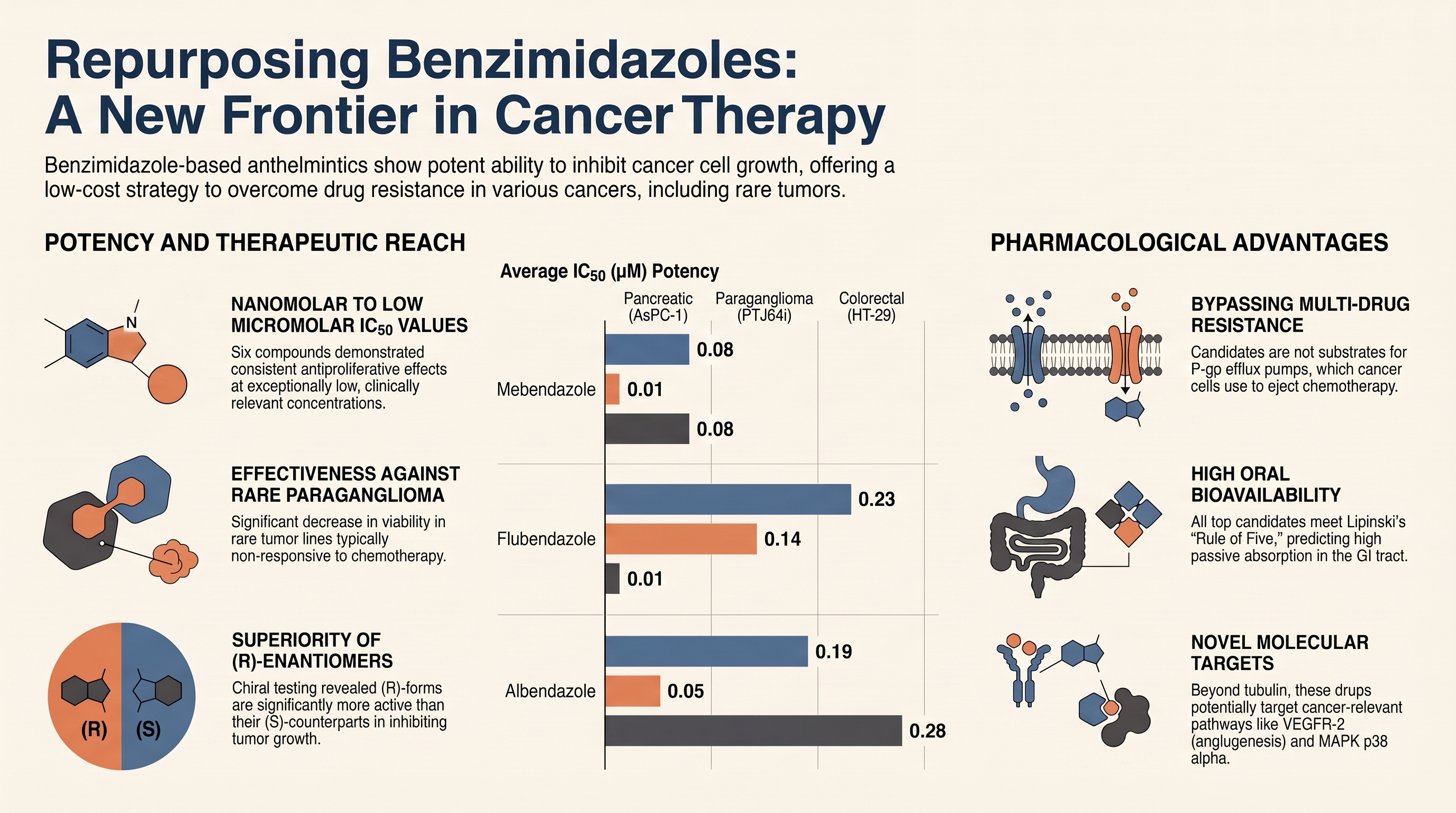
Benzimidazoles Tested on Paraganglioma for the First Time In a landmark breakthrough, researchers tested several benzimidazoles against PTJ64i and PTJ86i cell lines. Critically, these were patient-derived cell lines established directly from individuals with the disease, offering a high-fidelity model of how the drugs might perform in a clinical setting. The results were extraordinary: flubendazole and fenbendazole induced cell inhibition rates of up to 97%.
This discovery carries massive implications for “orphan designation.” For pharmaceutical innovators, obtaining orphan status for rare diseases like paraganglioma provides a strategic business advantage through market exclusivity. For patients, it represents a lifeline for “untreatable” conditions often overlooked by traditional R&D budgets.
4. Outsmarting Resistance: Avoiding the “Efflux Pump” Trap
A primary cause of chemotherapy failure is multi-drug resistance (MDR). Cancer cells are notorious for developing a defense mechanism known as P-gp (permeability glycoprotein)—a microscopic “efflux pump” that identifies and flushes out chemotherapy molecules before they can reach their targets.
Analysis of the pharmacokinetic parameters of benzimidazoles reveals a significant strategic advantage: flubendazole, parbendazole, oxibendazole, mebendazole, albendazole, and fenbendazole are not substrates for P-gp.
This “stealth” ability means these drugs are essentially invisible to the cell’s security system. While conventional treatments are being pumped out of the cell, these benzimidazoles remain inside, maintaining the concentrations necessary to trigger cell death. This makes them potentially superior to current chemotherapies in the context of resistant, aggressive tumors that have already learned to “reject” standard care.
5. The Power of the “Right Hand”: Why Chirality Changes Everything
In molecular science, “chirality” refers to molecules that are mirror images of one another—much like a right and left hand. While chemically identical, these “enantiomers” are processed differently by the human body. Precision at this level is the hallmark of modern clinical translation.
Researchers used high-performance liquid chromatography (HPLC) to isolate the (R) and (S) versions of certain benzimidazoles. They discovered that the (R)-enantiomers were drastically more potent. Furthermore, the (R)-form of ricobendazole has been observed to accumulate in the cerebrospinal fluid, suggesting a unique potential for treating brain metastases where other drugs fail to cross the blood-brain barrier.
The potency gap is most evident in pancreatic cancer cell lines (AsPC-1 and BxPC-3). The IC50 data (where a lower number indicates higher potency) tells the story:
(R)-oxfendazole: 1.18 µM (AsPC-1) / 1.82 µM (BxPC-3)
(S)-oxfendazole: >20 µM (Virtually inactive in both lines)
By selecting the “right-handed” version of the molecule, scientists can unlock a therapeutic power that the standard mixture simply cannot match.
6. More Than Just a One-Trick Pony: Unlocking “Polypharmacology”
Historically, benzimidazoles were thought to work solely by inhibiting tubulin (the cell’s structural skeleton). However, recent target prediction data reveals these drugs are “polypharmacological,” meaning they engage multiple biological targets simultaneously.
This multi-pronged attack is a massive advantage in oncology. Because these drugs hit several targets at once, it is significantly harder for a tumor to “mutate around” the treatment—a common cause of cancer recurrence. Key molecular targets identified include:
MAPK14 (p38 alpha): A protein linked to shorter survival and advanced cancer stages.
ABL1: A major regulator of cell growth and survival, often targeted in leukemias.
VEGFR-2: A receptor that controls angiogenesis, the process by which a tumor builds its own blood supply.
By disrupting growth signals and simultaneously cutting off the tumor’s nutrient supply, these drugs offer a comprehensive assault on cancer’s infrastructure.
7. Conclusion: A Thought-Provoking Path Forward
The potential to repurpose benzimidazole anthelmintics into affordable, oral, low-toxicity cancer treatments represents more than a scientific curiosity—it is a move toward democratizing cancer care. By combining the low cost of “old” drugs with the high innovation of patented salt formulations and enantiomer precision, we can bypass the “Innovation Gap” and bring effective therapies to patients globally.
As we look for the next breakthrough in oncology, could the answer be hiding in the medicine we’ve already been using for decades?
Source:
Screening of Benzimidazole-Based Anthelmintics and Their Enantiomers as Repurposed Drug Candidates in Cancer Therapy
Pharmaceuticals 2021, 14, 372. https://doi.org/10.3390/ph14040372 Published: 17 April 2021, https://www.mdpi.com/1424-8247/14/4/372